In 1980, 19 states did not allow residents to carry concealed firearms. Now, all 50 states do, and 29 of them allow gun owners to do so without a permit.
To make that happen, gun rights groups had to reshape more than state laws. They had to change the public perception that carrying a gun in public was something suspicious, a sign of bad intentions. It worked so well that millions of Americans now go through daily life armed.
But then President Trump — normally an ally of the gun rights movement — started saying the opposite, spurred by the death of an armed man who opposed his policies.
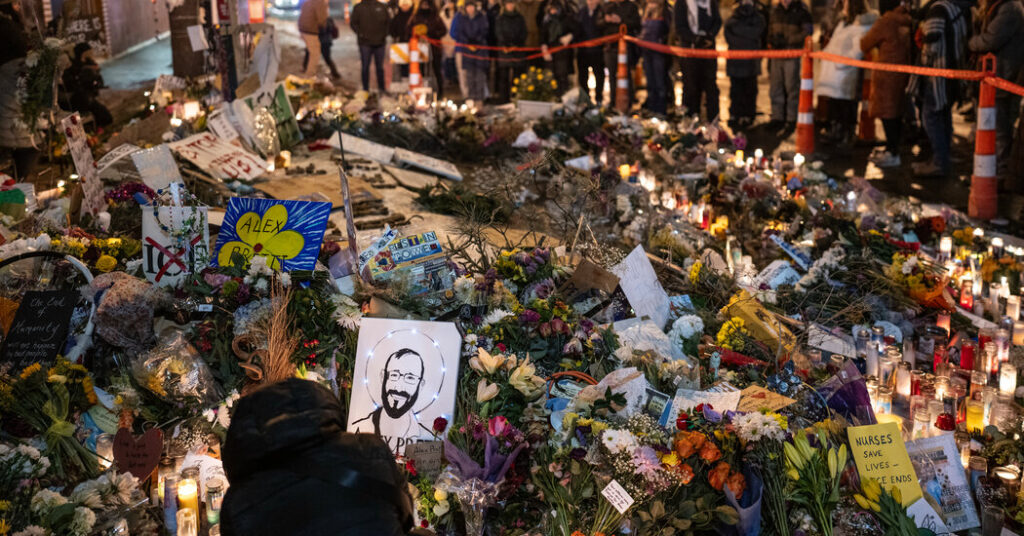
Since Alex Pretti was shot and killed by a Border Patrol agent and a Customs and Border Protection officer on Jan. 24, Mr. Trump and many top aides have blamed Mr. Pretti for carrying a firearm and ammunition during demonstrations against the immigration crackdown in Minneapolis. Why would Mr. Pretti do that, they have asked, if he was not looking for trouble?
“I don’t like that he had a gun, I don’t like that he had two fully loaded magazines, that’s a lot of bad stuff,” Mr. Trump said last week at an appearance in Iowa. In another appearance that day, he said, “You can’t have guns, you can’t walk in with guns.”
Those statements seemed to contradict Mr. Trump’s past rhetoric, where he said he was in favor of allowing more people to carry concealed weapons. Mr. Trump himself was grazed by a bullet fired by a would-be assassin during the 2024 campaign.
His words have — at least briefly — brought about a strange realignment in the debate over gun laws. Groups wanting tighter gun laws have said Mr. Trump is right to warn about the dangers of carrying firearms in public. Gun rights groups have said he is flat wrong.
What both sides want to know is: Will Mr. Trump actually change his policies to make it more difficult to carry guns the way Mr. Pretti did?
Many gun rights groups believe he will not. They are treating the president’s statement as a passing controversy, rather than a breach of their alliance or a real threat to the armed society they have built.
”I’m hoping it’s just the president speaking out of turn, as opposed to a thoughtful change in policy,” said Bryan Strawser, chairman of the Minnesota Gun Owners Caucus.
Mr. Strawser pointed out that Mr. Trump’s administration has continued to push to expand which guns can be sold and where they can be carried, including a court filing on Wednesday seeking to strike down restrictions on the sale of some handguns in Massachusetts.
“President Trump has a tendency to just stay what’s on his mind,” Mr. Strawser said.
However, firearms policy often revolves around fear, so even a sound bite like Mr. Trump’s has potentially far-ranging implications among Second Amendment supporters.
Mr. Pretti had a valid permit to carry his gun, either openly or concealed. Videos of the confrontation show he did not take it out during the fatal confrontation with federal agents. Rather, his gun was holstered at his waist, and appeared to be covered by Mr. Pretti’s winter coat until after agents had wrestled him to the ground. Brian O’Hara, the Minneapolis police chief, said that he had seen no evidence that Mr. Pretti violated the state’s gun laws.
Groups that want to tighten gun restrictions say Mr. Trump is wrong to attack Mr. Pretti, since he followed the law.
But they say Mr. Trump is right about something important: that carrying a weapon is risky, in a way the gun rights lobby has sought to downplay. These groups say that carrying a gun increases the chance that any interaction will turn deadly.
“Trump here has exposed a truth that the gun lobby doesn’t want to admit, which is: more guns in more hands in more places doesn’t make anyone safer,” said Nick Suplina, a senior vice president at Everytown for Gun Safety, a group backed by former New York City Mayor Michael R. Bloomberg. “It does make deadly encounters more likely.”
Kris Brown, president of the Brady Campaign to Prevent Gun Violence, said that Mr. Pretti’s death particularly showed the risk of a concealed weapon in an interaction with law enforcement. Her group was named in honor of James Brady, the press secretary to President Reagan, who was wounded in an assassination attempt against Mr. Reagan in 1981.
Video of Mr. Pretti’s fatal shooting shows officers yelling “gun” as they hold him to the ground. An agent is seen pulling Mr. Pretti’s gun out of his waistband and carrying it from the scrum. But it was unclear if the other officers knew that. One of them shot Mr. Pretti moments later.
“These are high-stakes encounters, where it is a momentary judgment about riskiness of an individual that has to be made,” Ms. Brown said.
Ms. Brown said Mr. Trump was right that people with concealed guns were often perceived as high risk to begin with. Police officers are also quick to point out that the presence of one weapon sometimes means there are multiple on a person.
“He’s stating the obvious,” Ms. Brown said. “It’s the one piece of fact I’ve seen him utter in the last eight years.”
Mr. Pretti’s killing has set off a debate within the gun rights community itself about whether Mr. Trump has a point.
Chase Welch, who works for a public relations firm that represents firearms manufacturers and is a self-described Second Amendment absolutist, said the shooting has revealed a fractured subculture wrestling with what exactly they stand for.
“The amount of vitriol in the community has been disheartening,” Mr. Welch said. “This is so far past the point of productivity I don’t know what to do with it anymore.”
In public, many of the most prominent gun rights groups have condemned Mr. Trump’s remarks.
“I don’t know what to say except, ‘Mr. President, you’re wrong,’” Dudley Brown, the president of the National Association for Gun Rights, said in an interview on the right-wing news channel OANN.
Mr. Brown called the arguments made by Mr. Trump and others “patently ludicrous.”
“They kept saying that you shouldn’t take a gun to a protest. All I can say is, that’s the place you actually want it, and might need it,” Mr. Brown said. “Not only do I disagree, I resent the fact that they would even claim that.”
But, for now, Mr. Trump’s words are just that.
They stand in contrast to actions the president took after the Las Vegas shooting that left at least 60 people dead in 2017 and the Parkland, Fla., school shooting just months later. Mr. Trump’s first administration banned bump stocks, an accessory that allows a semiautomatic weapon to shoot like a machine gun. The ban was eventually struck down on procedural grounds by the Supreme Court.
Since Mr. Trump made his comments about Mr. Pretti, the National Rifle Association has condemned the president’s ideas without criticizing him by name.
“The N.R.A. unequivocally believes that all law-abiding citizens have a right to keep and bear arms anywhere they have a legal right to be,” the group wrote on X.
After a Trump-nominated prosector posted that approaching law enforcement officials with a gun meant “there is a high likelihood they will be legally justified in shooting you,” the N.R.A. called that statement “dangerous and wrong.
The N.R.A., once the dominant force in the gun rights movement, is now diminished and divided after a series of financial scandals and damaging lawsuits that accused its executives of spending the nonprofit’s funds on lavish benefits for themselves. In its place have risen a number of new, smaller, often more strident gun-rights groups.
In interviews, some of those groups have offered similar criticisms of Mr. Trump’s words. But they said their unhappiness was tempered because — whatever he said — Mr. Trump’s administration still seemed supportive of loosening gun laws.
“His statement was perhaps made without all the information,” said Adam Kraut, the executive director of the Second Amendment Foundation. He said that Mr. Trump’s administration had already demonstrated its support for expanding gun rights, including by filing lawsuits seeking to make Los Angeles County and the U.S. Virgin Islands move more swiftly to issue permits for concealed firearms.
“They’re certainly much better than anything I’ve ever seen,” he said.
One of his colleagues at the Second Amendment Foundation, Kostas Moros, on Friday posted on X a list of 17 “positives” from the Trump administration, including the establishment late last year of a new section at the Justice Department focused only on gun rights. Below that, he listed just six negatives, the last of which was “Trump’s dumb comments following Pretti shooting.”
“While not any policy shift, rhetoric still matters,” he wrote.
Several gun rights groups said they were hoping that, despite Mr. Trump’s comments, the administration would support a bill that would give gun owners more freedom to carry concealed firearms without a permit nationwide. During the 2024 election, Mr. Trump said he supported that idea.
The White House declined to say if he still did.
In response to questions from The New York Times, the White House sent a snippet of a news conference given by Karoline Leavitt, the press secretary, in which she said Mr. Trump remained a strong supporter of gun rights.
But Ms. Leavitt ended by echoing Mr. Trump’s words about the risk of concealed carry.
“Any gun owner knows that when you are carrying a weapon, when you are bearing arms, and you are confronted by law enforcement, you are raising the assumption of risk,” Ms. Leavitt said.
Haley Willis contributed reporting.
David A. Fahrenthold is a Times investigative reporter writing about nonprofit organizations. He has been a reporter for two decades.
The post Despite ‘Wrong’ Comments, Gun Rights Groups Say Trump Has Their Back appeared first on New York Times.