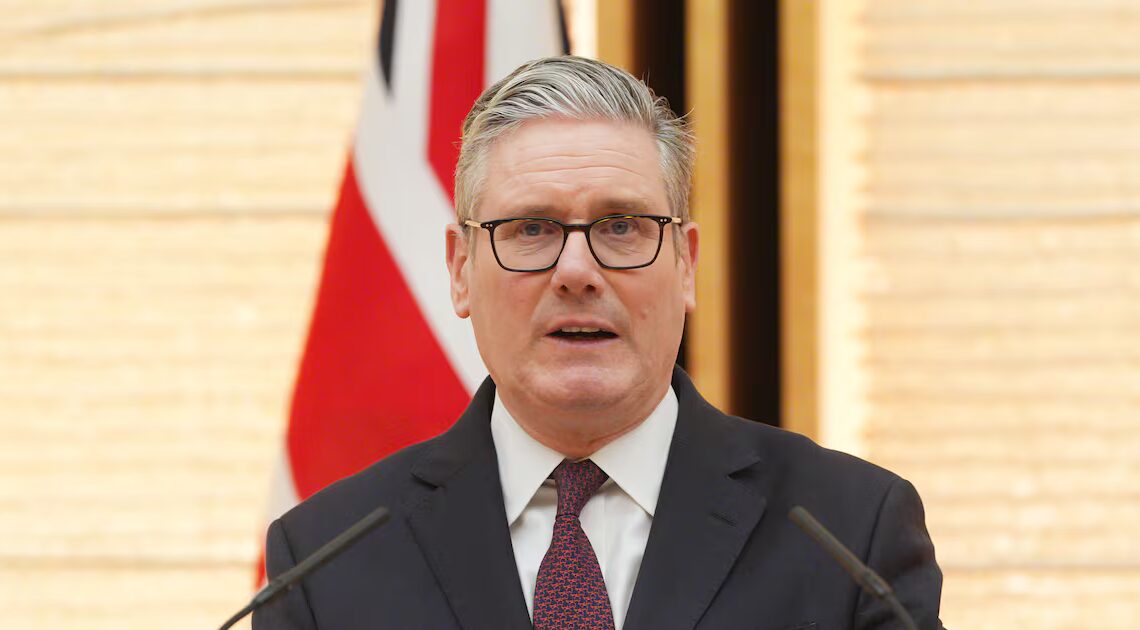
British Prime Minister Keir Starmer used a stopover in Japan on Saturday to state, in clear terms, that Andrew Mountbatten-Windsor should cooperate with the American investigation into the late sex trafficker Jeffrey Epstein.
For a British leader to speak so directly about a member of the reigning monarch’s family is an extraordinary departure from normal practice—and a serious new problem for Andrew.
Asked by reporters if Andrew should apologize and give evidence to the congressional Epstein investigation, Starmer responded, “Firstly, I always approach this question with the victims of Epstein in mind. Epstein’s victims have to be the first priority.”
He continued: “Whether there should be an apology, that’s a matter for Andrew. But yes, in terms of testifying, I’ve always said anybody who’s got information should be prepared to share that information in whatever form they’re asked to do that, because you can’t be victim-centered if you’re not prepared to do that.”
In parliamentary life, there has long been a hard rule that politicians do not criticize the royal family as individuals. Erskine May, the core reference text on parliamentary procedure, states that “reflections must not be cast in debate upon the conduct of the sovereign, the heir to the throne or other members of the royal family.”
For decades, ministers pressed on Andrew’s conduct fell back on the same formula, saying that it was “a matter for the royal family” or “a matter for the palace.”
Starmer has now torn up that rule book—aided by the fact that Andrew has been stripped of his royal title.
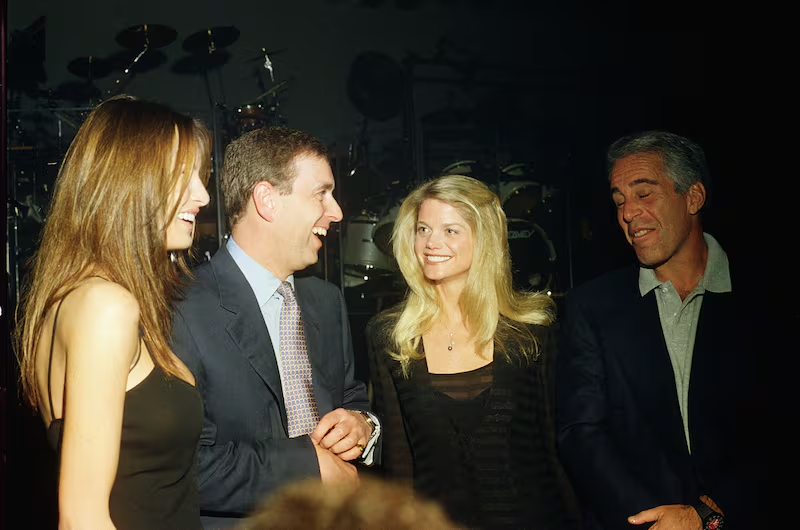
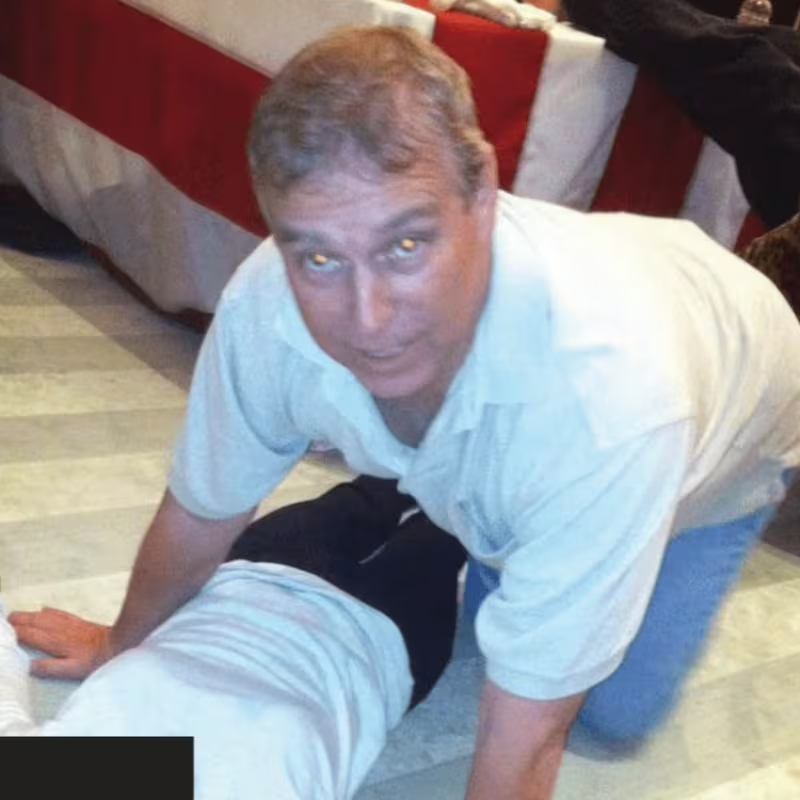
His intervention was, of course, triggered by the latest “Epstein files” material, including photographs of Andrew on all fours over an unidentified woman who appears, unsurprisingly, to be young. It’s not the worst photo in the world, but it fits the entitlement narrative and has truly cut through, along with documents that seem to place Andrew even more firmly inside Epstein’s sex trafficking network.
Biographer calls for investigation
As this batch of files became public, The Royalist spoke at length with the historian and biographer Andrew Lownie about how Andrew has, so far, avoided any criminal investigation.
Lownie spent years examining Andrew’s links to Epstein and Ghislaine Maxwell for his book, Entitled, and has reviewed large volumes of material that have not yet seen the light of day.
“He’s pleading his innocence. But all I would say is this: he’s been caught time and time again lying. He hasn’t told the truth,” Lownie said.
“It would be very easy to prove his innocence by providing logs and evidence from (his bodyguards), which he has refused to do.
“He has refused to cooperate with lawyers and with law enforcement. This isn’t the behavior of an innocent man.”
Lownie argues that the main blockage is the absence of a proper criminal inquiry in Britain. “What would push this toward a conclusion is if the Met [the Greater London police force] were actually to investigate him properly, as they should be doing. The National Crime Agency and HMRC [the UK tax authorities], among others, should be looking at him.
“If charges are justified, they should be brought, and then let’s see him actually prove his case. At the moment, there has been a complete fudge that has allowed him to wriggle free. There is so much strong evidence against him that it’s time for legal action. He can no longer be protected, and some people need to actually take responsibility and act.”
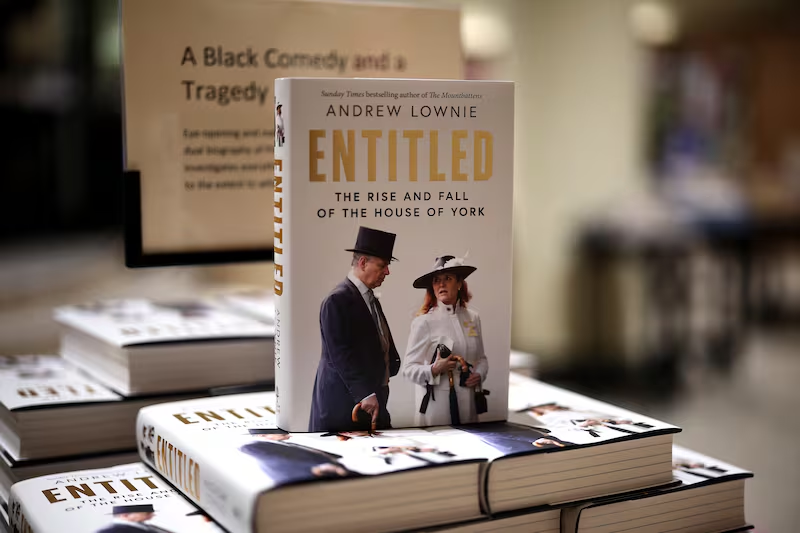
When asked why he thinks that still has not happened, Lownie replied, “The royal family don’t want this to happen, or the police are just making this decision themselves because they don’t really want to go there.”
“And this is why there needs to be parliamentary pressure. We need to keep making the case publicly to the media and politicians.
“I would like a parliamentary investigation into his time as a trade envoy. That’s a very clear-cut role as a public servant which could be investigated, in which he was corrupt.
“And I think that would help move the dial in terms of perhaps other legal authorities taking action, particularly if Parliament were to persuade the government to release all the files from his time as trade envoy, files that should be available under the Public Records Act and which remain closed, which is pretty suspicious.
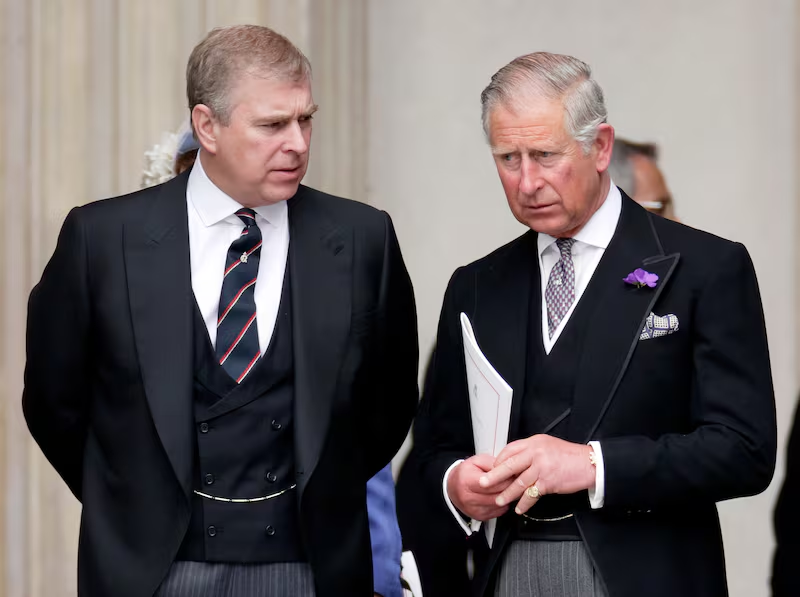
“If the files were released, if there was a proper investigation, if the diplomats were actually questioned on this, and we actually began to get the full story, that would create a snowball effect to persuade law enforcement that they would have to act, which I think is the only way to lance this boil.
“The royal family has played the normal game: never explain, never complain, put some pressure behind the scenes, and hope the problem goes away. But it’s not going away. We’ve only had 1 percent of the Epstein files released. There’s so much more material that’s likely to come out. There’s more material that I’m going to be producing in May for the paperback of Entitled, and there is stuff that I had for the hardback, which we couldn’t put in for legal reasons, which I’ve offered to the National Crime Agency.
“There is an overwhelming case for him to be properly investigated and charged if required. We can no longer have this two-tier justice system, and other jurisdictions don’t have it. The grandson of the King of Norway is now being charged with rape. We had King Juan Carlos of Spain, who was charged with corruption and disappeared.”
Lownie’s comments reflect the public mood in light of the latest Epstein documents, which include emails that appear to show Epstein arranging women for Andrew.
In one 2010 exchange, Epstein wrote to a contact saved as “The Duke”: “I have a friend who i think you might enjoy having dinner with, her name is irina she will be london 20-24 [sic].” The reply, apparently from Andrew, said: “Of course. I am in Geneva until the morning of 22nd but would be delighted to see her. Will she be bringing a message from you? Please give her my contact details to get in touch.” It was signed “HRH The Duke of York KG.” Epstein followed up by describing the woman as “26, russian, clevere [sic] beautiful, trustworthy and yes she has your email.”
Taken together with the photographs, and with earlier evidence about girls and young women being moved around Epstein’s properties, those messages raise obvious questions about whether Andrew was involved in sex trafficking.
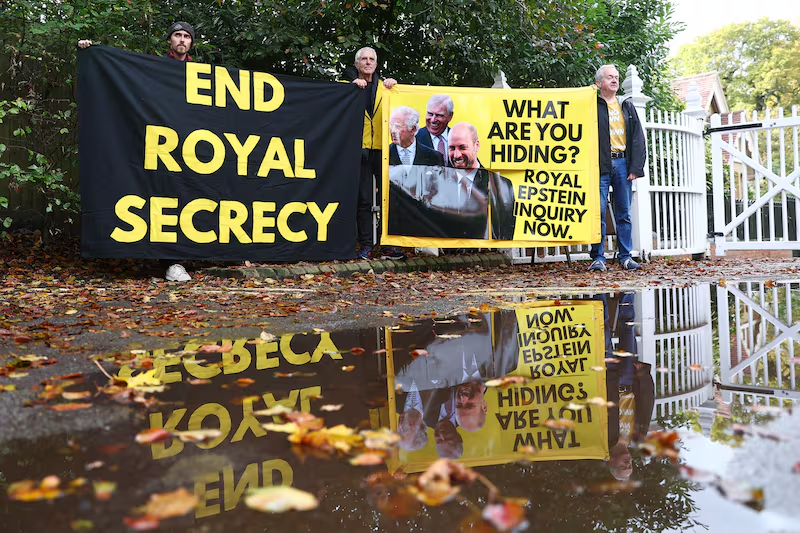
Under the UK’s Modern Slavery Act 2015, trafficking includes arranging or facilitating another person’s travel so that they can be exploited, including sexual activity where consent does not exist or is undermined through coercion, deception, abuse of power, or exploitation of vulnerability.
Until now, the royals’ strategy has been to keep Andrew away from any courtroom. The royal family agreed to fund a substantial settlement of the civil case brought by Virginia Giuffre, widely reported to be worth many millions of dollars, precisely so there would be no trial and no public cross-examination of Andrew. The aim was to close the matter, not to test his account.
In October, Andrew was stripped of the royal title of “prince” and other remaining honors. The palace hoped that by removing his formal status and keeping him largely out of view, public anger would slowly subside.
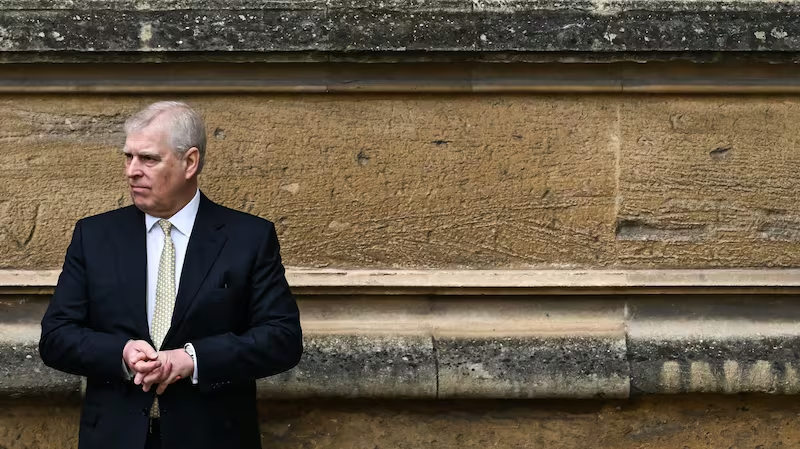
That calculation is now under heavy strain. The new material contains claims that Andrew passed confidential reports about Afghanistan and other sensitive issues to Epstein.
While the images of him bent over a woman on the floor are gross, the documents around them may provide the smoking gun of evidence of serious crime.
If any other man were linked to such material, many people believe he would already have been questioned by police. The sense that members of the royal family are treated differently by the criminal justice system has grown stronger with every fresh disclosure.
Pressure from Washington has been building as well. Members of the House Oversight Committee and other lawmakers in the United States have repeatedly written to Andrew asking him to sit for a transcribed interview, saying they want to “uncover the identities of Mr Epstein’s co-conspirators and enablers.”
People close to Andrew have dismissed this as grandstanding by American politicians looking for attention, insisting that he would never travel to the U.S. to testify and would simply ignore the requests.
Starmer’s background helps explain his stance. Before entering politics, he served as director of public prosecutions, while his stress on victims echoes recent statements from King Charles and Queen Camilla, who said when Andrew lost his titles that their thoughts were with Epstein’s victims.
If Andrew were to agree to a transcribed interview with members of Congress, whether in Britain or the United States, that would almost certainly increase pressure on U.K. police and prosecutors to reopen their own investigations. Some of the alleged crimes involve women trafficked to Britain to have sex with him. It is hard to imagine a situation in which he cooperates fully with American politicians and law-enforcement agencies while continuing to refuse the same level of cooperation to his own country’s authorities.
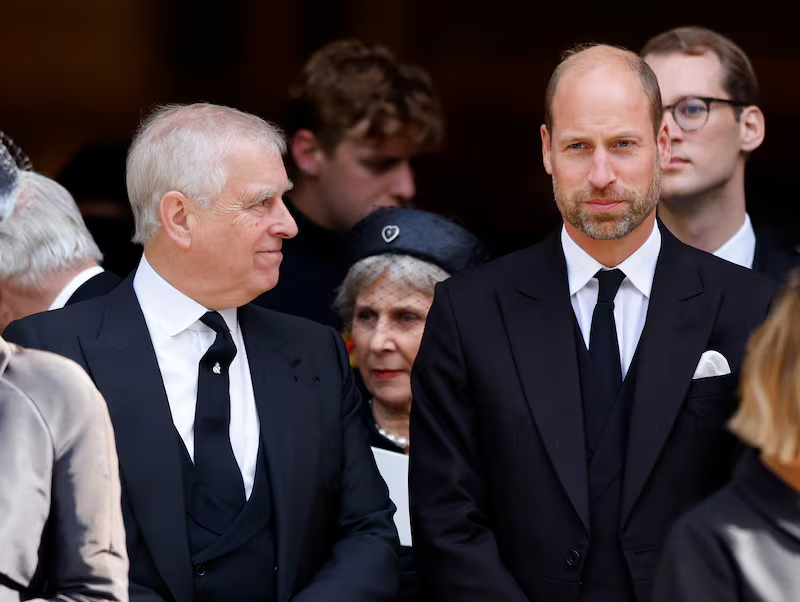
Within the royal family, this is no longer only an issue for the king. Because Charles is much older than Andrew, many insiders see this as a problem that will sit with Prince William for years to come. William is thought unlikely to accept a situation in which his uncle lives comfortably on royal estates while the institution he leads carries the reputational cost.
Lownie believes that only sustained political pressure in Westminster will break the deadlock. He wants Parliament to open a detailed inquiry into Andrew’s time as a trade envoy, with all the relevant files released under the Public Records Act and diplomats formally questioned. He has already supplied material he could not publish in the hardback of Entitled to the National Crime Agency and says more will appear in the paperback in May.
“The royal family have played the normal game,” he told me. “But it’s not going away. We’ve only had 1% of the Epstein files released. There’s so much more material that’s likely to come out.”
There is now a sense that time is running out for the old approach of deny and delay. Starmer’s remarks on victims and testimony do not, on their own, guarantee that Andrew will suddenly board a plane to Washington or sit down in a committee room in Westminster. But they do show that the highest level of government is no longer prepared to hide behind the phrase that this is simply “a matter for the royal family.”
Andrew should cooperate with U.S. authorities, submit to a transcribed interview and provide a complete account of what he knew and when. For his own sake, and for the credibility of the monarchy he once represented, he needs to do something he has resisted from the start: tell the truth.
Want more royal gossip, scoops and scandal? Click through to follow all Tom Sykes’ reporting at The Royalist on Substack.
The post Big Trouble for Ex-Prince Andrew as UK Leader Urges Him to Face US Questioning appeared first on The Daily Beast.