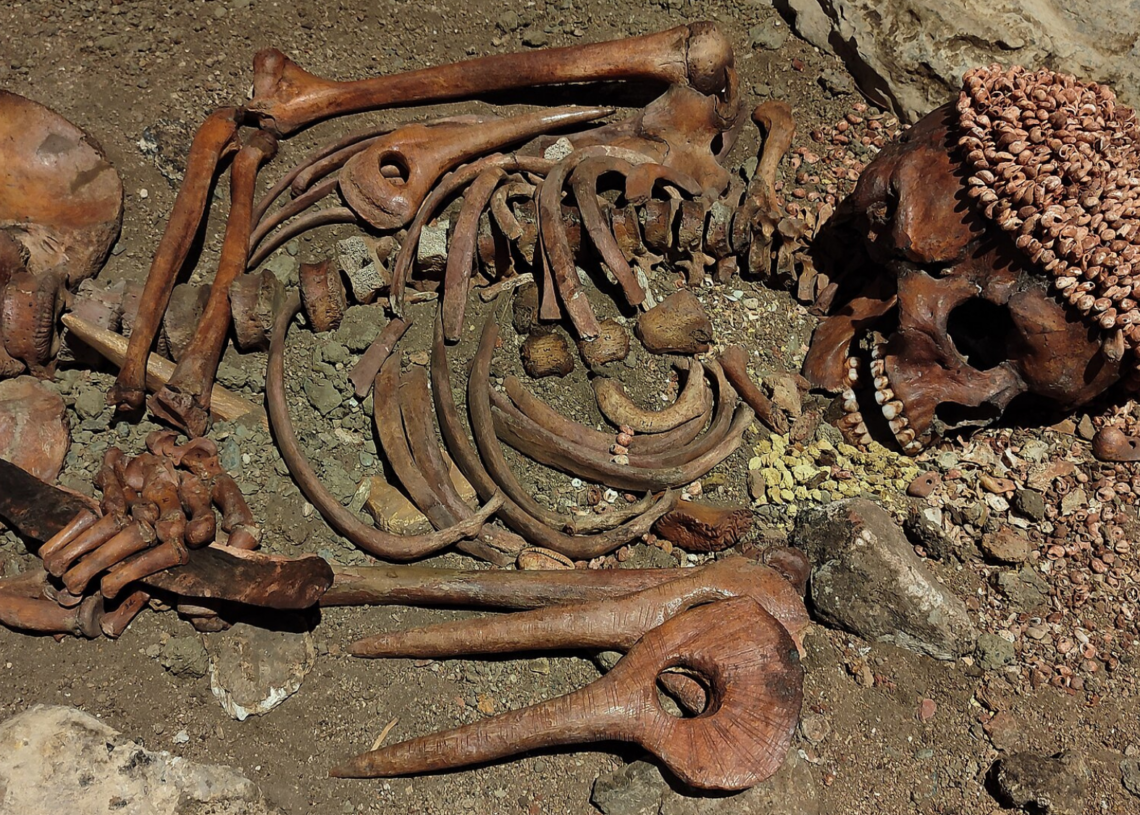
Nearly 28,000 years ago, a teenage forager was laid to rest in a cave along Italy’s Ligurian coast, his body arranged with care. A cap made from hundreds of shells covered his head. A flint blade rested in his right hand. Red ocher stained the ground beneath him. For decades, archaeologists knew something violent had happened. Now they know what it was.
According to a new skeletal analysis, the boy, nicknamed Il Principe or “the Prince,” died after a brutal encounter with a bear. The research, published in the Journal of Anthropological Sciences, confirms what early excavators suspected back in 1942 but never formally proved.
“He probably lost consciousness during the event and never regained it,” bioarchaeologist Vitale Sparacello of the University of Cagliari told Live Science in an email. “We know that these people hunted bears and that bears tend to avoid humans whenever they can, but a fortuitous encounter is still possible.”
The Prince’s remains were originally pulled from the Arene Candide cave in northern Italy and quickly reconstructed, glued together, and displayed in a museum. That meant decades passed without a proper forensic analysis. Recently, researchers were granted permission to remove the bones from the display one by one and examine them under magnification, using photography and 3D surface modeling to look for microscopic clues.
What they found resembles a prehistoric crime scene reconstruction. The teenager suffered catastrophic trauma to his left shoulder, neck, and face around the time of death. A narrow linear mark on the left side of his skull, hidden beneath the shell cap, matched the size and shape of a claw swipe. On his right ankle, a teardrop-shaped depression pointed to a cone-shaped object, likely a tooth. Pieced together, the injuries align with a fatal mauling by a large carnivore, most likely a brown bear or the now-extinct cave bear.
The most morbid detail is that the attack didn’t kill him immediately. Microscopic signs of bone healing suggest he survived for up to three days. “Given the extent of the bone injuries, it is surprising that this adolescent forager survived even for this brief time,” the researchers wrote, noting that major blood vessels appear to have been narrowly spared.
That survival window suggests something else. “Most likely the adolescent was not alone because he was cared for immediately,” Sparacello said, though what the group was doing at the time remains unknown.
The elaborate burial might reflect more than grief. As the researchers suggest, it could have been a way to process an event that shattered a small Stone Age community. Violence, loss, and meaning-making clearly didn’t start with modern humans. We’ve been trying to understand tragedy for a very long time.
The post A Teenager’s 28,000-Year-Old Burial Tells the Story of a Brutal Bear Attack appeared first on VICE.