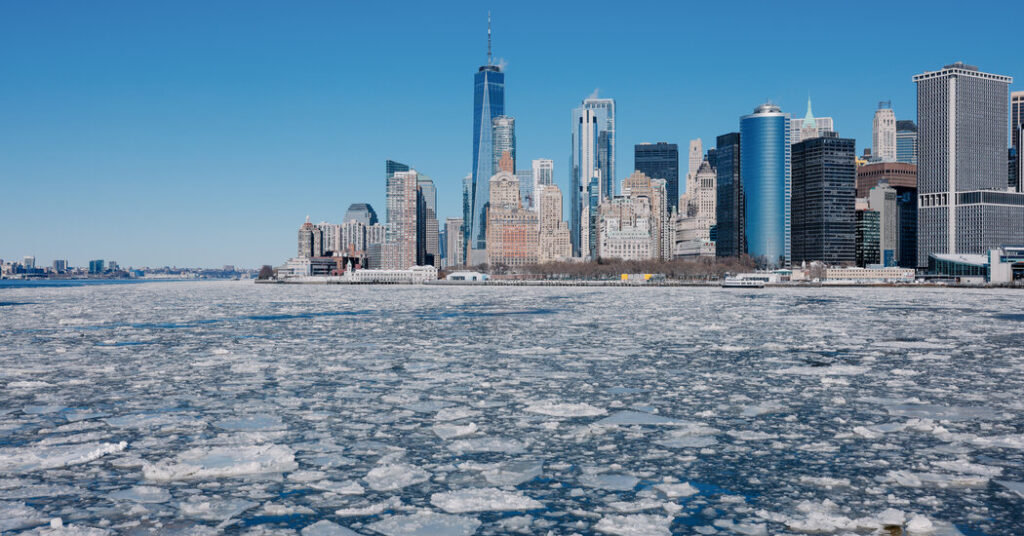
Any New Yorker who has spent time this frigid week gazing at the Hudson River, its wide expanse growing ever more packed with angular pieces of ice, may have wondered: What would it take for the whole thing to freeze over? How cold would it have to be, and for how long, before you could lace up your boots and walk to New Jersey?
It has happened before: In the 19th century, ice sometimes clogged New York’s waterways so thoroughly that pedestrians could stroll off Manhattan. In the era before bridges and tunnels, when ice halted ferry traffic, walking across the Hudson River, once the city’s most crucial conduit, became not only possible but necessary.
“The ice was for some time the only means of getting from New Jersey to this city,” The New York Times wrote in 1888.
But experts said such scenes were unlikely to happen again this century, at least not around New York City.
For seven days, temperatures in Manhattan have not risen above freezing — cold enough to ice over the reservoir in Central Park and freeze fountains across the city. The chill is expected to continue through at least early next week, but it’s not a deep enough cold to solidify the city’s waterways.
“In order for the river to freeze over, enough ice needs to be forming that it starts to cohere along the banks and then across the whole river,” said Tamlin Pavelsky, a professor at the University of North Carolina who has studied river ice. “Even a weeklong cold snap would usually not be long enough to make this happen.”
A river starts freezing when its full depth chills to near 32 degrees, Dr. Pavelsky said. That has happened in the shallower waters of the Hudson in recent weeks and has intensified amid the colder weather since Sunday from West Point and northward, where the Coast Guard is breaking up large sheets of ice to maintain a pathway for boats.
“We have large shelves of ice up near Albany, Poughkeepsie and West Point, but the river is not fully frozen over, and we’re going to keep it that way,” Petty Officer Third Class Logan Kaczmarek, who is based in New York City at Battery Park, said.
But at the wide southern mouth where the Hudson meets New York Harbor, the volume of water is immense and would require a very long period of cold weather to reach that freezing point. The Atlantic Ocean presents another problem: While the Hudson’s more northern reaches are fresh water, by the time it drains into New York Harbor, it has begun mixing with salt water from the Atlantic.
“And salt freezes at a much lower temperature,” said Heather Gierloff, the Hudson River programs supervisor with the New York Department of Environmental Conservation.
The ice that has been accumulating in the Hudson since last week has floated down the river from north of West Point and Poughkeepsie, where the fresh water freezes on the surface before Coast Guard boats break it up into smaller pieces.
The ice comes and goes with the tide every six hours. When the tide comes in from the ocean, it pulls in salt water, and the ice in the Hudson partly clears and melts. “And then, when the tides changes, all that ice from up the river starts coming down again and packs in,” said Mike Duffy, a boat captain for Circle Line, which takes sightseers around Manhattan by boat. The jumbles of ice have forced his company to cancel all its tours through Feb. 8. This is the second time the company has done this because of ice since Mr. Duffy started as a captain 47 years ago, he said.
Mr. Duffy described the early accumulations of ice as what’s called “brash ice,” fragments that are less than seven feet in diameter. “Then the ice starts overlapping and welding itself together so it becomes thicker and thicker, it’s piling on top of each other,” he said.
Complete freezes have been rarer in the past century. On Feb. 5, 1918, during one of the coldest New York winters on record, the Hudson froze solid as far south as Harlem. In 1947, an icebreaker recently returned from capturing a German weather station in the Arctic cut a channel up the Hudson to Albany, allowing emergency fuel and food to reach the capital.
Research shows that climate change is reducing the extent and duration of river ice. In a 2020 study of the world’s major waterways, scientists helped track ice formation on rivers wider than 90 meters to forecast how a warming climate might soon reshape them.
“It turns out that about half of all of the rivers in the world freeze regularly during the winter, but this is decreasing as temperatures warm,” Dr. Pavelsky said.
In the days when freezes were more common, the ice occasionally brought ferry traffic and harbor shipping to a standstill — but it could not halt all commerce. During a two-day-long freeze in 1821, sleighs carried passengers from Manhattan’s financial district to Hoboken. A pop-up entrepreneur built a temporary tavern on the ice in the middle of the Hudson River and sold food and drink to sleigh-bound commuters.
And once, when an ice floe jammed the entrance to the East River in March 1888, an enterprising boy lowered a ladder from a Wall Street dock to the ice and charged commuters two cents for passage. On the Brooklyn side, a laborer at the foot of Fulton Street charged the icebound travelers five cents more to climb his ladder back up to the pier.
Amy Graff is a Times reporter covering weather, wildfires and earthquakes.
The post What Would It Take to Actually Freeze the Hudson River? appeared first on New York Times.