

For decades, the path to success at the Big Four has been clear, if unglamorous.
Juniors used to cut their teeth on time-consuming, repetitive tasks like drafting documentation and slide decks, data input, reconciliations, and quality checks.
The tasks taught them foundational skills and the reasoning behind the work they’d later lead as directors and partners.
Agentic AI is changing that. Big Four leaders say agents will soon handle the grunt work, freeing up junior employees to focus on strategic work.
The shift is creating a new challenge for junior employees and talent leaders — if they skip the grunt work, how do they develop the deep understanding that traditionally came from years of repetition?
“This is the big question right now that I haven’t been able to get anybody to answer for me,” Yvonne Hinson, CEO of the American Accounting Association, told Business Insider.
If people move up the ladder without understanding the work beneath them, she said, that creates risk for firms and clients alike.
Even inside the firms, leaders acknowledge the uncertainty. There is a question around how to develop those core skills when you bring an agent into the mix, Niale Cleobury, KPMG’s AI workforce lead, told Business Insider in November.
“I probably don’t 100% know the answer to that question,” Cleobury said.
At this year’s Davos, Business Insider’s Kim Last found that many executives were also short on answers about the next generation of workers.
“The sense I have is that the leaders gathered here haven’t deeply thought about the ways education or job preparation need to evolve to meet this moment for young workers,” Last reported.
‘The why not just the task’
AI agents can now sift through vast amounts of information in seconds, producing summaries and recommendations that once took juniors days or weeks.
But experts have warned that this efficiency comes with a cognitive risk: people can develop the illusion that they understand something deeply when they’ve only reviewed an AI-generated output. Others warn of over-reliance or codependency, where users lose confidence in their own judgment.
Bridging that skills gap for the thousands of junior employees across their global offices has become a key focus for talent leaders at the Big Four.
At KPMG, Cleobury said learning patterns will have to change. Junior employees will need to pull apart agents’ outputs and understand how conclusions are drawn, rather than simply executing tasks from scratch.
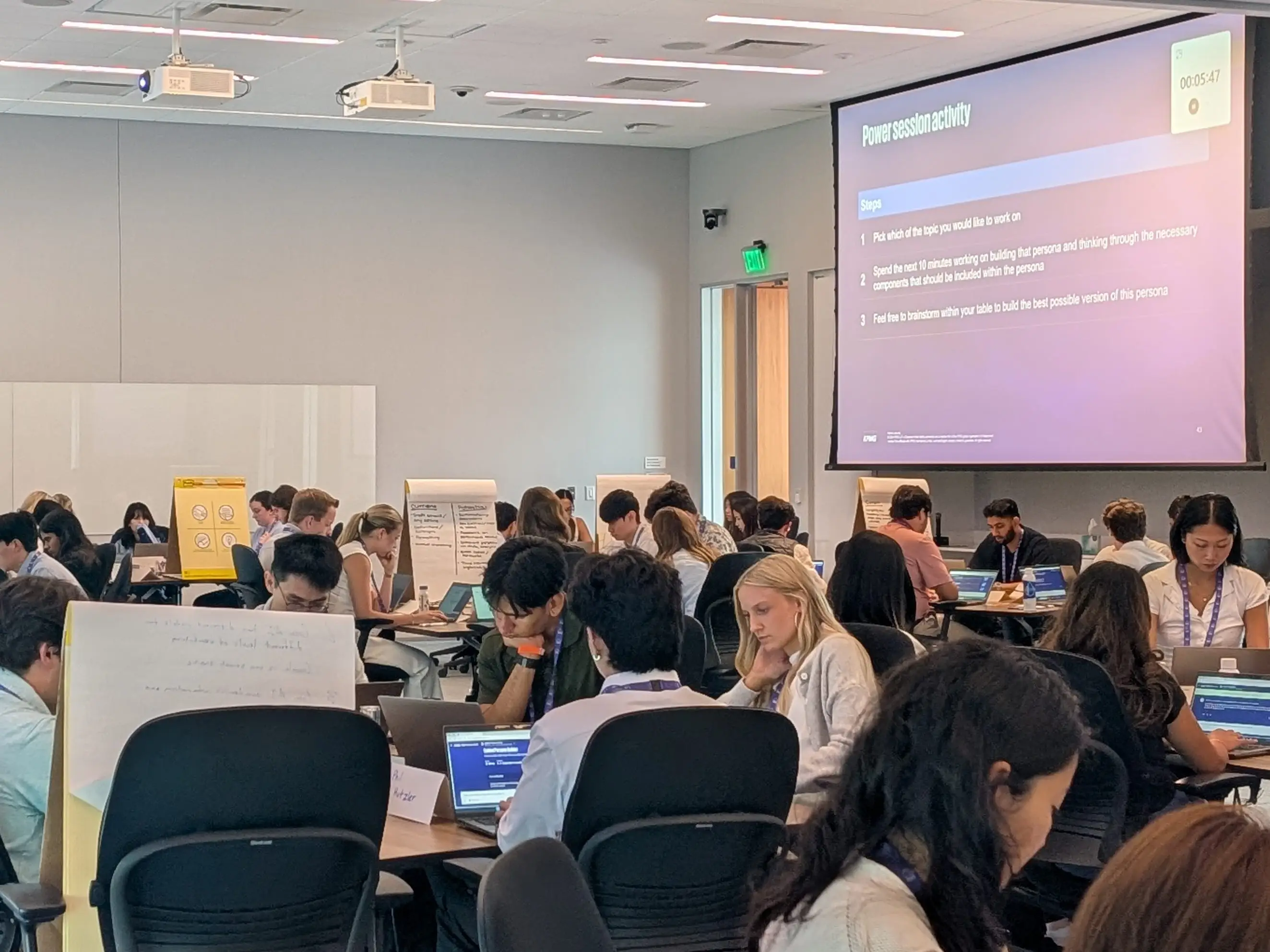
“We’re constantly asking ourselves: if technology changes where the experience comes from, how do we make sure our people are still learning the underlying concepts behind the work?” said Margaret Burke, PwC’s US talent acquisition and development leader.
Burke said PwC’s approach is to teach “the ‘why,’ not just the task.”
“We believe foundational skills still matter, she said. “Even when AI assists with parts of the work, our early-career professionals are learning how the work fits together and how to ask better questions.”
For every technical AI skill that PwC teaches employees, there’s a corresponding human skill. Entry-level hires complete a “four-day AI immersion course” that teaches them both how to work with AI and how to leverage human skills, the firm told Business Insider.
Deloitte did not respond to a specific question about the skills gap, but Jim Rowan, head of AI at Deloitte US, recently told Business Insider the firm is “actively investing” in upskilling its workforce.
New work, different skills
Maybe the old learning model isn’t the only — or the best — way to develop leaders in an AI-first workplace.
AI is already changing the nature of Big Four work, driving them toward large-scale transformations and deeper sector expertise on the consulting side, as well as greater efficiency and strategy on the accounting arm.
Consultants are actually returning to the core of what they used to be: “that strategic advisor, that person who’s got the strong hand on our client’s back,” said KPMG’s Cleobury.
As that happens, they need to develop different skills, making exposure to strategic decisions and clients more important.
Errol Gardner, global vice chair of consulting at EY, told Business Insider that the foundational skillset now includes developing judgment about where and how to use AI.
“Graduates learn by doing and observing on real projects alongside experienced consultants,” said Gardner. “If anything, AI assistance will allow for earlier exposure to client and stakeholder decision makers.”
That earlier exposure, firms argue, can accelerate development rather than weaken it.
“AI actually gives us the opportunity to be more deliberate about development, helping early-career professionals move into higher-value work sooner,” said PwC’s Burke.
Gardner said the next generation of workers will arrive at EY with strengths previous cohorts didn’t have — and their differences will be an advantage, not a liability.
“We’re continuing to give newer talent earlier client exposure, assigning them ownership to interrogate and explain AI‑assisted analyses, and rotating them across teams to spot patterns and challenge norms,” Gardner said.
AI-native graduates may challenge long-standing norms in ways today’s leaders cannot, making multigenerational teams even more important, he said.
Whether that approach can truly replace the old model of learning by doing the grunt work remains an open question — one that the Big Four may only be able to answer after a generation of AI-native managers reaches the top and become tomorrow’s leaders.
Have a tip? Contact this reporter via email at [email protected] or Signal at Polly_Thompson.89. Use a personal email address, a nonwork WiFi network, and a nonwork device; here’s our guide to sharing information securely.
Read the original article on Business Insider
The post The Big Four’s AI revolution has a problem: how junior staff actually learn appeared first on Business Insider.