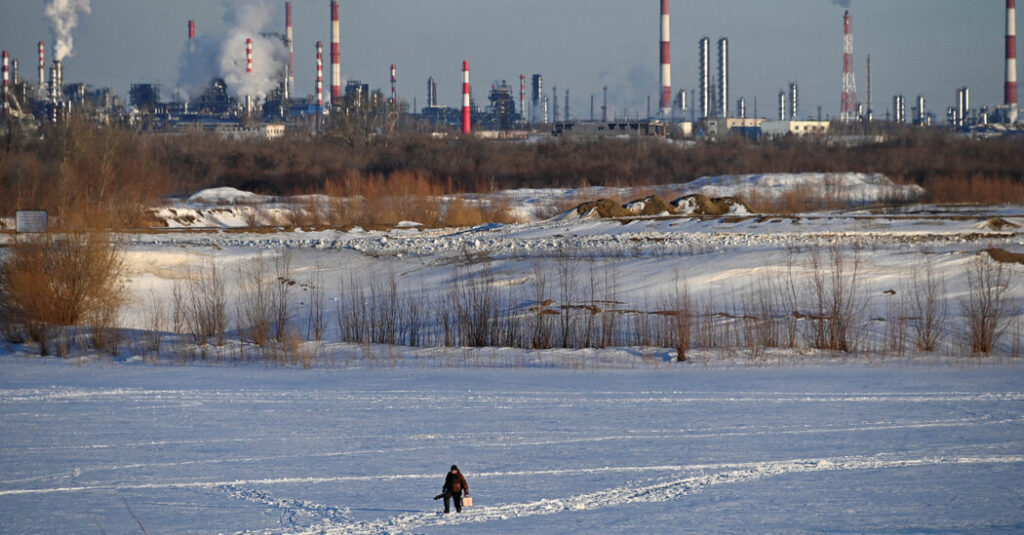
As Russia holds direct peace talks with Ukraine for the first time in months, the Kremlin’s most potent fuel for the war, oil revenue, is under mounting strain.
The price of Russian oil, the country’s primary export, has declined under the weight of surging global supplies and Western sanctions related to the war. Last year, Russia’s oil and gas revenue fell by almost a quarter, according to the Finance Ministry. The Kremlin is resorting to tax increases and deficit spending to bridge the gap.
So far, there is little sign that the economic strains, and any discontent they generate among business leaders and the public, will be enough to change President Vladimir V. Putin’s calculations on the war. Trilateral negotiations involving Russia, Ukraine and the United States are set to continue on Sunday in Abu Dhabi, the capital of the United Arab Emirates.
But with the economy stagnating and the Kremlin reaching the limit of what it can squeeze from it, the Russian people will have to bear more of the burden of a war whose costs exceed about $170 billion a year.
“This situation is manageable,” said Yevgeny Nadorshin, an economist in Moscow who advises companies and banks. “But no one is comfortable with that.”
Throughout his decades-long rule, Mr. Putin has taken pride in the stability he has brought to a Russian economy that was in free fall after the demise of the Soviet Union — slashing debt, streamlining taxes and taming inflation.
A strong oil economy allowed the Russian state to deliver an improved standard of living. That, the Kremlin hoped, would keep the public content even as the government eroded personal freedoms.
Now, the carefully cultivated economic stability is fracturing. The steep drop in oil revenue has sent Russia into a new era defined by sustained budget deficits, higher taxes and stubborn inflation.
Russia’s oil trade has been battered by two forces. Oil prices have declined since April, after the Organization of Petroleum Exporting Countries decided to gradually increase production after years of cuts. The Russian oil industry has also been hit in recent months by new Western sanctions and the heavier enforcement of existing ones.
In October, President Trump imposed sanctions on Russia’s two largest oil companies, Rosneft, which is state-owned, and Lukoil, which is private. Those penalties significantly undercut the companies’ ability to sell crude. Since then, Russia has also faced stepped-up enforcement of restrictions against the illicit “shadow fleet” of tankers it uses to ship oil.
This month, the U.S. military seized a Russian-flagged vessel in the North Atlantic that had been used to carry Venezuelan oil. The French Navy also intercepted a tanker in the Mediterranean suspected of using a false flag and belonging to a Russia-linked fleet.
Because of the current global oversupply, buyers now have more alternatives to Russian crude. This allows them to either walk away entirely or demand significantly higher discounts to compensate for the risk of handling goods hit with sanctions, said Sergey Vakulenko, an energy expert at the Carnegie Endowment for International Peace.
“Had it not been for this noticeable decrease in oil prices,” he said, “all these measures would have been far less effective.”
Discounts on Russian oil have grown drastically. The economy ministry said this month that the average price of Russian oil was $39 per barrel in December, down from more than $57 in August.
Adding to Moscow’s problems, Ukraine has been using drones since November to strike Russia-linked tankers in the Black Sea and the Mediterranean. The Ukrainian military has also been attacking Russian refineries. That has contributed to fuel crises in several regions, forcing the government to temporarily ban the export of oil products.
“The only factor that can change the situation is economic pressure on Russia,” President Volodymyr Zelensky of Ukraine said on Friday. “Russia must run out of money for the war to start coming to an end.”
This is not the first time that Mr. Putin has dealt with a drop in oil prices. But in previous years, the Russian state had more options. It could cut expenditures or allow the currency to weaken to replenish the budget. But the costs of the war, which amount to about 30 percent of Russia’s $580 billion annual budget, make it hard to reduce expenses. And the currency, the ruble, has remained strong.
Propped up by restrictions on imports and high interest rates, the ruble surged by about 45 percent against the U.S. dollar in 2025. A strong ruble means that the government receives less money for each barrel of crude that is sold.
With options dwindling, the Kremlin had little choice but to increase state debt as well as personal and corporate taxes. The Russian government also increased taxes on smaller enterprises like bakeries and shops, causing a rare uproar among owners.
Russia’s budget deficit reached $72 billion in 2025, nominally the highest since 2009. Mr. Nadorshin, the economist, said he expected it to increase further this year.
“The situation is becoming more complicated,” he said, “and it’s clear that the pace of this complication is, naturally, worrying.”
Ivan Nechepurenko covers Russia, Ukraine, Belarus, the countries of the Caucasus, and Central Asia.
The post Russia’s Oil Revenue, the Lifeblood of Its War Machine, Is Plummeting appeared first on New York Times.