When does an artist know he’s truly made it? Perhaps when he can direct a theater full of fans to joyfully woof at him on command. “I want every single person in this room to bark on the count of three,” Leon Thomas screamed at a sold-out Brooklyn crowd in November. The room dutifully filled with pet sounds.
Just a few weeks earlier, the R&B singer and songwriter had received another form of affirmation: six Grammy nominations, including two of the biggest categories, album of the year and best new artist. (He won his first Grammy in 2024, as a writer on SZA’s best R&B song, “Snooze.”)
Amid an ongoing, much-ballyhooed conversation about the death of R&B, Thomas’s second album, “Mutt,” released in late 2024, is one of several projects reviving a sense of possibility in many fans of the genre. The album was inspired by his dog (and he has likened his own romantic misbehavior to the pup’s mischievousness). Buoyed by the groovy title track, which peaked at No. 6 on the Billboard Hot 100, it’s an LP of soulful, patient, edgy music about the tensions of living as a young man in the 21st century — climbing in and out of lust; waxing nostalgic and being desperate for the future; wanting to settle down but living peripatetically; feeling both increasingly unsure and overconfident.
On a video call a few weeks later, Thomas said he was hoping his Grammy spotlight could help “give ‘Mutt’ its flowers.” Bizzy Crook, a longtime collaborator with writing credits on the LP, said that Grammy wins “would just be a testament to putting the art first again. Leon went in and made an album of music he enjoyed, not what other people were making.”
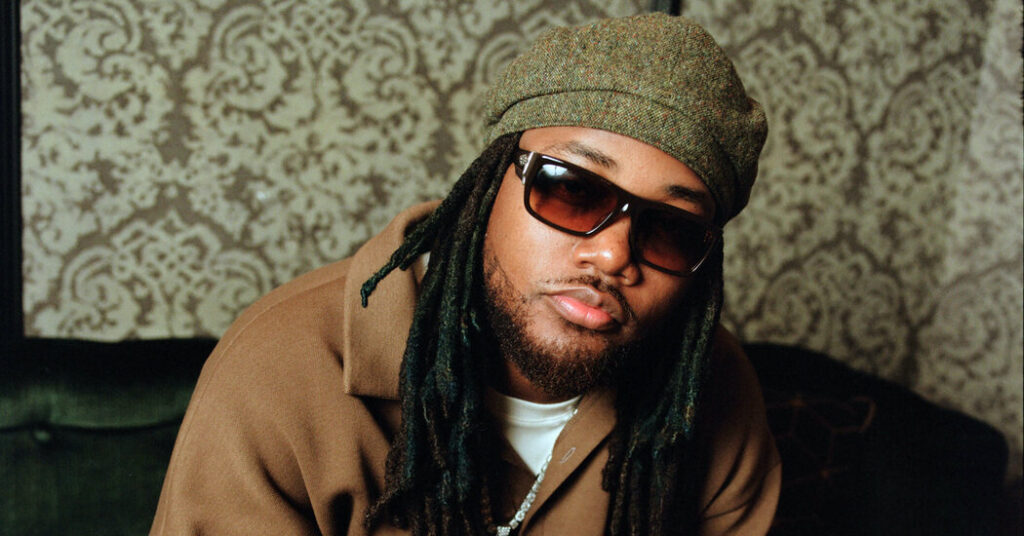
Thomas, 32, was halfway through the North American leg of a more than 50-date international tour, and he was at that part of the journey where everything had begun to run together: cities, days of the week, meet-and-greets, club appearances, hotel rooms. The musician, who has a teddy bear’s countenance, wore large aviator frames with yellow lenses. His locs were colored dark green, but his sandy brown mustache and beard were undyed. Every so often, he tipped his head out of the frame, and plumes of white smoke replaced his face.
Thomas used to be a child actor, and he still shows evidence of a young star’s discretion and indefatigable professionalism. He is also a scion of a multigenerational entertainment family. His grandfather, John D. Anthony, was an opera singer and theater actor who appeared in “Porgy and Bess” on Broadway. His mother, Jayon Anthony, is a vocal coach. In 2003, at age 11, Thomas began acting, scoring a role as Young Simba in “The Lion King” on Broadway, which he followed with parts in “Caroline, or Change” and “The Color Purple” and work on the Nickelodeon series “The Backyardigans.”
Growing up in Park Slope, Brooklyn, Thomas honed his artistic interests outside of professional jobs, preferring to experiment at home. “We had a shed in the backyard where I learned how to play drums, bass. It was a place where I could be as loud as I wanted without killing my parents,” he said. “And it’s where I kind of worked out a lot of my artistic integrity. That was my first real studio.”
When he was 16, Thomas and his family moved to Los Angeles for an opportunity on another Nickelodeon show, “Victorious,” where he played a musical prodigy at a performing arts high school and co-starred with Ariana Grande. Other gigs, on HBO’s “Insecure” and “Fear the Walking Dead,” came later. In the early 2010s, he signed with an independent label and released a suite of mixtapes and an EP, but nothing really caught on, and adult stardom seemed to elude him.
In 2017, he supplied Bobby Brown’s singing voice in BET’s “The New Edition Story,” which suggested the kind of dynamic he might have to accept, playing a background role for others. He wrote music for acts like Drake, Grande and Rick Ross, trying to get a firmer toehold in the industry, and served as an apprentice for Babyface, one of music’s most reliable hitmakers.
“I got to learn a lot of the dos and don’ts of traditional R&B,” he said. But when he cast out on his own and worked with more rappers, that “taught me so much about freedom of expression.”
Things changed in 2022, when he signed with Ty Dolla Sign’s label, EZMNY Records. “Electric Dusk,” his debut album released a year later, represents a shift in his musicianship. Ty remembered that Thomas played him a song that was so refreshing, “It reminded me a lot of why I love music.” Thomas’s sweet spot of late has been noirish soul music inspired by life in Los Angeles. “California is such a mystical land of opportunity and also hidden figures in the shadows,” he said. “Vibes Don’t Lie,” from “Mutt” is a tribute to perceptive intimacy, with stutter-stepping instrumentation that traipses, as if driving down Sunset Boulevard after midnight and getting all yellow lights.
In Thomas’s recent music, genre categorizations are slippery. Some songs, like “Blue Hundreds” and “Baccarat,” have a bluesy flair, while others take off from Minneapolis funk. The songs are thematically richer, too, contending with masculinity and responsibility, and failures of communication abetted by contemporary technology.
“Mutt,” he said, was formed by pressure. “It was at a time in my life where I was scared I was going to get dropped by my label.” He was after a hit single, which he said “has to be something that I call ‘drunk and fun.’ Can somebody really drunk at a club sing this back to me? The hook has to be almost like a lullaby.” (He also had a ’90s-style rom-com in mind, “where there was a guy who was dating the love of his life and then he just broke up with her to live a single life that he saw on social media.”)
Shawn Barron, the chief executive and co-founder of EZMNY Records, attributed the album’s success to its mix of forward thinking and backward glances. The title track he said, “it’s nostalgic, and it’s now at the same time, I feel like he was able to have that perfect balance of it feeling like a song from the ’70s and a song from 2024.”
The key to the album is Thomas’s expressive voice, which he often runs through filters. He doesn’t engage in traditional vocal tropes like gradual escalation as much as a series of undulations, periodic coos, grunts and oohs. He’s one of R&B’s foremost practitioners of melisma, stretching out rhythmic riffs like pebbles skipping in water.
Thomas said that his music is deliberately off-kilter, and inspired in part by hip-hop’s unruliness: “It was like the closest thing to jazz I could really get my hands on.” The approach sums up his “rebellion to structure,” he said, explaining that “the second verse doesn’t have to sound exactly like the first, melodically. There’s really no rules.” Barron noted that “the way he hears sonics is different.”
Crook said that Grammys success for Thomas could be an inspiration to others with unusual paths to stardom. “We’ve seen Leon grow up,” he said, “getting signed by labels, getting dropped by labels.” But he stayed the course, “not being discouraged and still chasing that dream when everybody’s counted you out.”
For best new artist, Thomas is up against a long list of charismatic upstarts, including the British chanteuses Olivia Dean and Lola Young, who have been part of a new wave of U.K. soul. (All the nominees in the category are slated to perform at the ceremony, guaranteeing Thomas prime-time exposure.) The album of the year category is stacked with superstars, including Bad Bunny, Lady Gaga and Kendrick Lamar.
Despite the competition, Barron feels like this year is R&B’s time to shine, because “R&B is telling real stories and has real song structure.”
During our interview, Thomas seemed most excited about the new music he’s working on. He has said that in the studio, he’s out to “chase chills,” or trigger the physical sensation of having made something that can catalyze real feeling in listeners. “I feel like as musicians and as creatives, we get caught up in our own little loops of creativity and that can be positive and negative at the same time,” he said.
“The thing for me is just trying to discover more unknown territories.”
The post R&B May Have a Major Grammys Night. Leon Thomas Is Ready. appeared first on New York Times.