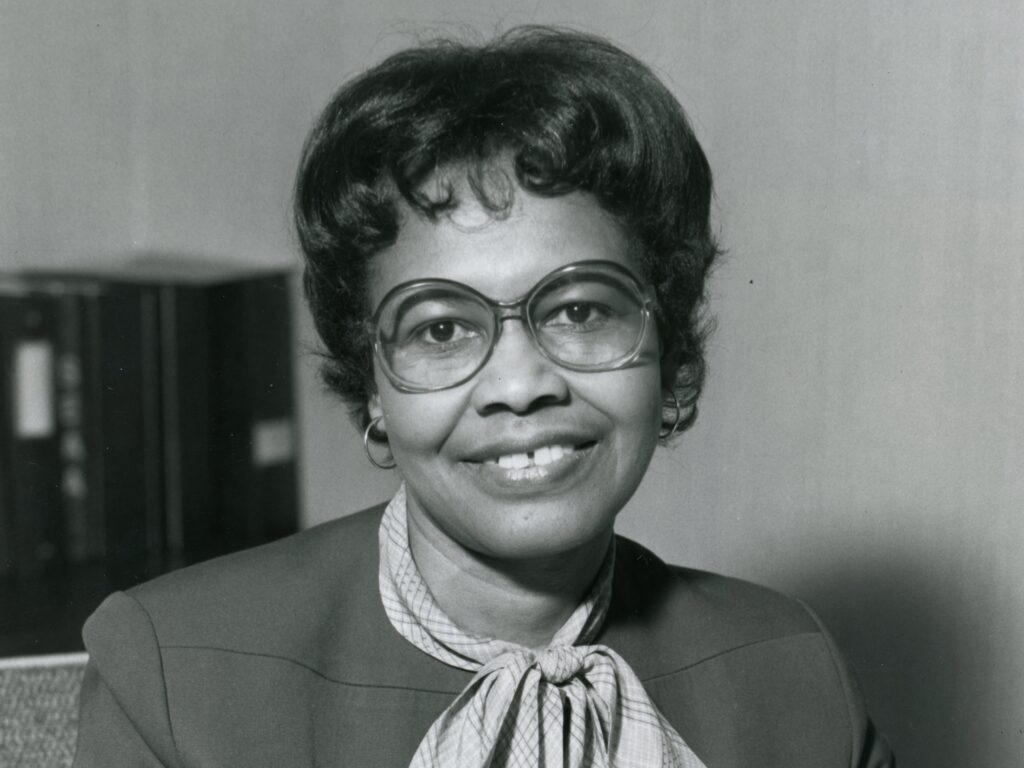
As a young girl in the Jim Crow-era South, Gladys West passed the time counting fenceposts, dreaming of life beyond her family farm south of Richmond.
Each day, she walked three miles to a segregated one-room schoolhouse with a leaky roof and a solitary, underpaid teacher. And each way, there and back, she counted the fenceposts along the road, discovering that she had an aptitude for numbers that would help her bridge the distance between poverty and opportunity, between a life working in the fields and a career helping society advance beyond its limits.
Dr. West, who died Jan. 17 at 95, used her mathematical skills to become a barrier-breaking researcher for the Navy, mastering a bulky supercomputer known as Stretch while calculating satellite orbits and developing a precise model of the Earth’s surface. Her research laid the groundwork for the Global Positioning System, GPS, a technology that has made getting lost a thing of the past. Thanks in part to Dr. West, anyone with a smartphone — or a receiver-equipped car, airplane or boat — can navigate easily from one place to the next, without having to stop to ask for directions.
Without the mathematical model that she and her team helped develop, “the extraordinary positioning, navigation, and timing accuracy of GPS would be impossible to achieve,” the U.S. Space Force said in an online biography of Dr. West, who was named one of the military’s Space and Missile Pioneers in 2018.
“I have to be honest with you, it’s mind-boggling that they pulled it off,” said Reza Malek-Madani, a retired mathematics professor at the U.S. Naval Academy, who interviewed Dr. West for a 2021 paper on her work. “We are finding, now, that GPS finds our position within a few meters of where we are. Just the fact that we can come within the scale of a kilometer, say, was a significant accomplishment.”
Dr. West’s achievement was all the more remarkable given that she faced twin prejudices, as an African American and as a woman, from the outset of her 42-year career at the Naval Surface Warfare Center Dahlgren Division. When she was hired in 1956 at the base on the lower Potomac, she was one of only four Black professionals there. The installation had recently integrated, and while it took years for the surrounding town to follow suit, she sought to pave the way for other African Americans, excelling at her job even as some co-workers refused to socialize with her.
“When many of my white colleagues saw me in the bathroom, they would get this look on their face like they had seen a ghost or something,” she wrote in her 2020 memoir, “It Began With a Dream.”
One of the base’s few other Black mathematicians, Ira West, became her husband, working on Navy missile programs while Dr. West conducted the classified research that contributed to GPS’s development in the late 1970s and ’80s.
The program’s architects, including scientists such as Bradford Parkinson, Roger Easton and Ivan Getting, gained recognition even as Dr. West’s name remained unknown. Her story mirrored that of mathematicians like Mary Jackson, Katherine Johnson and Dorothy Vaughan — NASA staffers who, like Dr. West, were long marginalized because of their race and gender, even as their calculations helped America win the space race.
After the work of her NASA contemporaries was featured in the 2016 book and movie “Hidden Figures,” Dr. West stepped into the spotlight as well, aided by a fellow college sorority alum who wanted to help share her story. A 2018 profile in the Fredericksburg, Virginia, Free Lance-Star was followed by a flurry of news coverage and a commendation from the Virginia General Assembly, which passed a joint resolution honoring “her trailblazing career in mathematics and vital contributions to modern technology.” In 2021, she became the first woman to receive the Prince Philip Medal from Britain’s Royal Academy of Engineering.
“The Navy stands on the shoulders of the geniuses that have been advancing our technology,” retired U.S. Navy Adm. Philip S. Davidson said in 2023, when Dr. West was honored in an awards ceremony at Dahlgren. “We’re standing on Dr. West’s shoulders,” he continued, “to execute the mission of the United States.”
The second of four children, Dr. West was born Gladys Mae Brown in Sutherland, Virginia, on Oct. 27, 1930. Her mother had a job at a tobacco factory, and her father worked for the railroad in addition to looking after the farm. Dr. West helped out by chopping wood, feeding chickens and joining in the tobacco harvest.
After graduating first in her class, she enrolled at Virginia State College, a historically Black institution (now a university) in the nearby town of Ettrick. She majored in math — she said she liked “the preciseness of it, the neatness of it” — and received a bachelor’s degree in 1952, followed by a master’s in 1955.
At Dahlgren, she helped calculate range tables for Navy weapons systems and joined an astronomical research team that established the regularity of Pluto’s motion relative to Neptune. The project was said to require 5 billion arithmetic calculations and 100 hours of computing time.
By the late 1970s, she was using satellite data to develop a more accurate model of the Earth’s bumpy, irregular shape, one that accounted for variations in gravity and factored out the effects of the tides, winds and other forces. The shape, known as the geoid, was lumpy and potatolike — far from the traditional image of Earth as a slightly squashed sphere — and was further refined as GPS satellites took flight.
While still working at Dahlgren, Dr. West received a master’s of public administration degree from the University of Oklahoma and, near the close of her career, began working on a PhD in public administration from Virginia Tech. She continued to pursue the degree even after she suffered a stroke that sapped her strength and mobility. “You can’t stay in the bed,” she recalled a voice saying. “You’ve got to get up from here and get your PhD.” In 2000, she earned her doctorate.
After her husband died in 2024, Dr. West moved to Fredericksburg to live with her daughter, Carolyn Oglesby. She died at her daughter’s home of complications from Alzheimer’s disease, Oglesby said. In addition to her daughter, survivors include two sons, David and Michael West; seven grandchildren; and eight great-grandchildren.
When it came to new technologies, Dr. West proved adaptive, using Zoom to chat with journalists during the pandemic and embracing digital innovations that made computers ever smaller. GPS, of all things, was an exception. The system didn’t offer the tactile experience of navigation that she had enjoyed since childhood.
As she told a Virginia public television interviewer in 2020, “I prefer maps.”
The post Raised in the segregated South, Gladys West was a hidden figure behind GPS appeared first on Washington Post.