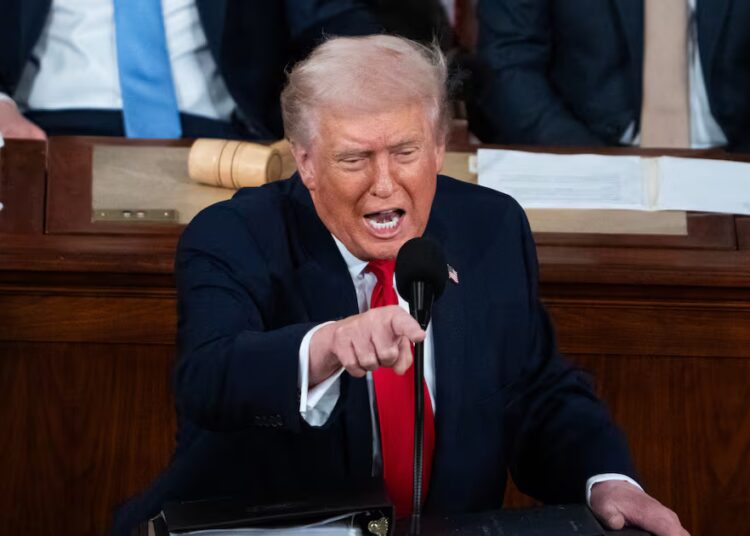
The second government shutdown of President Donald Trump’s second term began early Saturday, as aggressive immigration enforcement in Minneapolis derailed congressional negotiations to fund the agencies driving the administration’s policies.
Lawmakers missed a midnight deadline to approve six new spending bills because the Senate changed some of the measures after the House passed them, in response to deadly shootings of U.S. citizens by federal immigration agents in Minnesota.
Without funding, the IRS will shutter just days into tax season. Money for housing assistance programs could be at risk in the aftermath of a winter storm that sent temperatures in much of the country plummeting to historic lows. Federally backed scientific research will immediately halt.
Military service members, transportation security agents and air traffic controllers will continue to work — unpaid.
But this shutdown may be brief and have limited effects: The Senate on Friday evening approved a bipartisan agreement backed by Trump to pass five major appropriations bills and a temporary funding extension for the Department of Homeland Security.
House Speaker Mike Johnson (R-Louisiana) has said his chamber will aim to pass the package when lawmakers return early next week, despite frustrations from conservative members of the Republican caucus and skepticism from House Democrats.
“The House is going to do its job,” Johnson said Thursday night.
Congress faced a similar situation less than three months ago, when Republicans and Democrats deadlocked over expiring subsidies that made Affordable Care Act health insurance plans less expensive. Without a deal in place to preserve them, Senate Democrats refused to back new spending bills, leading to the longest government shutdown in U.S. history.
Lawmakers eventually brokered a compromise to reopen federal agencies, funding some for the full fiscal year. For others — including the Departments of Defense, Homeland Security, Labor, Treasury, Health and Human Services and more — Congress set a Jan. 30 deadline to construct a fresh deal.
But the killings of two people in Minneapolis, Renée Good and Alex Pretti, in recent weeks led Democrats to demand new accountability measures for immigration enforcement efforts. They demanded that Republicans break off the bill to fund DHS — which includes ICE and Border Patrol, as well as agencies such as the Transportation Security Administration and the Federal Emergency Management Agency — from other government spending bills, which have broader bipartisan support.
Most Senate Republicans said they were open to negotiating additional oversight for ICE, but at first resisted splitting up the bills, arguing Democrats’ demands could be met through an executive order or separate legislation. Senate Democrats struck a deal with Trump to temporarily extend the DHS funding to buy time for additional policy negotiations.
In a social media post Thursday, Trump urged lawmakers of both parties to give the package “a very much needed Bipartisan ‘YES’ Vote.”
But getting the funding agreement through the House may still prove challenging. Republicans control the House by a razor-thin margin, and several House Republicans have said they will oppose any changes to the DHS funding bill.
“I will not vote for a DHS bill that does not fully fund and empower ICE. Immigration enforcement operations might offend the sensibilities of some of my colleagues. But perhaps they should also show compassion for the families of Laken Riley, Jocelyn Nungaray, and so many other victims,” Rep. Dan Crenshaw (R-Texas) wrote on X, referencing a woman and a child killed by undocumented immigrants. “Those victims lost their right to due process because of men that should never have been here. And now there are politicians demanding we disarm the only agency that could’ve stopped these senseless murders.”
Meanwhile, House Democrats have not committed to supporting the bipartisan agreement struck in the Senate, though they do plan to support the other five funding bills.
“We have to deal with the issue of reining ICE and the Department of Homeland Security in with the fierce urgency of now,” House Minority Leader Hakeem Jeffries (D-New York) told reporters Friday. “A two-week window — we’ll evaluate whether that’s sufficient time.”
If House lawmakers are able to pass the funding package and end the shutdown early next week, lawmakers will turn to finding an agreement on new accountability measures for the administration’s immigration enforcement operations.
Senate Democrats demanded a list of changes this week, including tightening warrant rules, implementing a code of conduct for ICE and other federal agents, requiring independent investigations of misconduct, removing masks on agents, and requiring they wear body cameras.
“Understand that what we’re asking for are what police departments do. It’s what your local cop does. It’s what any well-trained law enforcement force does,” said Sen. Brian Schatz (D-Hawaii.) “We’re not asking for some progressive wish-list.”
Republicans said they would be pushing their own changes in the negotiations, including a crackdown on so-called “sanctuary cities.”
Sen. John Neely Kennedy (R-Louisiana) predicted that the immigration debate over the next two weeks would “have all of the substance and efficiency of an eighth-grade car wash.”
“I’m not going to vote for a bunch of so-called reforms that are designed to cripple ICE, nor do I think my Republican colleagues will,” he said. “And I hope I’m wrong on this prediction, but what I smell coming is a long, long shutdown for DHS.”
Senators of both parties acknowledge it will likely be challenging to find a compromise.
“It’s going to be hard, but let’s get to it,” said Sen. Lisa Murkowski (R-Alaska.)
Federal functions necessary for public safety, national security and protecting government property are exempt from shutdowns. Presidents also have broad latitude to keep other agencies open in the absence of funds.
Despite the funding lapse, Immigration and Customs Enforcement and Customs and Border Protection — the main targets of Democrats’ outrage — will remain open.
DHS and its subagencies also have access to a $170 billion pool of money approved in this summer’s One Big Beautiful Bill, Trump and the GOP’s massive tax and immigration law.
Administration officials have tapped those funds to continue operations without an annual agency budget and could continue that strategy during a shutdown.
If the government remains partially closed for longer than expected, Trump could make other budget maneuvers. During the shutdown last year, the administration aggressively shifted resources to sustain certain federal functions — and reward or punish political allies and opponents.
Trump ordered the Pentagon to continue making payroll even though the Defense Department lacked congressional authorization to do so. After the shutdown ended, he also repurposed housing assistance money for troops to hand out $1,776 Christmastime bonuses.
To keep the IRS operating last fall, the Treasury Department used money from the Biden administration’s 2022 Inflation Reduction Act that had been meant to beef up the tax agency’s enforcement and customer service. Republicans had previously sought to rescind much of those funds. Partway through the shutdown, the Trump administration cut off those resources, furloughing much of the IRS’s staff.
White House budget director Russell Vought attempted to cancel $8 billion in clean energy funds for a group of 16 Democratic-run states. A federal judge said this month that the move was unlawful and reinstated the money. The Office of Management and Budget also paused billions of dollars for New York subway and rail projects.
Most big social benefit programs, which drive the vast majority of federal spending, will remain open during a shutdown. Social Security, Medicare and Medicaid are funded through separate tax receipts, rather than annual appropriations. Mail delivery will also continue; the U.S. Postal Service is generally funded through the sale of postage.
The post Most of the federal government shuts down, but a quick end is in sight appeared first on Washington Post.