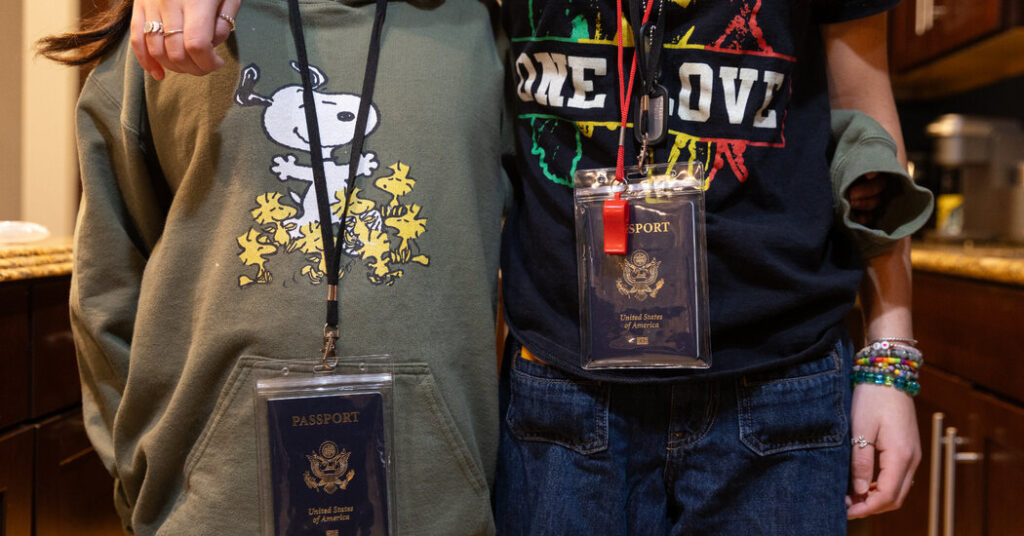
María Pabón Gautier has a new routine when she sends her 8- and 15-year-olds off to school in their Minneapolis suburb. Before they run out the door, she slips lanyards around their necks. The lanyards hold their American passports.
“I don’t like it,” her youngest said. “I really don’t like it.”
In the past two months, federal immigration agents have arrested thousands in the Twin Cities, detaining citizens, asylum-seekers, refugees and the undocumented. They have killed two American citizens, Renee Good and Alex Pretti. And they have stopped people seemingly at random, asking for identification or simply demanding: “Where were you born?”
Now, many people here are asking a question that is a novel one in America: Is it safe to leave home without proof of citizenship? Has the United States turned into a show-me-your-papers nation?
For many Minnesotans, the answer has been an unequivocal yes.
“We need to be ready before they point a gun to us,” said Joua Tsu Thao, a citizen, retired mental health practitioner and pastor who fought with U.S. forces during the Vietnam War. The 75-year-old now tapes his passport and drivers license to the outside of his clothing.
On Sunday Jan. 18, the Hmong community watched in horror as ChongLy Scott Thao, a naturalized citizen, was dragged from his home in freezing temperatures, wearing only underwear and sandals. He was released hours later, without explanation or apology.
The state is home to one of the country’s largest Hmong populations, and the Thao family was the 27th to arrive, Mr. Thao’s daughter, Kaying Thao, said. That pride has dissipated.
Ms. Thao, who is also a citizen, has canceled two trips out of the country out of fear that officials will seize her passport, which she now carries at all times. She rarely leaves her Twin Cities home, and if she does, she tries to travel with white friends, or her children, “who look more racially ambiguous.”
“This is our real life now,” Ms. Thao said, her voice breaking.
Residents of the United States who are not citizens can be asked to produce immigration documents. In a September 2025 case, Justice Brett M. Kavanaugh also gave ICE increased discretion to detain anyone based on factors that include race and ethnicity. He wrote that people wrongly detained “may promptly go free after making clear to the immigration officers that they are U.S. citizens.”
Those actions, which opponents call “Kavanaugh stops,” have become ubiquitous.
“I never used to worry about, like, ‘Am I American enough?’” said Zaynab Mohamed, a state senator who carries her passport all the time now. “The past three or four weeks have shown people that your place in this country isn’t assumed, that your belonging is conditional and can be questioned at any point based on your name, your accent, how you dress.”
Even the mayor of St. Paul, Kaohly Her, carries her passport at all times.
The question of whether to carry one’s papers has taken an emotional toll, said Pauleen Le, a communication director who lives in Minneapolis.
“What’s worse, you get stopped, you exercise your rights, and you risk forcibly being taken away?” she asked herself. “Or you just give in?”
Still, for weeks, she refused to carry her passport. It felt like a capitulation: She was born in Minnesota. What did she need to prove?
On Jan. 18, she was going to a ceremony at a Buddhist temple. Could it be a target for ICE, she wondered?
“That morning, the answer was yes,” she said. “I took out my passport and I put it in my purse. And I still get emotional about it.”
Ms. Gautier was raised in Puerto Rico, whose native residents are U.S. citizens, and has lived in Minnesota for 22 years. Soon after President Trump began making disparaging comments about Somali immigrants in Minnesota, she realized her family would “need to figure out how we move differently,” she said.
“I’m trying to create a balance between showing them the reality, what’s happening right now, and not making them feel like an outsider in their own home,” Ms. Gautier said.
Her children — she asked that they remain nameless, for their own safety — came home from school on Wednesday and removed their passports from their necks. The lanyard was heavier than expected, both said; the 15-year-old made it clear that she was speaking both literally and figuratively.
“Every few seconds, I would feel it pressing into my stomach, and I’d be like, ‘Oh, I actually have to do this’,” she said.
Being able to prove their citizenship without making a sudden movement, toward a bag or a back pocket, did provide a sort of solace, they said. But “feeling safe” was a stretch.
Ms. Gautier’s younger child furrowed her brow. “It’s all concerning,” she said. “I have a passport, but it’s paper, not a shield.”
Lauren McCarthy, Ernesto Londoño and Bernard Mokam contributed reporting.
Talya Minsberg is a Times reporter covering breaking and developing news.
The post Minneapolis Residents Wear Their Passports, Desperate to Ward Off ICE appeared first on New York Times.