More than a week after part of a major D.C. Water sewage pipeline collapsed, causing more than 200 million gallons of untreated wastewater to spill into the Potomac River, concerns are rising about the impact on wildlife and experts warn that the cleanup and emergency repair costs will likely be several million dollars.
The Washington Post talked to D.C. Water and city officials, engineering and water management experts and environmental groups to answer some questions about what the spill means for the D.C. region.
What happened?
On the evening of Jan. 19, D.C. Water officials — through security cameras at one of their nearby facilities — discovered the collapse of part of a large pipeline, known as the Potomac Interceptor, along the Clara Barton Parkway near the Capital Beltway in Maryland.
The interceptor is a 54-mile sewer line that is roughly 60 years old and carries up to 60 million gallons of wastewater daily from Loudoun and Fairfax counties and areas near Washington Dulles International Airport, Vienna, Herndon and Montgomery County, Md., to the Blue Plains wastewater plant in D.C. for treatment.
The break caused an estimated 40 million gallons of untreated sewage a day initially to spill into the Potomac River — an amount D.C. Water called a “significant overflow.”
There’s a certain amount of sewage and stormwater that already leaks from D.C. Water’s pipelines — about 600 million gallons a year on average, according to its reports and experts. This incident spilled roughly two-thirds of that amount in a few days.
“It’s a nasty, massive sewage spill,” said Gussie Maguire, a scientist for the Chesapeake Bay Foundation’s Maryland office.
What’s being done to fix the pipe, and when will it be finished?
Late Thursday afternoon, D.C. Water officials said engineers had reported “no sanitary sewer overflows escaping from a damaged section” of the interceptor, according to a news release. Officials said a “small amount of residual wastewater is still in the creek bed, but most of the flow to the river has stopped in the interim.”
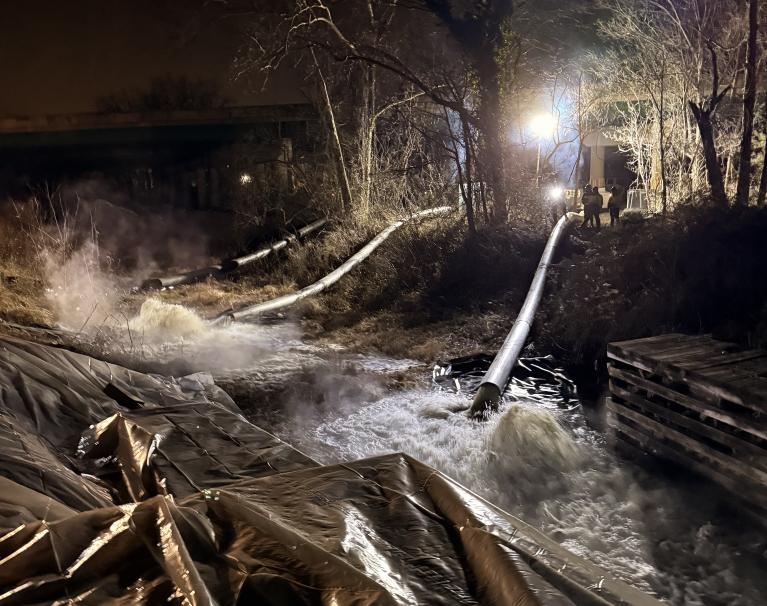
D.C. Water crews have worked around-the-clock to stop the overflow. They hauled in heavy equipment and installed eight industrial-sized pumps that reroute the wastewater around the damaged pipe about 125 feet away to an isolated section of the Chesapeake & Ohio Canal, where it is being redirected into the sewer line.
The canal’s locks 11, 12 and 13 were removed to accommodate the bypass, officials said. The sewage did not overflow onto the towpath, which remains open.
D.C. Water has not given an estimate on when the complex repair will be finished.
What caused the problem?
D.C. Water officials say they don’t know what caused the rupture.
The interceptor pipeline is part of an aging system. A 10-year, $625 million “high priority” project is underway to rehabilitate its “most vulnerable sections,” D.C. Water officials said.
John Lisle, a spokesman for D.C. Water, said the section where the collapse occurred was to undergo rehabilitation, but crews had not been working in that area. There was work recently completed about a quarter-mile from the site of the collapse, he said.
Is the region’s drinking water in danger?
No. D.C. Water’s drinking water system is separate from the wastewater system. The drinking water is “safe to drink and water service is NOT affected by this incident,” D.C. Water has said in a statement.
The primary intake facility for the Washington Aqueduct, which supplies drinking water from the Potomac to the region, is upstream from the sewage spill. As a precaution, an intake facility downstream remained closed after the spill was discovered, the U.S. Army Corps of Engineers said.
What will happen to wildlife? Are fish dying?
It is uncertain what will happen to wildlife in the area, experts said, and it could take time to see any harmful impacts.
Wastewater carries toxic chemicals, microplastics, pharmaceuticals, excess nutrients, viruses and bacteria — all things that can be harmful to fish and wildlife. Nutrients can drain oxygen quickly and contribute to fish kills and harmful algae blooms.
Some wildlife experts are worried that ducks, gulls and Canada geese overwintering in D.C. could be susceptible to bacteria and pathogens found in the sewage.
There could also be a cascading effect, biologists said, where invertebrates, including bugs, spiders, water beetles and worms, could die from bacteria in the sewage. Then, when shad, rockfish and other species eat those invertebrates in the spring they too could be impacted — creating a chain reaction that could lead to a reduction in wildlife populations.
Days after the spill, Dean Naujoks of the Potomac Riverkeeper Network, said his group had documented signs of fish kill.
Still, experts caution that it’s not a sky-is-falling scenario.
“Short term, this is a pretty bad spill,” said Gary Belan, a senior director of the national clean water program at American Rivers, a nonprofit based in D.C. “Long term, it could end up in sediment and soils.”
But, he and other experts said, the sewage will get diluted as it passes through the river — especially with the heavy snowmelt — and will wash away and eventually break down.
Is it safe to be near the river?
People — and their pets — are advised to avoid touching wastewater in the area and to seek medical attention if needed. Untreated sewage can cause a variety of illnesses.
Is the river being tested?
Yes. On Wednesday morning, a team of scientists from the University of Maryland took water, sediment and sewage samples from the river. They plan to check what microorganisms and pathogens are in the water and continue to check it for weeks, according to Rachel Rosenberg Goldstein, an assistant professor of public health at the University of Maryland who led the group. The scientists are also monitoring dissolved oxygen levels, which were significantly lower than normal seasonal levels at the spill site as of Wednesday — creating a hazardous environment for fish.
Already, there’s some cause for concern. Testing done just a few days after the spill found that E. coli levels were high in the water near the spill — more than 11,000 times the levels deemed safe for humans — and had dissipated significantly four miles down the river in D.C., though were still forty times safe limits, according to the Potomac Riverkeeper Network.
Christopher Brown, a spokesman for D.C. Department of the Environment, said Thursday in an email that “as far as we are aware this should not impact the city’s ultimate goal for a swimmable, fishable river, but we will be closely monitoring the river’s health going forward.”
Brown said it is “too early to tell what the situation will be by the summer, but we will be testing after the repairs are complete” and working with D.C. Water and other partners to “ensure the river will return to safe use.”
How much will this incident cost? And who pays for the cleanup?
Several engineers and environmental cleanup experts estimate that fixing the break — with the costs of equipment, overtime for workers and other related repairs — could cost between $5 million and $10 million.
Lisle of D.C. Water, said officials did not have an assessment yet of how much it will cost to cleanup and fix the ruptured pipeline. Lisle said D.C. Water — along with some of its wholesale customers, including Washington Suburban Sanitary Commission, Loudoun and Fairfax counties — will pay for the cleanup and repairs. The portions paid by D.C. Water’s wholesale customers, he said, will be based on the percentage of the capacity of the pipe they use.
D.C. Water is working with several partners from D.C.; Montgomery, Fairfax and Loudoun counties; state agencies; plus federal offices, including the Environmental Protection Agency, National Park Service and U.S. Coast Guard to contain the overflow and monitor environmental impacts — and many agencies have toured the collapsed site to see the ongoing cleanup operations, officials said.
The post Millions of gallons of sewage spilled into the Potomac. Here’s what we know. appeared first on Washington Post.