For nearly 50 years, research has shown that having a bachelor’s degree or higher led to better employment prospects, from higher pay to greater job security. Now, with the stability of white-collar work in question as U.S. companies embrace artificial intelligence, federal data suggests that’s beginning to change.
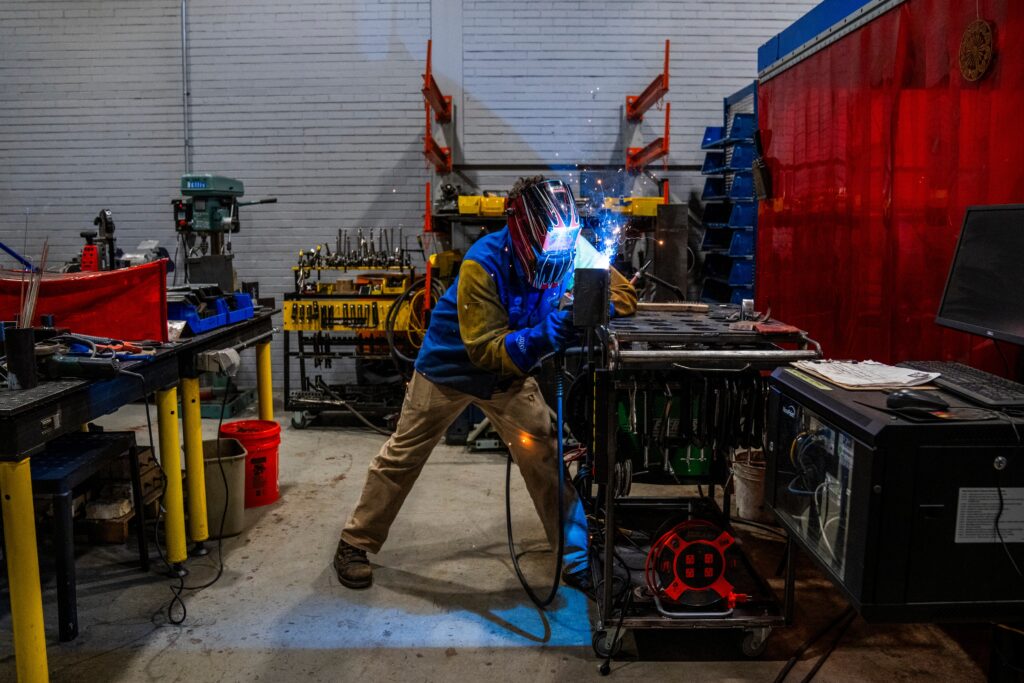
The unemployment gap between workers with bachelor’s degrees and those with occupational associate’s degrees — such as plumbers, electricians and pipe fitters — flipped in 2025, leaving trade workers with a slight edge for six months out of the past year, according to the Bureau of Labor Statistics. It’s the first time trade workers have had a leg up since the BLS started tracking this data in the 1990s.
This shift coincides with a broad reassessment of what the best career paths are in today’s labor market, which economists have called one of the most vexing in generations — especially for entry-level applicants. The soaring costs of a four-year degree, combined with an uncertain outlook amid the rise of AI, are prompting young people to consider alternative routes to economic prosperity. Community colleges and blue-collar employers are trying to harness the rising interest in skilled trades, amping up recruiting efforts aimed at young people.
With more students pursuing occupational and technical degrees in fields with labor shortages such as construction, manufacturing and health care, enrollment at community colleges rose 3 percent in the fall compared with the year before, according to data from the National Student Clearinghouse, more than double the growth seen at public four-year colleges. Enrollment at private four-year institutions declined by more than 1.5 percent.
“For decades, college graduates have typically faced lower unemployment rates, found jobs faster, and experienced more stable employment than high school graduates without college experience,” according to a 2025 report from the Federal Reserve Bank of Cleveland, adding that recent job data is “indicating that a long period of relatively easier job-finding prospects for college grads has ended.”
The unemployment gap between college and high school graduates has been narrowing since the 2008 financial crisis, BLS data shows. Workers with a bachelor’s degree or higher had a 2.8 percent unemployment rate in December, compared with 4 percent for high school graduates and 3.8 percent for those with some college or an associate’s degree. It’s the narrowest these gaps have been since the 1970s.
“Certainly, the softness we’re seeing in the labor market is mostly white-collar, mostly workers in business, professional services and technology,” said Laura Ullrich, director of economic research in North America at the Indeed Hiring Lab.
Fields such as manufacturing and construction have a legacy of constrained labor supply that’s coming to bear now, she added, because of a stigma that such jobs offered less professional success and economic stability. “But now the stigma’s being pulled back.”
Jeff Strohl, director of Georgetown University’s Center on Education and the Workforce, cast the shifts as a “historic anomaly.”
“The question becomes, are we talking about a structural break? Is this in any way indicative of what the world is going to look like in two or three years?” Strohl said.
His research suggests not. The center’s “Future of Good Jobs” report predicts that “economic opportunity will increasingly favor workers with higher levels of education and training” in the next five years. It puts the median pay of a “good job” at $82,000.
By 2031, only 15 percent of good jobs will be available to workers on the high school pathway, the report says, compared with 66 percent for those with a bachelor’s degree and 19 percent for those who have more than a high school diploma but less than a four-year degree.
The last time workers with a high school education dominated the U.S. economy was in the 1970s, Strohl explained, when a decades-long manufacturing boom was winding down and computers had yet to transform the workplace. During the 1980s, Strohl said, as manufacturing struggled and technology took off, guidance counselors began to funnel students, especially high-performing ones, toward pursuing four-year degrees.
Those not bound for college were guided toward technical education programs, many of which offered little opportunity for growth and were “highly susceptible to economic shocks” wrought by the rise of automation and other forces, he noted.
“Overdoing college for all has done a disservice to many,” Strohl said. “What we didn’t do was set up viable alternative pathways for students to succeed, to the detriment of the economy and the detriment of those students.”
Now, according to a January report from Associated Builders and Contractors, the construction industry needs to attract 349,000 net new workers this year.
Anirban Basu, chief economist with ABC, said interest in the skilled trades is rising, particularly among younger workers whose parents were saddled with hefty student debt. The total average balance for U.S. student loan borrowers is estimated to be more than $42,600, according to the Education Data Initiative.
Meanwhile, mean hourly wages for plumbers, pipe fitters, electricians and boilermakers — all of which typically require apprenticeships — eclipsed the overall hourly mean wage for U.S. workers in 2023, which was about $31.50, according to BLS data. The highest-paying role requiring an apprenticeship, elevator and escalator repair, earned an hourly mean of more than $48.
Young people “are realizing the world is changing; they’re seeing more and more college grads working as baristas,” said Basu, whose group represents more than 23,000 general contractors and construction firms. He added that “many are quite savvy in recognizing that AI doesn’t threaten the blue-collar workforce the way it threatens the livelihoods of the white-collar workforce.”
Workers ages 22 to 25 have seen a 13 percent drop-off in employment in the most AI-exposed occupations — such as software developers and customer service representatives — since 2022, according to recent research from Stanford University.
C-suite leaders are fueling worker anxiety. Anthropic’s Dario Amodei has said he thinks AI will wipe out about half of entry-level white-collar roles in the next five years. In a December interview, LinkedIn CEO Ryan Roslansky argued that having a five-year career plan is “outdated” and “a little bit foolish” in an era when workers should be more adaptable, given that “technology and the labor market and everything is moving beneath you.”
Community and technical colleges are seeing an influx of interest as tides turn, including among mid-career workers.
Galen DeHay, president of Tri-County Technical College in South Carolina, said enrollment in the fall was up 4 percent compared with 2024, attracting students in advanced manufacturing, health care, business administration and computer service. Programs such as nursing have extensive wait lists.
Nearly 10 percent of the college’s students already have bachelor’s or master’s degrees, he noted, which is much higher than in the past and reflects mid-career workers seeking new skills in the age of AI.
Young people are seeking out dual-enrollment programs in nursing, HVAC, welding and other disciplines, DeHay said, which allow students to build skills and rack up certifications at low or no cost during high school, and then, “by 19, they’re in the workforce.”
“Whether students are younger or older,” DeHay said, “one of the first things they want to know is, ‘What am I going to make when I come out and where can I go immediately?’”
At 21, Caleb Clement already has an associate’s degree in mechatronics from Tri-County and a job he loves at the BMW plant in Spartanburg, South Carolina.
Clement joined the robotics team in middle school, having grown up transfixed by the Transformers movies. In high school, he took part in Tri-County’s dual-enrollment programs, building mechanical and electrical skills and learning advanced math and equipment safety at no cost. The school also trained him in networking and interviewing — how to dress professionally, shake hands, make eye contact — which he said has served him well in forging a career path.
Now, through the BMW Scholars Program, he splits his time between coursework and night shifts at the plant, where he maintains the robots that help assemble everything from windowsills to body panels. Every day, Clement said, “I’m doing something new.”
“I get to genuinely go into work and work with my hands, but I’m also working with my mind,” Clement added. “Don’t just think we’re turning wrenches.”
Many blue-collar companies are also focusing their recruiting efforts on younger people to meet the moment.
Power & Construction Group, a New York-based contractor that works on utilities, recently opened a new 15,000-square-foot training center replete with simulators and other high-tech training equipment. Construction is a maturing industry — the median worker age in 2023 was 42, according to data from the National Association of Home Builders — so the firm’s vice president, Thomas Murphy, said outreach to “younger and younger” ages is a top priority.
“Our customers keep asking us to do more, but until we can get more people and get them properly trained, we can’t take on that work,” Murphy said.
He recently arranged for 80 fifth-graders to explore the training center — where existing employees come for safety and training courses. He also devotes time to talking with high school guidance counselors about opportunities for students in the trades.
Like DeHay, Murphy is noticing that incoming workers are more focused on long-term professional pathways than those in the past, which marks “a major change,” he said. Many want to know how they can progress from being laborers to owning their own firms.
“We can show them a career path, and that’s a retention tool.”
The post For the first time in 50 years, college grads are losing their edge appeared first on Washington Post.