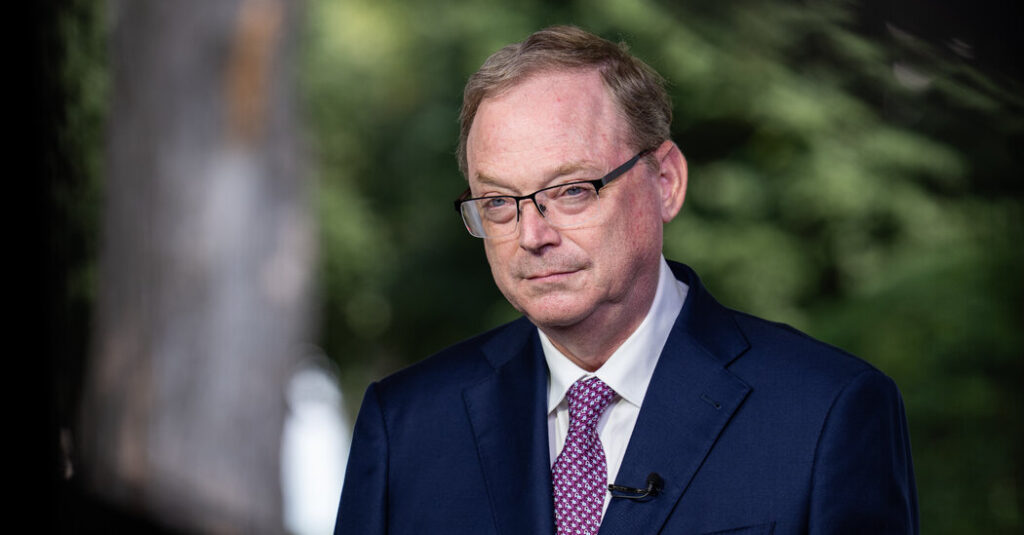
For Kevin A. Hassett, his loyalty to President Trump was seen as his most valuable asset once auditions began to become the next nominee to lead the Federal Reserve.
But that proximity ultimately morphed into his biggest liability, leaving Mr. Hassett on Friday to lose out on one of the most powerful roles overseeing the U.S. economy.
In the end, Mr. Trump’s decision evinced both the risk and reward for an economist whose previous views had morphed in service of the White House and its economic agenda. The president did not want to lose one of his most forceful champions, whose full-throated advocacy had won deep praise from Mr. Trump but had fueled fears that Mr. Hassett could not guide monetary policy while resisting political influence.
Offering his first public comments on the decision, Mr. Hassett on Friday thanked Mr. Trump on CNBC for his praise and commended Kevin M. Warsh, the president’s new Fed nominee, as a “great choice” for the job. He also offered a few clues about the timeline that ultimately led to Mr. Trump’s final decision to keep him as the director of the National Economic Council, known as the N.E.C.
“When the president and I talked about me being the candidate, it was really all about, you know, if I left, then what would happen to N.E.C., and so on,” Mr. Hassett said. “At one point, the president said, ‘Well you didn’t ask me for the job, you never asked me for the job,’ and the point is, I said, ‘I want to do what you want me to do, sir.’”
Remaining at the White House, it will still fall to Mr. Hassett to see through the continued implementation of the president’s agenda, at a moment when Republicans are bracing for a difficult slog through the midterm elections — with voters unhappy with the economy and the stubbornly high cost of everyday goods.
Mr. Hassett on Friday reprised the role of loyal foot soldier. He predicted that the president’s recent tax cuts and other policies would lead to a surge in growth this year. He briefly teased what might yet be “possible tax legislation” to come, though he did not elaborate. And he heralded a coming investment boom in the United States, echoing his past defense of the president’s trade policies.
No matter which of the Kevins Mr. Trump ultimately chose, his next pick to lead the Fed was always bound to become a political lightning rod, especially for Democrats who believe the president has vastly overstepped his authorities in applying pressure to the nation’s central bank.
Congress granted the Fed the autonomy to ensure its officials set interest rates in pursuit of low, stable inflation and a healthy labor market, rather than in a bid to benefit the president or cater to the whims of electoral politics. But Mr. Trump has regularly encroached on that tradition in his repeated attacks on Jerome H. Powell, the current Fed chair, whose term in leadership expires in May.
With frequent threats or efforts to fire, investigate and pillory policymakers at the central bank, Mr. Trump has waged a remarkable campaign in his second term to force down interest rates perhaps by as much as three percentage points, far lower than what many economists believe is appropriate. Just this week, the Fed voted 10 to 2 to leave borrowing costs unchanged, infuriating Mr. Trump once more, even as most on the central bank believed caution would better suit the economy.
The broadsides against the Fed added to the political weight on all of Mr. Trump’s candidates for chair, especially Mr. Hassett, given his proximity to the president. Even though he had maintained that he would listen to, but not always act on, Mr. Trump’s views about monetary policy, he faced a steady stream of questions about whether he could truly resist the president’s influence.
“The idea that being close to the president and serving the president well disqualifies someone for any job just doesn’t make any sense to me,” Mr. Hassett told reporters outside the White House last month, as speculation intensified that he might win the job.
Even Mr. Hassett’s supporters acknowledged over the monthslong vetting process that it would be a difficult yet navigable challenge for him to keep the Fed truly insulated from the White House.
“There’s nobody on the planet who’s going to be able to have free rein here,” Mark Zandi, the chief economist at Moody’s Analytics, said before Mr. Trump chose Mr. Warsh. “It’s about who can navigate the hurdles the best, and I think he’s well situated.”
“If anyone’s going to be able to maintain some semblance of Fed independence, it’s got to be someone like him,” Mr. Zandi continued, referring to Mr. Hassett. “If it’s not someone the president trusts, there’s just no possible way that happens.”
Similar complaints had dogged another Fed governor, Stephen I. Miran, who took a leave of absence from the White House in September to join the central bank for a temporary term. In a break with many of his colleagues, Mr. Miran has called for setting interest rates around 2 percent, and most recently, he broke with a majority of his peers as the Fed voted to keep rates unchanged.
Mr. Miran’s stint officially concludes after January, but it could be extended until another governor is confirmed by the Senate. Whether that is Mr. Warsh or another candidate remains unclear. It will depend on an unfolding game of musical chairs that hinges on Mr. Powell and whether he will serve as a governor once his term as chair expires.
Mr. Hassett, for his part, shared with Mr. Trump a criticism of the Fed and its policies under Mr. Powell. The White House adviser expressed those views frequently on television, where he also highlighted the president’s arguments about the strength of the economy — insisting that tariffs were not inflationary, for example, and that deportations would benefit the labor market.
The interviews delighted Mr. Trump, but they sowed doubts among several of Mr. Hassett’s peers, some of whom came to find his current policy stances unrecognizable from the classic conservative economic principles he used to espouse.
“It’s one thing when it comes out of Donald Trump’s mouth, but when it comes out of a trained economist who knows better, it’s very, very disconcerting,” said Alan S. Blinder, who served as vice chair at the Fed in the 1990s. “There’s a huge credibility deficit.”
By January, though, Mr. Hassett appeared to be the front-runner to lead the Fed, sitting ahead of a set of candidates who continued to interview for the job. But the political winds appeared to shift once Mr. Powell revealed that he was under investigation by the Justice Department, an inquiry focused on a renovation of the Fed’s headquarters that the Trump administration long saw as wasteful.
The inquiry set off broad, bipartisan concern — including on Capitol Hill, which must confirm the new chair — that Mr. Trump might jeopardize the integrity of the central bank. It was against that backdrop that Mr. Trump days later began to muse aloud about keeping Mr. Hassett at the White House, where he could continue his public advocacy for the administration and its agenda.
The president reaffirmed that belief on Friday, telling reporters shortly after announcing Mr. Warsh as his pick for the Fed, “I wanted to keep Kevin here.”
Mr. Hassett insisted on Friday on CNBC that he already had a “dream job” at the White House. Asked if at any point Mr. Trump had ever demanded that he lower interest rates as a condition for the job he did not receive, Mr. Hassett said, “I guess if he had asked me to be Fed chair, then at that point that conversation might have begun.”
Pressed if any assurances were made, before Mr. Trump tapped Mr. Warsh, Mr. Hassett replied, “You’ll have to talk to Kevin about that.”
Colby Smith covers the Federal Reserve and the U.S. economy for The Times.
The post For Hassett, Loyalty to Trump Became a Liability in Fed Race appeared first on New York Times.