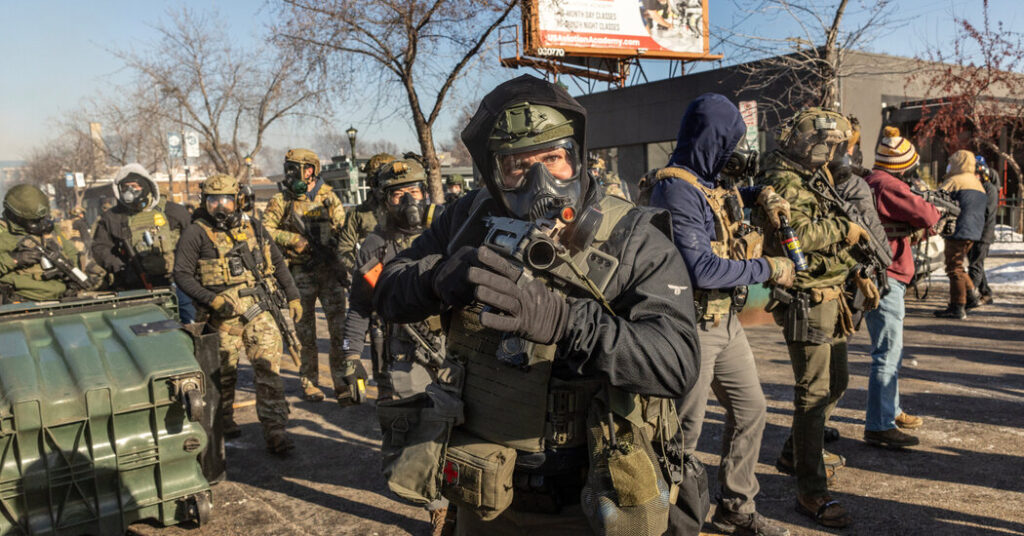
A federal judge in Minnesota denied a request by the state government and the cities of Minneapolis and St. Paul on Saturday to temporarily block a surge of federal immigration agents that has led to three shootings, thousands of arrests and weeks of protests.
The judge, Kate M. Menendez, who was nominated to the bench by President Joseph R. Biden Jr., had resisted requests by state lawyers for an immediate ruling on halting the Trump administration’s immigration enforcement campaign, known as Operation Metro Surge, which began late last year.
The state and the cities argued in a lawsuit filed on Jan. 12 that the decision to send some 3,000 immigration agents to Democratic-led Minnesota over the objections of local officials amounted to a violation of state sovereignty under the 10th Amendment. They also described the deployment as an illegal attempt to coerce them into cooperating with civil immigration enforcement. The Trump administration dismissed that legal theory and defended their actions as a lawful campaign to crack down on illegal immigration.
Judge Menendez wrote that the state and local governments had failed to show that the deployment crossed a constitutional line and therefore had not met the burden for a preliminary injunction.
“Plaintiffs have provided no metric by which to determine when lawful law enforcement becomes unlawful commandeering, simply arguing that the excesses of Operation Metro Surge are so extreme that the surge exceeds whatever line must exist,” she wrote, referencing a courtroom exchange with a lawyer for the state. “A proclamation that Operation Metro Surge has simply gone ‘so far on the other side of the line’ is a thin reed on which to base a preliminary injunction.”
The Department of Homeland Security and the Minnesota Attorney General’s Office did not immediately respond to requests for comment on Saturday.
The lawsuit was filed days after a federal agent in Minneapolis shot and killed Renee Good, a U.S. citizen. After the first hearing on the case, agents shot two more people in the city. On Jan. 14, an agent shot and injured a Venezuelan man who officials said was in the country illegally and had resisted arrest. And last Saturday, agents shot and killed Alex Pretti, a U.S. citizen and intensive-care nurse.
Lindsey Middlecamp, a lawyer for the state, reiterated the call for swift action in a court hearing on Monday, asking the judge to stop what she called an “invasion” of federal agents.
Ms. Middlecamp called on the judge to “issue a temporary restraining order today. Not tomorrow. Not next week. Today.” Hours after the hearing ended, Judge Menendez requested an additional written brief from the federal government and gave them until Wednesday evening to file it.
Judge Menendez said in court that “I think it goes without saying that we are in shockingly unusual times.” But she pressed lawyers for the state to explain when, in its view, the federal government deploying federal agents to enforce federal law could become a constitutional affront. The state did not seek an end to all immigration enforcement in Minnesota, only a return to the levels seen before the surge.
Though she rejected the request for an injunction, Judge Menendez expressed concern about the impacts of the surge and tactics used by federal agents, writing that there was evidence that “agents have engaged in racial profiling, excessive use of force and other harmful action.”
“Plaintiffs have made a strong showing that Operation Metro Surge has had, and will likely continue to have, profound and even heartbreaking, consequences on the State of Minnesota, the Twin Cities and Minnesotans,” the judge wrote.
In court this week, Brantley Mayers, a lawyer for the Trump administration, described the request for an order blocking the surge as “a pretty staggering remedy.” Mr. Mayers noted that Congress had passed immigration laws and that President Trump had campaigned on a promise to crack down on illegal immigration. He also pushed back against the state’s claims that political retribution or coercion was motivating the crackdown.
“There is nothing to back up this claim that we’re here for another reason,” Mr. Mayers said, insisting that immigration enforcement was the reason for the surge.
Judge Menendez referred to a social media post by President Trump that mentioned Minnesota and said “THE DAY OF RECKONING & RETRIBUTION IS COMING!” She also asked repeatedly about a letter sent by Attorney General Pam Bondi to Gov. Tim Walz that outlined several policy demands for the state related to immigration enforcement, welfare programs and a request to hand over voter rolls.
While other states have brought 10th Amendment lawsuits against the federal government over the years, lawyers for both sides struggled to find direct parallels for the claims being made in this case.
Brian Carter, a lawyer for the state, said that “this situation is unprecedented in the 250-year history of our country.” He claimed the deployment of immigration agents — which he called “essentially an army” — was intended to “basically stir the pot with conduct that is pervasive and includes widespread illegal violent conduct.”
Mr. Mayers countered that it was well within the president’s rights to deploy federal law enforcement agents within the country as he saw fit.
Mitch Smith is a Chicago-based national correspondent for The Times, covering the Midwest and Great Plains.
The post Federal Judge Denies Request to Block ICE Surge in Minnesota appeared first on New York Times.