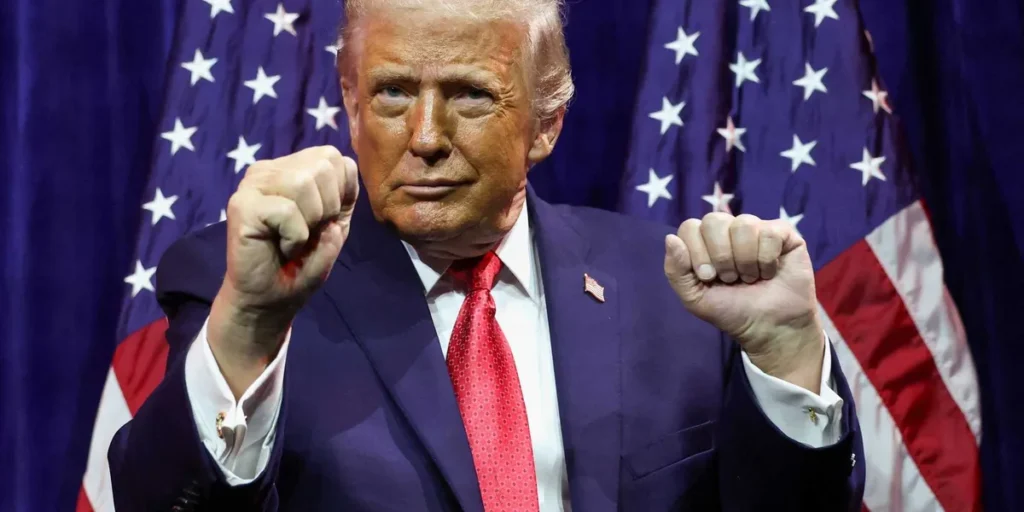
The New York Times issued a full-scale alarm Saturday as fears that Donald Trump and his allies moving to rig the midterm elections reached fever point.
The newspaper’s editorial board warned readers they couldn’t be complacent, days after the president’s FBI swooped in Georgia in a supposed investigation into the validity of the 2020 election, which Trump has long argued — contrary to all evidence — was stolen from him.
“For every election, thousands of principled election officials painstakingly update voter rolls, mail information to households, train poll workers, oversee voting and transport ballots with a documented chain of custody,” the editors wrote. “Voter fraud is extremely rare, and voter turnout in the past two presidential elections reached higher levels than in any other over the previous century.”
And yet, they went on, November’s midterms face significant threat. Trump has demonstrated consistent willingness to interfere with electoral processes and, since entering politics a decade ago, he has suggested election outcomes are legitimate “only if his side wins.”
Trump’s 2020 actions escalated these patterns. After losing the presidential election, “he attempted to direct a sprawling conspiracy to overturn the result.” As this effort failed through the integrity of election administrators from both parties, “he encouraged protesters to march to Congress when it was meeting to certify his defeat — and later celebrated their violent attack,” the editors remembered.
Since returning to the presidency, Trump has escalated his approach. He “has pushed for extreme gerrymandering of congressional districts, outside the normal 10-year cycle, to help Republicans hold the House even if most voters want them out.” His Justice Department is “building an unprecedented database of voter information that experts fear the administration may use to cast unfair doubt on voters’ eligibility.”
Most dramatically, Trump “recently told The Times that he regretted not sending the National Guard to seize voting machines after the 2020 presidential election.”
The recent swoop in Atlanta amplifies these concerns, the editors wrote. FBI agents searched an election center over baseless fraud accusations from 2020, with Trump’s director of national intelligence Tulsi Gabbard accompanying them. Analysis indicates the search “could be used to justify a forced takeover of the elections operation” in Georgia’s most populous county.
“To look at this pattern and conclude that the 2026 midterm electionsare safe is to leave American democracy exposed,” the editors wrote.
“In a divided country where many elections are close and congressional control could come down to a handful of races, a local disruption affecting turnout or vote counting could have national consequences. If you are somebody who has previously dismissed talk of election interference as overwrought, we understand where you are coming from. Yet we urge you not to assume that the past will repeat itself.”
This pattern demonstrates Trump’s willingness to deploy federal power — “prosecutors, national security officials, National Guard members and F.B.I. and immigration agents”— for political purposes, the editors wrote.
The editors suggested multiple tactics to stop potential election corruption. They recommended working as poll workers, serving as election observers, and avoiding disinformation spread. Ford Foundation president Heather Gerken noted that “influential disinformation often arrives via a well-meaning peer rather than a random bot.”
Supporting organizations defending election integrity is critical. These nonpartisan groups include the Election Official Legal Defense Network, which “pairs election officials with pro bono attorneys who can advise them on how to respond to threats and lawsuits, which have increased in recent years.” The Campaign Legal Center “is fighting the Trump administration’s demands for voter data and an executive order that would force states to change voter ID requirements and ballot deadlines.”
The analysis concluded by referencing Ronald Reagan’s observation that orderly authority transfer “was a commonplace occurrence to most Americans but was nothing less than a miracle to much of the world.” It emphasizes: “Our elections remain both commonplace and miraculous. This country should be proud that it can feel so routine for a citizen to drop a ballot in the mailbox or walk down the street to cast a vote. In 2026, we should guard that tradition.”
The post Code red issued as NY Times declares midterms in serious risk from Trump appeared first on Raw Story.