China’s leader, Xi Jinping, has said that great danger and opportunity often arrive together. That is acutely true for him now that he has eviscerated the Chinese military’s high command, leaving a void that he is expected to fill with a new generation of handpicked loyalists.
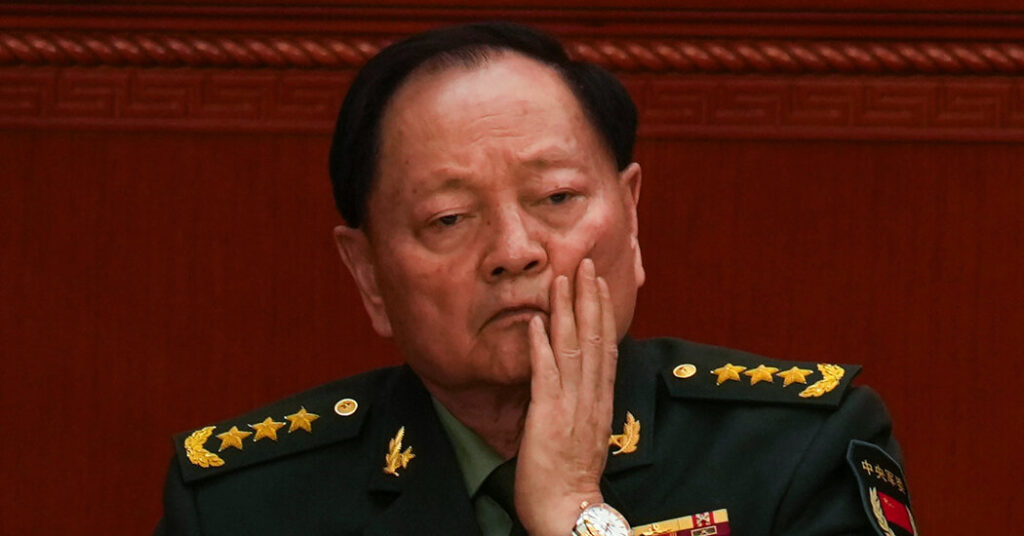
The purging of China’s top general, Zhang Youxia, last week, was a stunning display of Mr. Xi’s autocratic dominance over the military, the ultimate source of power for Chinese leaders. But the hollowing out of the People’s Liberation Army’s leadership also complicates Mr. Xi’s longstanding ambition to bring Taiwan under Beijing’s control, by force if he deems it necessary.
A pressing concern for Mr. Xi will be how the upheavals affect a 2027 milestone he has set for modernizing the military and also — according to some American intelligence officials — for gaining the ability to successfully invade Taiwan.
Mr. Xi’s swift ousting of General Zhang and another senior commander, Gen. Liu Zhenli, who have been accused of “grave violations of discipline and the law,” gives him virtual carte blanche to choose a new cohort of commanders. Dozens of generals and admirals have been detained or have disappeared over the past three years.
“Xi has wiped the table clean,” John Culver, a former Central Intelligence Agency analyst who is now a nonresident senior fellow at the Brookings Institution, wrote in an email.
“He tried incremental reforms while largely trusting the P.L.A. to manage military affairs,” he wrote. “By last year, he concluded that failed. Something entirely new is coming.”
But Mr. Xi will probably need years to nurture a new generation of younger officers he can trust. The resulting delay and disruption could set back Mr. Xi’s military goals and sap his confidence that the People’s Liberation Army will be able to subjugate Taiwan in the coming years, some experts said.
Already, the turmoil appears to be slowing the military’s momentum, Mr. Culver argued, noting that some public exercises that take place every year seem to have been postponed. In Mr. Culver’s view, the Chinese leader may become more hesitant, not more belligerent, when it comes to Taiwan.
“For Xi Jinping,” Mr. Culver said, “Taiwan is a crisis he needs to avoid, not an opportunity he wants to seize.”
The vacancies at the top of the military command present Mr. Xi with a choice that will shape the prospects for a war over Taiwan. Which officers he promotes and how much he trusts them could define how a rebuilt Chinese high command navigates a future crisis, experts said.
The danger, some analysts say, is that new commanders may lack the confidence and authority to give Mr. Xi candid military assessments.
“If Xi Jinping gets bad advice, if he miscalculates because he’s got sycophants telling him what he wants to hear, not what he needs to hear, that’s risk number one,” said Drew Thompson, a former Pentagon official who hosted General Zhang and other Chinese senior officers on a visit to the United States in 2012.
General Zhang had seemed especially close to Mr. Xi. Both men are sons of revolutionary army commanders who had fought alongside each other. Mr. Xi promoted General Zhang, making him an ally in his efforts to clean up and remake the military into a 21st century force. He kept him on as a vice chairman of the Central Military Commission in 2022, even past the retirement age, and promoted him to be China’s most senior full-time commander.
Publicly, General Zhang was a staunch defender of Mr. Xi’s core mission to bring Taiwan under Beijing’s sovereignty. When he met with U.S. officials in 2024, he laid down a hard line, said Sarah Beran, who attended the meeting as a senior director for China and Taiwan Affairs at the National Security Council.
He delivered a “clear warning on Taiwan and a defensive framing of the Chinese military buildup: China did not seek a fight with the United States, but if the U.S. started one, China would fight to the end,” Ms. Beran, who is now a partner at Macro Advisory Partners, wrote in an email.
What prompted Mr. Xi to move against the two generals remains unclear. An editorial in the Chinese military’s newspaper indicated that they were accused of corruption and of undermining Mr. Xi’s command, but it offered no specifics. Such wording suggested that the rupture between Mr. Xi and General Zhang may have involved disagreements or friction over how to implement Mr. Xi’s goals, some analysts said.
General Zhang oversaw operations as senior vice chairman of the Central Military Commission while General Liu, as commander of the Joint Staff Department, was heavily involved in planning for exercises and operations.
Their simultaneous downfall on identical accusations suggested that Mr. Xi may have seen them as acting in cahoots against him, said Mr. Thompson, the former Pentagon official, who is now a senior fellow at the S. Rajaratnam School of International Studies at Nanyang Technological University in Singapore.
In Mr. Xi’s inner circle, “small slights can become big ones,” Mr. Thompson said. “If Xi Jinping was sensitive to disagreements he had with Zhang Youxia, then even rather small differences could get amplified to a threat or affront in Xi’s own mind.”
By lopping off so much of China’s previous military leadership, Mr. Xi has shown that he wants to build a new generation of generals untainted by the failings he sees in their predecessors. There are already signs of this transition in motion. In December, he appointed new commanders to two theaters, including the Eastern Military Region, which is responsible for operations around Taiwan.
Just over a week after the appointments, the Eastern Region held two days of menacing exercises around Taiwan. Mr. Xi seems to want to demonstrate that despite all the chaos in the military command, it would be a mistake to think that the People’s Liberation Army cannot fight if he commands it to.
Even in its politically wounded state, the Chinese military would likely be prepared to conduct operations, said David Finkelstein, a Distinguished Research Fellow and expert on the Chinese military at CNA, a research organization in Arlington, Virginia. Preparation for military campaigns and exercises is the responsibility of the regional joint theater commands, at least partly insulating the preparations from upheavals in Beijing, he said in an interview.
“For folks in Taiwan, they have to assume that they need to do what they need to do for their own national defense and not tie it to political developments out of Zhongnanhai,” Mr. Finkelstein said, referring to the Chinese Communist Party headquarters in Beijing.
Chris Buckley, the chief China correspondent for The Times, reports on China and Taiwan from Taipei, focused on politics, social change and security and military issues.
The post Xi’s Military Purge May Set Back His Taiwan Ambitions appeared first on New York Times.