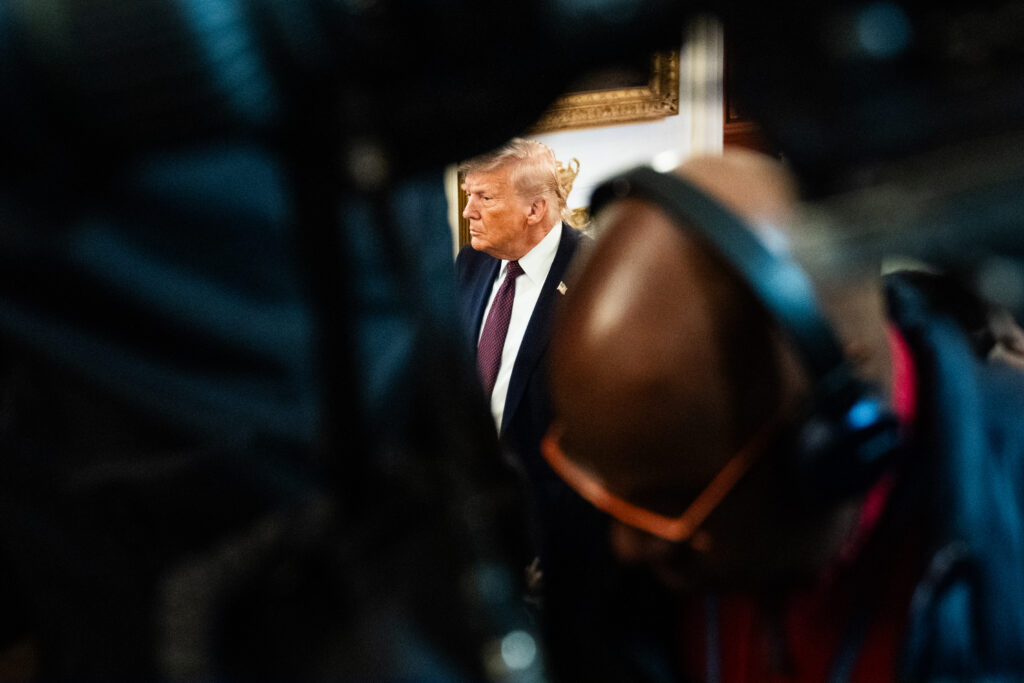
As the Supreme Court prepares a landmark ruling about the scope of presidential power, the current president is acting more unleashed than any predecessor. He is demonstrating that a president not self-restrained by his or her constitutional conscience is almost unrestrainable.
The court case concerns whether presidents have the power to remove, for any reason, all principal officers of executive agencies exercising significant executive power. The ruling will emphatically bolster or substantially quarantine the “unitary executive theory.” It holds that all executive power is vested in the president, who exercises sole authority over executive branch activities. The theory says Congress has no authority to limit the president from exercising command over administrative policymaking by denying the president’s power to remove agencies’ principal officers.
The Framers could have, but did not, limit the president’s removal power. Some unitary executive advocates construe this silence as implied permission. Jurist James Kent wrote to Daniel Webster in 1830: “the power to appoint and reappoint, when all else is silent, is the power to remove.” James Madison said “the power to annul an appointment is in the nature of things incidental to the power which makes the appointment.” And Madison said the presidential duty to “take care that the laws be faithfully executed” entails the power of removing subordinates to accomplish this.
Furthermore, the Constitution’s opinions-in-writing clause says: “The President … may require the Opinion, in writing, of the principal Officer in each of the executive Departments.” This is an empowerment, not a duty: “may” means it is the president’s choice.
University of Virginia law professor Saikrishna Bangalore Prakash, in “Imperial from the Beginning: The Constitution of the Original Executive,” notes that a principal official has an “opinion,” but the president decides. In “The President Who Would Not Be King: Executive Power Under the Constitution,” Stanford law professor Michael W. McConnell says the opinions-in-writing clause “prevented Congress from trying to make the heads of departments independent of presidential oversight.” Hence, the clause is “further evidence” that the court erred in its unanimous 1935 ruling “that some regulatory agencies can be made ‘independent’ of the president.”
But the argument against an unlimitable removal power is stronger. Even if the Constitution’s silence about the president’s general removal power, or the vesting clause, implies such a power, why cannot Congress stipulate, in laws the president is duty-bound to faithfully execute, exceptions to that power? University of Virginia law professor Caleb Nelson argues that Congress can decide when limiting the reasons the president can remove officers is “necessary and proper” for the intended functioning of laws it passes:
“The power to execute the law is itself subject to the law.” Besides, “Congress is in charge of creating offices within the executive branch,” and the president has no unlimited power to dictate how — or for how long — those who fill those offices shall perform their duties. Congress can decide some necessary and proper limits on presidential power that the Constitution does not stipulate.
The unitary executive theory charges that “independent” agencies are insulated from accountability. But voters can hold both Congress and the president accountable for the administrative state’s behavior. And Nelson, a self-described constitutional “originalist,” adds:
“If most of what the federal government currently does on a daily basis is ‘executive,’ and if the President must have full control over each and every exercise of ‘executive’ power by the federal government (including an unlimitable ability to remove all or almost all executive officers for reasons good or bad), then the President has an enormous amount of power — more power, I think, than any sensible person should want anyone to have.”
If the court gives its imprimatur to a strong version of the unitary executive theory, presidential power will become even more formidable and less circumscribable than current events reveal it to be. This is a recipe for enhanced presidentialism — more government by executive fiats, more president-centric politics, more congressional anemia.
As Nelson says, the Constitution’s provisions concerning presidential power “are far more equivocal than the current Court has been suggesting … I hope the Justices will not act as if their hands are tied and they cannot consider any consequences of the interpretations that they choose.”
Yes. When considering the logic of our constitutional structure, the justices should not disregard their conclusions’ likely consequences for the nation’s political practices and civic culture. Quoting a member of Congress in 1789, the year the Constitution was adopted, Nelson warns against “interpretations of the Constitution that ‘legaliz[e] the full exertion of a tyrannical disposition.’”
The post With this decision, the Supreme Court can and should rein Trump in appeared first on Washington Post.