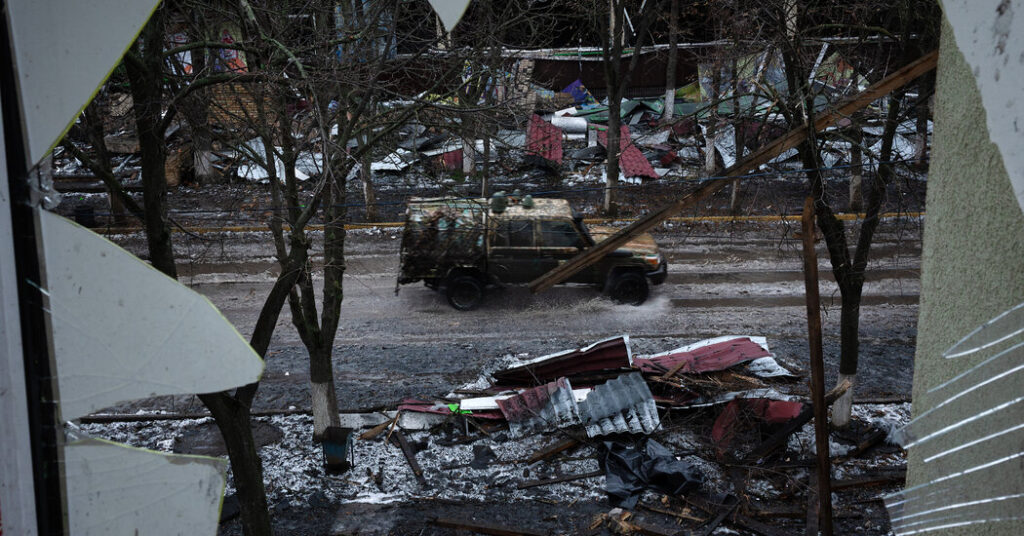
As their lines began to buckle, the Ukrainian units hunkered down in the small town of Huliaipole, bracing for an assault.
It came under cover of fog, with Russian troops slipping into the town by moving along a river that bisects it. Drawn by the hum of a generator, they charged into a Ukrainian command post. A firefight erupted. Caught off guard, the soldiers defending the post retreated, leaving behind laptops and battlefield maps that exposed the positions of nearby Ukrainian drone operators. Soon enough, those teams came under heavy Russian fire.
“It was a catastrophe,” said Capt. Dmytro Filatov, commander of the Ukrainian First Separate Assault Regiment, whose unit was rushed in to reinforce Huliaipole, in southeastern Ukraine.
The fall of the command post in late December — recounted by Captain Filatov, who said he tracked it through radio communications — highlights the central challenge facing the Ukrainian Army after four years of grinding war. Stretched by Russian assaults across a 700-mile front line, Ukraine lacks enough troops to defend every sector equally, creating gaps where Moscow’s forces can advance more easily.
For most of the past year, Ukraine has concentrated the bulk of its forces on holding cities in Donetsk, the eastern region that Russia says it must fully control, by force or through negotiations, before any settlement to end the war. Given the strategic and political imperatives in Donetsk, Ukraine has left a vast stretch of land to the west, including Huliaipole in the Zaporizhzhia region, thinly defended and vulnerable.
In November and December, Russian forces made their biggest advances in Zaporizhzhia and the neighboring Dnipropetrovsk region, seizing nearly 170 square miles of territory, according to Pasi Paroinen, a military analyst for the Finland-based Black Bird Group, which tracks the front line in Ukraine. That is about 20 percent more than in Donetsk during the same period.
The Russian Army now controls at least half of Huliaipole, according to battlefield maps. “The Ukrainians simply don’t have the resources to defend everywhere,” Mr. Paroinen said.
Ukrainian forces do not appear to be in imminent danger of a collapse in Zaporizhzhia that would allow Russian troops to sweep deeper into Ukraine. Even as Moscow’s gains quicken in the region, they remain modest. In 2025, Russia captured less than one percent of Ukraine’s overall territory.
But Ukrainian soldiers say the situation has forced them to wage war like firefighters — rushing to contain a flare-up in one sector, only to see another ignite elsewhere, then running back as the first combusts again. The goal is not to cling to every inch of territory, they say, but to hold enough to deny Russia battlefield momentum that would strengthen its hand in U.S.-brokered peace talks, which are continuing this weekend in the United Arab Emirates.
“We go where the fire breaks out,” Captain Filatov, a tall, mustachioed man, said as he directed troops from an underground command post near Huliaipole, lined with screens streaming drone footage from the battlefield.
‘Nothing to Shoot With’
Despite its location near the front line, Huliaipole had escaped Russian assaults for years.
Its situation mirrored that of the rest of the Zaporizhzhia front: tense, with both armies facing each other, yet largely stable as most fighting remained concentrated in neighboring Donetsk. To guard Huliaipole (pronounced hoo-lyai-PO-leh), Ukraine stationed poorly trained units from the Territorial Defense, an army branch made up mostly of civilian volunteers.
Residents who stayed in Huliaipole described a life lived in the shadow of the front. With all the shops closed, Svitlana Lystopad, 70, bought food in a nearby village and stored it at home, along with firewood. “The cellar was full,” she said. “Completely full.”
She grew used to the occasional shelling. “I would lie in bed and not even hide,” she said.
Then, starting this fall, Ms. Lystopad began hearing a new sound, one that usually foreshadows Russian assaults: the buzz of small kamikaze drones. “You step outside, just one step off the porch, and it’s already hovering over you,” she said, recalling one attack. “It buzzed, then flew to the neighbor’s house — bang! — and destroyed it.”
Ms. Lystopad soon realized that Huliaipole had little chance of holding out. The 102nd Territorial Defense Brigade, the unit defending the town, she said, had little to fight with. “There was one artillery gun. Once every other day, it would stand on our street, fire maybe 10 shots — and that was it,” she said. “No firepower. Nothing to shoot with.”
In the weeks before she was evacuated from Huliaipole, in mid-November, she watched soldiers trudging through yards to reach the front because no vehicles were left to carry them. At first, troops rotated every three days, she said, “Then a week. Then two weeks. Then a month.”
“What does that tell you?” she asked. “That there were no people left. No one to replace them.”
An officer from the 102nd Brigade, speaking on the condition of anonymity to discuss a sensitive situation, denied that the unit faced critical shortages of weapons and manpower. A brigade spokesman declined to comment because the unit was under investigation for losing the command post.
Angel of Death
Just as Ms. Lystopad fled the town, the Ukrainian Army announced that it had withdrawn from five settlements north of Huliaipole. The rare admission underscored the worsening situation. Only then did Ukraine rush in reinforcements, said Mr. Paroisen, the military analyst.
Captain Filatov arrived near Huliaipole from Donetsk around early December. He found that positions on the town’s northern edge that he had been told were held by Ukraine had actually fallen to Russia. Some units had not reported the losses for fear of retribution, he said, showing the lost positions on a map spread across a table at his command post.
His regiment and other units had to counterattack. That meant advancing across a battlefield filled with attack drones that swooped down on anything that moved and then fighting at close range. The brutality of that task is echoed by a patch stitched on Captain Filatov’s chest: an angel of death playing a flute above a skull and crossbones.
Helping Captain Filatov’s regiment in the counterattacks is Ukraine’s 225th Separate Assault Brigade, which was also redeployed from Donetsk. On a recent evening at a base hidden among trees north of Huliaipole, eight soldiers in full battle dress drilled close-combat movements in full battle dress under the flicker of a bulb — pivoting from right to left, dropping to their backs and bellies, then springing up again.
Suddenly, the mechanical whine of a drone pierced through the night. The commander ordered the lights turned off, and the men froze mid-movement, plunged into an eerie silence. After a minute, they resumed the drills — pivoting, dropping, rising.
“Continuous training means constant improvement of combat skills,” said the company commander. Like other servicemen interviewed for this article, he asked to be identified only by his call sign, Valle, for security reasons and according to military protocol.
‘Constantly Short on People’
Once terrain is recaptured, holding it falls to the Ukrainian 260th Territorial Defense Brigade.
It is a difficult task. Russia often manages to slip small teams of soldiers behind Ukrainian lines, said a company commander whose call sign is Horol.
“We’re constantly short on people,” Horol said, adding that Ukraine lacked troops to both repel infiltrations and launch counterattacks.
Vladyslav Bashchevanzhy, chief of staff of a drone battalion in the 260th, described the personnel issue bluntly.
“A battalion is supposed to have around 500 soldiers. In reality, we’re lucky if we have 100,” he said. “Out of those 100, perhaps only 50 are actually combat-ready — those not wounded or exhausted.”
Draft dodging and desertion, two issues that Ukraine has struggled with since 2024, have only exacerbated the shortages. Ukraine’s new defense minister, Mykhailo Fedorov, recently said that two million Ukrainians were “wanted” for avoiding military service, while 200,000 soldiers were absent without official leave.
Ukrainian soldiers acknowledge that they most likely lack the resources to retake Huliaipole. President Vladimir V. Putin of Russia recently ordered his troops to press on and capture the regional capital of Zaporizhzhia “in the near future.”
Ukraine has pinned its hopes on new defensive lines built across Zaporizhzhia to stop the Russian advance — a lesson learned from Russia’s push through Donetsk in 2024, which partly exploited the lack of such lines.
The new lines snake across the snowy fields of Zaporizhzhia for miles. First comes a belt of barbed wire. Then a deep anti-tank ditch filled with more wire, followed by a person-high berm of excavated soil. The sequence repeats three times over dozens of yards, built to channel attackers into a maze of obstacles.
The risks of charging such a line were clear on a recent morning at Captain Filatov’s command post.
On screens streaming live footage of the battlefield, a flicker of movement appeared: a Russian soldier crawling toward an anti-tank ditch. Commanders relayed his position to drone teams. Within minutes, two drones dived from the sky and killed him.
Constant Méheut reports on the war in Ukraine, including battlefield developments, attacks on civilian centers and how the war is affecting its people.
The post Ukraine Can’t Defend the Entire Front. Russia Is Finding the Gaps. appeared first on New York Times.