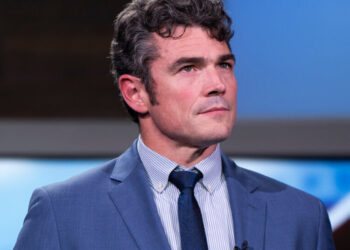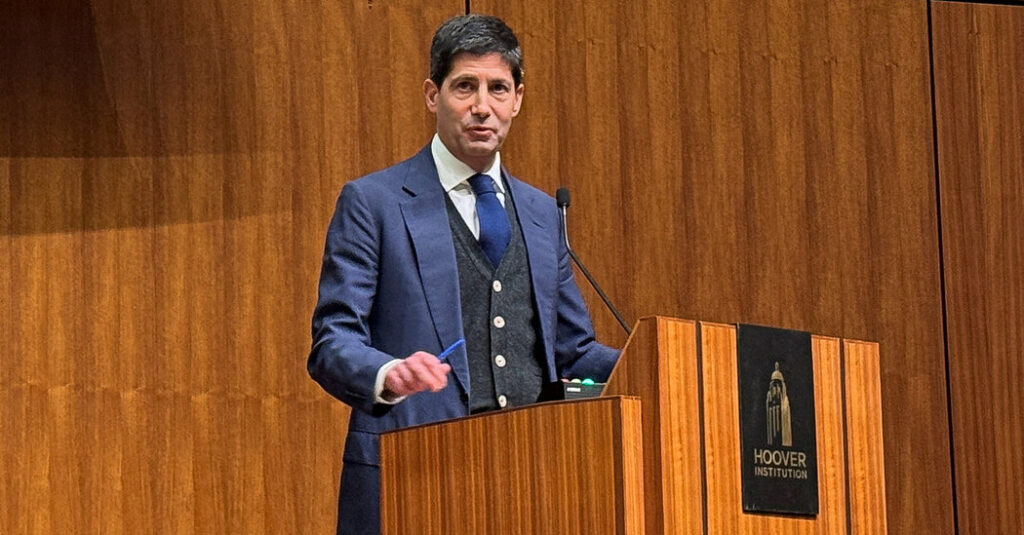
President Trump has selected Kevin M. Warsh to serve as the next chair of the Federal Reserve, giving the former central bank governor a pivotal role in steering an institution that has faced a barrage of attacks from the administration over its reluctance to more aggressively lower interest rates.
In a post on Truth Social, Mr. Trump praised Mr. Warsh, saying “he will go down as one of the GREAT Fed Chairmen, maybe the best. On top of everything else, he is ‘central casting’ and will never let you down.”
Friday’s announcement capped a drawn-out search process to replace Jerome H. Powell, whose term as chair of the central bank ends in May. Mr. Warsh, who served as a Fed governor between 2006 and 2011, edged out other contenders including Kevin A. Hassett, one of the president’s top economic advisers, and Christopher J. Waller, a current governor. Rick Rieder, a top executive at BlackRock, the world’s largest asset manager, was also a finalist.
Mr. Warsh, a conservative economist who was a front-runner to be Fed chair during Mr. Trump’s first term, will need to be confirmed by the Senate.
The selection comes at a critical moment for the Fed, whose officials are facing relentless pressure from the Trump administration to provide relief to borrowers while grappling with a weakening labor market and persistent inflation. That dynamic has put the Fed’s primary goals of stable prices and low unemployment in tension with one another, stoking internal divisions about what to do about rates.
Mr. Trump’s top criteria for Fed chair was someone who supported significantly lower borrowing costs, which has been the biggest source of tension between Mr. Trump and Mr. Powell, who is now the subject of a criminal investigation by the Justice Department stemming from his handling of renovations at the central bank’s headquarters in Washington.
Mr. Powell, who up until the investigation had brushed aside the president’s attacks, hit back directly, accusing the administration of leveraging legal threats as retaliation against the institution for not lowering rates as quickly as Mr. Trump would like. Senate Republicans jumped to Mr. Powell’s support, with some even going so far as to say they would block the confirmation of any Fed nominee until the issue was resolved.
As Fed chair, Mr. Warsh, 55, will have influence over the central bank’s policy decisions, but far from total control. Interest rates are set by a 12-person committee, which includes all seven members of the Fed’s board of governors as well as a rotating set of four presidents from the regional reserve banks. The president of the Federal Reserve Bank of New York has a permanent vote.
Officials on Wednesday opted to hold rates steady at a range of 3.5 percent to 3.75 percent at their first gathering of the year. This week’s pause followed three quarter-point cuts in the latter half of 2025. Despite those moves, rates are well above the roughly 1 percent level that Mr. Trump has called for in the past.
That disconnect has spawned other attempts by the Trump administration to pressure the Fed, aside from just targeting Mr. Powell. The president is in the process of trying to fire one governor, Lisa D. Cook, over allegations that she committed mortgage fraud before joining the Fed. The Supreme Court this month heard arguments for that case and appeared skeptical of the president’s argument that he had grounds to fire her. The justices also expressed unease about the incursion on the Fed’s independence and the prospects of an adverse economic impact.
.r. Warsh, who previously worked as an aide to President George W. Bush, has publicly backed the need for rate cuts, arguing that tariffs will not lead to persistently higher inflation.
In an early sign of some of the resistance that Mr. Warsh might face if he pursues substantially lower rates than the economy calls for, Mr. Trump’s pick to join the central bank for a temporary stint, Stephen I. Miran, has struggled to persuade other policymakers to support the aggressive reductions that he has repeatedly voted for since being installed in September. Mr. Miran filled an opening left vacant by Adriana D. Kugler, a governor who resigned early from her position and was later found to have violated the Fed’s trading rules.
Since leaving the Fed nearly 15 years ago, Mr. Warsh, who currently works with billionaire investor Stanley Druckenmiller and is also a senior fellow at Stanford University’s Hoover Institution, has emerged as a staunch critic of the central bank. Earlier this year, he called for “regime change in the conduct of policy,” telling CNBC at the time that “the credibility deficit lies with the incumbents that are at the Fed, in my view.” He has repeatedly hit out at the Fed for missing the inflation surge in the aftermath of the pandemic and is likely to support downsizing staff.
While at the Fed, Mr. Warsh established himself as a so-called “inflation hawk,” who was worried about price pressures and urged higher rates. Inflation instead became stuck below the Fed’s 2 percent target. He also advocated against the central bank’s decision to buy U.S. government bonds following the global financial crisis as part of a so-called “quantitative easing” program aimed at shoring up the economy by lowering borrowing costs.
Mr. Warsh was instrumental in formulating the Fed’s response to the crisis more broadly, including helping to broker the sale of Bear Stearns to JPMorgan Chase and the arranging the government’s bailout of American International Group, the insurance giant. Overall, he has supported the Fed maintaining a small balance sheet.
Mr. Warsh has since linked lower interest rates to a smaller balance sheet for the Fed, arguing that shrinking the central bank’s footprint in financial markets — a move that would likely raise long-term borrowing costs — would give officials more space to reduce short-term ones.
As part of that plan, Mr. Warsh has called for a revamp of a 1951 agreement that established the Fed’s monetary policy independence while giving Treasury control of government spending and taxation. What he wants is closer coordination between the Fed in terms of how it manages its balance sheet and the debt the Treasury Department issues in order to cover the government’s obligations.
If confirmed by the Senate, Mr. Warsh will be forced to overcome doubts about how he will carry out his responsibilities at the helm at the Fed and the extent to which he will bow to pressure from Mr. Trump.
At risk is the public’s confidence that the Fed is operating free of political meddling, an independence that economists and investors have long seen as crucial to the smooth functioning of financial markets and the overall strength of the economy.
In the past, Mr. Warsh has described the Fed’s independence as “precious” and “essential,” but he has also suggested that it should not operate entirely autonomously.
“History tells us that the independent operations in the conduct of monetary policy is essential,” he told CNBC this summer. “But that doesn’t mean the Fed is independent in everything else it does.”
Colby Smith covers the Federal Reserve and the U.S. economy for The Times.
The post Trump Picks Kevin Warsh as Fed Chair appeared first on New York Times.