The Trump administration’s latest move to cut off oil shipments to an already-struggling Cuba is a significant escalation in the decades-long effort by the United States to topple the Cuban government.
On Thursday, President Trump declared a “national emergency” over what he called the “unusual and extraordinary threat” by Cuba for its hostile actions, including, he said, allowing Russia to spy on the United States from its territory and “welcoming” hostile nations, like Iran, and terrorist groups, like Hamas and Hezbollah. (Mr. Trump did not provide evidence for any of those claims.)
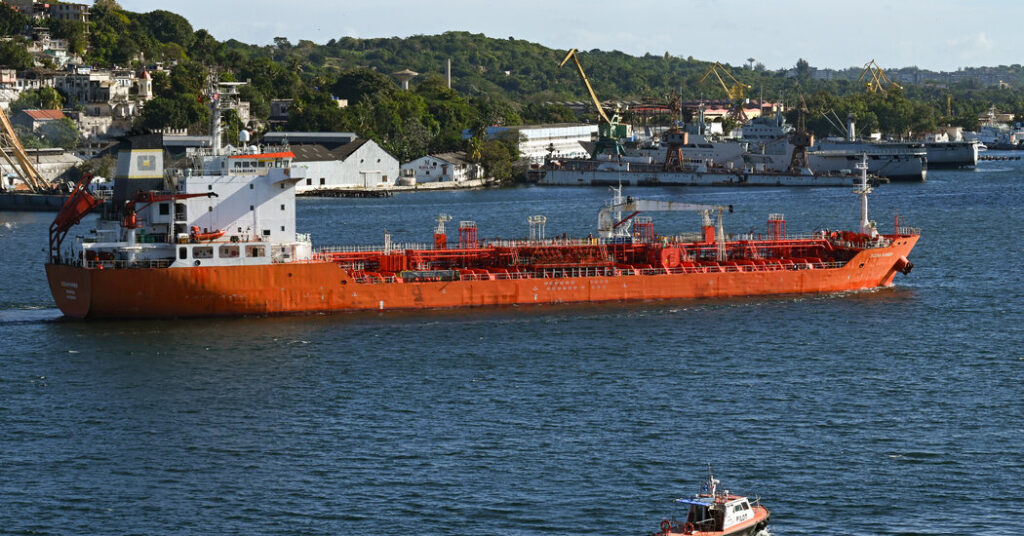
Mr. Trump warned that he might impose additional tariffs on imports from countries that sell or provide oil to Cuba. The announcement comes as Cuba is already experiencing severe oil shortages after Venezuela, its main source of fuel, stopped sending tankers following the U.S. extraction of its leader.
This latest U.S. measure leaves the Cuban government with no real alternative sources for the quantities of fuel necessary to keep its economy from collapsing and triggering a severe humanitarian crisis in a country already experiencing prolonged blackouts, experts who follow Cuba closely warned.
The announcement on Thursday appeared to be directed largely at Mexico, one of the few countries in the world that had been providing Cuba with oil, which it supplied in exchange for medical services from Cuban doctors. The oil deliveries, which Mexico describes as humanitarian aid, stopped in early January, according to Jorge Piñon, a University of Texas oil expert who tracks the shipments closely.
On Friday, Mexico’s president, Claudia Sheinbaum, said that Mr. Trump’s threat of new tariffs would set off a “humanitarian crisis of great scope’’ in Cuba. “Mexico unequivocally reaffirms the principle of sovereignty and free self-determination of peoples, a fundamental pillar of our foreign policy and international law,” she said.
Penalizing countries for providing oil to Cuba, she added, would directly affect hospitals, food and other basic services for the Cuban people, “a situation that must be avoided through respect for international law and dialogue.”
She instructed Mexico’s foreign secretary to immediately contact the U.S. State Department to clarify the decree and convey her concerns. Mexico, she said, would explore alternative ways to provide humanitarian support to Cuba.
Ms. Sheinbaum spoke to Mr. Trump the day before the announcement, but she said Cuba did not come up.
It was unclear whether Mexico had stopped supplying Cuba with oil even before Mr. Trump’s announcement because of previous pressure from his administration. The decree on Thursday turned that implied pressure into official U.S. policy.
Cuba had been heavily dependent on oil imports from Venezuela, but Mr. Trump cut those off after the Jan. 3 attack and capture of Venezuela’s president, Nicolás Maduro.
On Friday, the Cuban government called Mr. Trump’s decree “economic genocide.” Cuba’s foreign minister, Bruno Rodríguez, condemned the “total blockade on Cuba’s fuel.”
“In order to justify that, it resorts to a long list of lies with the purpose of portraying Cuba as a threat, which it actually is not” he wrote on X. “Every day there is new evidence showing that the only threat to peace, security and stability in the region and the only malignant influence is the one exerted by the U.S. government against the peoples and nations of our America.”
With widespread energy outages, a collapsed tourism industry and a falling population, Cuba is undergoing its worst economic crisis in the 66-year history of the Cuban revolution.
The United States has imposed a trade embargo on Cuba since the 1960s. Through the years, various Republican administrations trying to topple the Communist government have imposed tougher sanctions on the island nation, such as restricting air travel and putting penalties on foreign shipping companies carrying goods to Cuba.
Laritza Diversent, director of Cubalex, a U.S.-based human rights organization, said Mr. Trump’s measure was not the strictest in history, but could be the most damaging.
“Cuba depends totally on the importation of oil,” said Ms. Diversent, a lawyer who left Cuba in 2017 and now lives in Maryland. “The problems that exist today are going to get worse.”
She noted that Mr. Trump had not prohibited all commerce to Cuba, but given the current energy crisis, “the impact is much, much higher.”
On Thursday, two Republican South Florida lawmakers, Carlos Gimenez and Mario Díaz- Balart, asked Mr. Trump to take even more stringent measures to stifle Cuba’s sources of revenue. The two Cuban American lawmakers proposed ending U.S. flights to Cuba and the ability of Cubans in the United States to send money to their families.
Democrats and other critics of the hard-line U.S. policy have long argued that the fact the Cuban government has endured since 1959 proves that draconian tactics that may starve the population do not lead to regime change.
Mr. Piñon said Cuba’s last shipment of oil, which was from Mexico, arrived on Jan. 9.
Even if Cuba found a country willing to risk new tariffs, with oil at $60 a barrel, Cuba would have to spend $3.6 million a day to make up its energy shortfall. It doesn’t have the cash or credit, Mr. Piñon said.
“Who would sell any oil to Cuba? I don’t know,” he said. “Who would risk the retribution of the White House?”
David C. Adams contributed reporting from Miami, and Ana Sosa from Mexico City.
Frances Robles is a Times reporter covering Latin America and the Caribbean. She has reported on the region for more than 25 years.
The post Trump Aims to Cut Off All Oil to Cuba as U.S. Takes Aim at Its Government appeared first on New York Times.