The 2014 movie “Hercules,” a sarcastic swords-and-sandals romp starring Dwayne Johnson as the Greek demigod, was flawed but likable enough, according to reviews. It was not cheap to make but more than doubled its production budget at the box office, earning nearly $250 million.
In other words: It was vintage Brett Ratner.
For two decades, beginning with high-profile music videos in the 1990s, and then the blockbuster “Rush Hour” trilogy before capable entries in the “X-Men” and “Silence of the Lambs” cinematic universes, Mr. Ratner was one of the industry’s most reliable hitmakers. “It’s a much harder skill,” he told The New York Times in 2011, “to make movies for millions of people, for mainstream audiences, than it is a pretentious art film.”
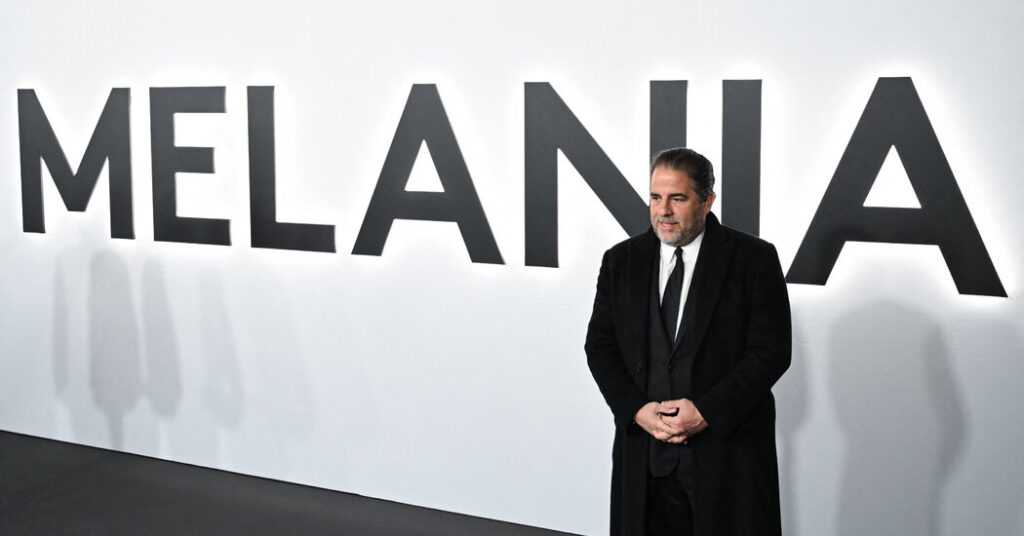
Then six women accused him in late 2017 of sexual misconduct ranging from lewd comments to forced oral sex. Although Mr. Ratner denied the accusations, Warner Bros. did not renew a giant production deal and his output collapsed. “Hercules” was the last theatrical release he directed until Friday, when “Melania,” an authorized documentary about Melania Trump, the first lady, was released widely.
“He’s been so frustrated these last eight years,” Dante Spinotti, a veteran collaborator of Mr. Ratner’s and one of three credited cinematographers on “Melania,” said in an interview.
Mr. Spinotti, who acknowledged that Mr. Ratner had “made some mistakes” in the past, added that “it was so nice to see Brett being his old self.”
Mr. Ratner, 56, did not reply to requests for comment but has seemed enthusiastic about his return in numerous social media posts promoting the film. (“Thank you,” reads one post addressed to Mrs. Trump, “for the opportunity to collaborate with you.”)
An official documentary about the wife of the polarizing Republican president might seem an unlikely comeback vehicle for Mr. Ratner, who came up in the broadly progressive worlds of Hollywood and pop music. He got his start directing music videos for soul and hip-hop stars like Lionel Richie and Mary J. Blige.
But Mr. Ratner’s rebrand, embodying how culture and politics are interwoven, may reflect his instinct for crowd pleasing as well as a shrewd opportunistic streak.
“Cancellation has become in some ways a bona fide of MAGA,” said Casey Kelly, a professor of rhetoric and public culture at the University of Nebraska, citing entertainers such as the comedian Russell Brand and politicians such as Robert F. Kennedy Jr. “That world is willing to allow you to resurrect your career so long as you have a certain flexibility.”
In the case of “Melania,” which was acquired by Amazon for $40 million, that means a documentary expressly approved by its subject: Mrs. Trump is among its producers. “I look forward to showing the world what an incredible First Lady you are!” Mr. Ratner said on social media.
Mr. Ratner’s had been an enviable Hollywood career.
In the 1990s, as a 20-something known as the Rat, he directed well-regarded music videos including the clips for “Brown Sugar” by D’Angelo and “Triumph” by Wu-Tang Clan.
Mr. Ratner’s first feature film, “Money Talks” (1997), was an action buddy comedy featuring Charlie Sheen as the straight man and Chris Tucker as the comic relief. It set the template for the following year’s “Rush Hour,” which paired Mr. Tucker with the martial arts legend Jackie Chan. “Rush Hour” and two sequels grossed a combined $850 million.
In 2017, The Los Angeles Times published the accounts accusing Mr. Ratner of misconduct. Although his lawyer denied them, Mr. Ratner’s partnership with Warner Bros. ended.
Not a decade later, the media landscape is different, Mr. Kelly argued, as major studios, networks and platforms have come under the control of figures who are either loyal to President Trump and the political right or eager to curry favor with them.
“It’s a new class of media owners,” Mr. Kelly said. “The structure is fairly conservative, even if the people who populate our movies are fairly progressive.”
Amazon Studios is an example. After winning the bidding for “Melania,” it is spending another $35 million to market the documentary. Many observers say that scale, which is significantly out of proportion to the film’s expected financial return, reflects the desire of Amazon to ingratiate itself with the openly transactional administration. (Amazon has said, “We licensed the film for one reason and one reason only — because we think customers are going to love it.”)
The same dynamic is said to apply to Paramount’s interest in a potential Ratner project, “Rush Hour 4,” reportedly at President Trump’s request.
In public statements approaching the release of “Melania,” Mr. Ratner has avoided overt politics. What is clear is that the film offered him a route back to the director’s chair. “One of his key qualities is his energy,” Mr. Spinotti said. “His enthusiasm for moviemaking — it’s very personal to him.”
After more than a decade away from the spotlight, Mr. Ratner appears grateful for another chance in Hollywood. “Dreams do come true!” he posted this month, calling his work on “Melania” “the experience of a lifetime!”
Marc Tracy is a Times reporter covering arts and culture. He is based in New York.
The post The Movie Is ‘Melania,’ but the Comeback Is Brett Ratner’s appeared first on New York Times.