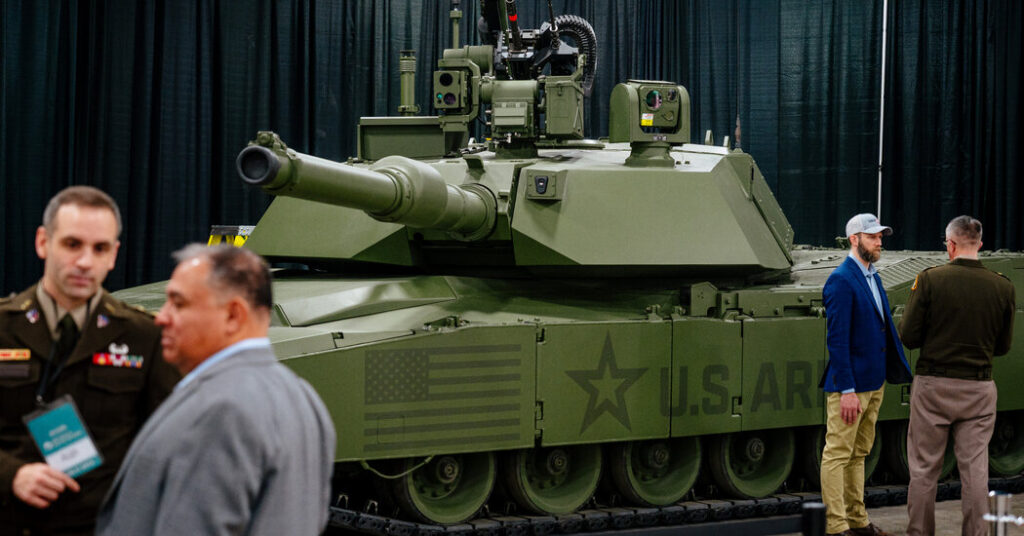
The Detroit Auto Show is the nation’s showcase for cutting-edge vehicles, and this year, along with flashy new Cadillac SUVs and Ford pickups, a model with a lot less chrome made its debut: the M1E3 Abrams, the latest version of the Army’s main battle tank.
The tank boasts many of the same upgrades seen in the newest civilian rides — bigger touch screens, comfier seats, more cameras — not to mention a hybrid engine designed to save fuel.
“It’s not as fast as the Corvette upstairs, but it can take out a target at a quarter-mile — so the quarter-mile in a tenth of a second,” Gen. Randy George, the Army chief of staff, said with a practiced grin as he hobnobbed with industry officials last week in front of the hulking green prototype.
The general did not mention that an unnerving development in warfare, driven by cheap, mass-produced attack drones, may be on the verge of making tanks obsolete. Or that the Army’s newest tank may also be its last.
Tanks have been the apex predators of ground warfare for generations. As recently as a few years ago, no major military was seriously considering the way swarms of inexpensive hobby drones might upend those plans. Now, they all are.
The war between Russia and Ukraine is the reason. The conflict has sparked a drone arms race that has left the skies over the front lines buzzing with toy-sized hunting robots strapped with explosives, and the mud below littered with thousands of destroyed armored vehicles, including some of the most advanced battle tanks in the world. Tanks that want to survive have often been forced to stay hidden miles behind the front lines in order to avoid a similar fate.
Other countries watching the fight, including the United States, are responding by swiftly expanding their own drone fleets. If tank designers don’t find a way to stave off this new threat, even the most advanced tanks may no longer be of much use.
“In future conflicts, there’s a good chance you’ll have large numbers of robots and drones and precision-guided weapons that are all expendable” said Paul Scharre, a former Army Ranger and a national security analyst at the Center for a New American Security. “There is not a clear place for a traditional tank to play a lead role in that scenario.”
Russia’s former top general, Yuri Baluyevsky, published an analysis in January, that voiced a similar caution.
“It is not clear what battlefield utility can be had from a vulnerable vehicle, with a limited armament, that approaches a fighter jet in cost,” he wrote.
To combat officers who may be tempted to argue that tanks will yet prove their worth, Gen. Baluyevsky warned that the unmanned technologies bedeviling today’s tanks are still in their infancy, and are likely to advance in capability more quickly than tanks can: “Thus, it is more likely that drones will yet prove their worth.”
The problem of new weapons imperiling the supremacy of armor is nothing new, as the steel-suited knights who first came up against the musket could once attest. And, in different ways, it has been happening for centuries.
The first tanks, were deployed in 1916 by the Allies against German trenches, during World War I.
What followed was a century-long contest, pitting efforts to make tanks harder to kill against the development of new weapons to kill them. World War II brought the first shoulder-launched tank killers, led by the bazooka. By the 1970s, compact guided missiles that could be carried by infantry teams were picking off tanks in large numbers.
Tank designers have responded by making the machines faster, tougher and more technologically advanced. The first generation of World War I tanks weighed about as much as one bull elephant and clanked along at about 6 miles per hour. The Abrams tanks deployed by the U.S. Army today weigh more than a dozen elephants, and can cruise easily at a speed of 45 m.p.h.
The most advanced versions of the Abrams are protected by radar-guided automatic interceptors that can shoot down incoming projectiles, and have armor that is not only tougher than in previous generations, but is covered in explosive tiles that blast outward when hit, to reduce the effect of enemy fire.
All of this comes at a cost. The sticker price of a current Abrams model runs to more than $10 million. The need for fleet maintenance and fuel trucks to support the tanks quickly runs up that bill.
If a $10 million Abrams can be destroyed by a handful of cheap drones, the tank’s value on the battlefield quickly becomes questionable.
Even so, most military experts are not ready to call the scrap-metal dealer just yet.
“The obituary of the tank has been written many times in the past, and the tank is sill here,” said David Barno, a retired Army lieutenant general who teaches strategic studies at Johns Hopkins. “Drones are an incredibly dangerous threat, but we still need something on the battlefield that gives human beings mobile, protected firepower. Until there is something else, there’s going to be a tank.”
Each new antitank threat that has come along, from bazookas and armor-piercing shells to guided missiles and tank-hunting helicopters, has forced tanks to adapt, but not to retreat entirely, he said. Still, he acknowledged that drones constitute an unnerving paradigm shift.
For 50 years, the U.S. military focused on developing cutting-edge precision weapons that were often unmatched, but also expensive. (A single U.S.-made shoulder-fired Javelin anti-tank missile, for example, costs about $170,000.)
“That’s been flipped,” General Barno said. “Now we have mass precision at very low cost. It isn’t a multimillion-dollar missile taking out a tank, it’s swarms of thousand-dollar drones.”
That is likely to mean fewer tanks, operating farther back from the enemy. In the future, he said, tanks or other armored vehicles will probably act as a battlefield “quarterback,” controlling a team of cheaper and more expendable unmanned vehicles that can push forward.
“The tank of the future is probably more like a mobile command center,” General Barno said.
The Army is already developing a fleet of unmanned ground vehicles, some as small as a Roomba, others as large as a rhino. The Air Force and Navy are pushing ahead with unmanned ships and jets.
Militaries are inherently conservative, though, and they tend to cling to old ways, sometimes long after those ways have stopped being effective. Before World War I, some American naval experts argued that the advent of aircraft would make battleships too vulnerable to attack from the air to be of much use. World War II proved the point. But the U.S. Navy continued to operate battleships, into the 1990s.
The U.S. Army had learned by 1865 that fixing bayonets on the ends of soldiers’ rifles offered little advantage in combat, but the Marine Corps — perhaps the most tradition-bound of the military branches — still conducts bayonet training today.
After the advent of the tank made horseback cavalry obsolete in World War I, the Army continued to train tens of thousands of horse troops, right up to the eve of the United States’ entry into World War II in 1941.
Samuel Bendett, an expert on Russian and Ukrainian drones at the Center for Naval Analysis, said that unlike the horse, the tank is unlikely to disappear entirely from the Army’s arsenal.
“Every time people try to draw up plans for what will replace the tank, it still ends up looking like a tank,” he said.
Anti-drone technologies are likely to advance quickly, he said, and those advances may clear the way for tanks to resume a prominent place on the battlefield. Rather than cutting tank production, he noted, Russia is ramping up.
At the Detroit Auto Show last week, General George acknowledged that warfare had changed, and said the M1E3 Abrams was positioned to change with it.
While it looks nearly the same as older Abrams models on the outside, inside the new tank has had a full digital makeover. The clunky steel driving controls have been replaced with a video game controller. The main gun now reloads automatically. The electronic guts of the tank have been entirely overhauled to make them almost as easy to update as an iPhone. And perhaps most important, the software system is modular, so the Army can plug in a new sensor, a new missile launcher or a new anti-drone system with relative ease.
“We’ll still need ‘em,” he said, gesturing to the tank. “How they’re shaped, configured, what systems are on them — that needs to be adaptable.”
Since the first version of the Abrams entered service in 1980, the tanks have required a crew of four. One of the biggest adaptations for the M1E3, he said, is that the Army is working on adding a remote-control option. No more soldiers needed.
In other words, in the age of drones, the best way for the tank to survive may be by becoming one.
Dave Philipps writes about war, the military and veterans and covers The Pentagon for The Times.
The post The Army Just Unveiled Its Latest Tank. Will It Be the Last? appeared first on New York Times.