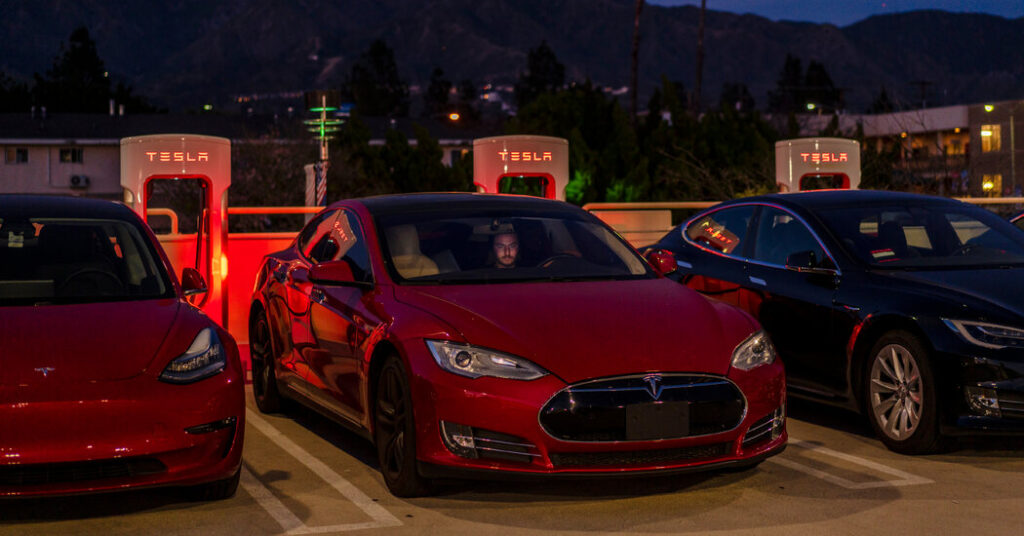
Thirteen years ago, Mike Ramsey, an auto industry analyst, test-drove a new car — the Tesla Model S. He knew almost right away that this car was unlike any other.
In the center of the dashboard was something he had never seen in a car — a 17-inch touch screen. Because the Model S was electric, and had far fewer parts than conventional automobiles, it was also surprisingly spacious.
Then Mr. Ramsey, an analyst at the research firm Gartner, hit the accelerator.
“I’d driven performance cars, but I was thrown back into the seat because of all the torque,” he said in an interview on Thursday. “And there was this cognitive dissonance because the car’s zooming down the road and yet it was almost silent,” he added. “I was stunned.”
On Wednesday, Tesla’s chief executive, Elon Musk, announced that the company would stop making the Model S and the Model X, a roomier vehicle that came out three years after the S, and use the space in a California factory for robot production. The decision followed several years of sluggish sales for the two cars. Almost all the cars that Tesla sells are either the Model Y or the Model 3, which are smaller and more affordable than the S and X.
Despite its recent weak sales, auto executives and analysts widely regard the Model S as one of the most important cars the industry has produced in its 125-year history. It was the modern equivalent of Ford’s Model T. Both cars upended conventional notions of what a car is, how it could be made and what it could cost.
There were electric vehicles before the Model S, but they were niche products sold in very small numbers. Most were designed to cut tailpipe emissions to satisfy laws and regulations and appealed to a small group of environmentally conscious drivers. In a word, they were boring.
Tesla designed the Model S to be sleek and exciting. Its electric motor gave it acceleration that had been available only in a few specialized cars, hence the sensation Mr. Ramsey felt in that first ride. The Model S was not cheap when it went on sale for $57,400 in 2012, but it cost a lot less than the sports cars it could outrun. The car now starts at $95,000.
The Model S became a sales and cultural sensation, redefining what a luxury car was, and upended a segment that the likes of Audi, BMW, Mercedes-Benz and Lexus had dominated for more than two decades.
But the impact of the Model S went far beyond its sales figures. It was a software-defined car, meaning a central computer controlled how all of its components worked. These days, virtually every automaker is seeking to put software at the center of its vehicles.
Many cars can now connect to the internet, but Tesla was the first company to send software updates wirelessly to its cars. Like an iPhone, the Model S could get new features overnight. Tesla used the updates to improve how the brakes worked or increase how far the car could travel on a charge.
Two years after its introduction, the Model S could be purchased with Autopilot, a driver-assistance system that could keep the car in its lane, accelerate and brake. Those innovations forced other automakers to respond, turbocharging a race to create self-driving cars.
“The Model S was a breakthrough and ushered in quite a number of technologies people hadn’t seen before,” said Sam Abuelsamid, vice president of market research at Telemetry, a research and communications firm in Detroit.
Of course, the auto industry had been disrupted before.
The Ford Model T, introduced in 1908, made the automobile something many people could afford, helping to turn cars into an indispensable part of American life. The Model T, though, was a breakthrough more for how it was made — on a moving assembly line, in a big factory, which drastically lowered costs — than for what the car was capable of. Its engine, transmission, brakes and other components were not much different from typical equipment at the time.
Other cars proved influential, too. The Benz Patent-Motorwagen, built in 1886, was the first car, although its impact was felt slowly. The modern auto industry didn’t really take shape until a quarter-century later.
The Ford Mustang, introduced in 1964, created a market for affordable sports cars. At the time, most American households had only one car. The Mustang helped paved the way for Americans to become two-car families.
The Volkswagen Beetle showed there was a market in the United States for small, inexpensive foreign cars, which opened the door for Toyota, Honda and others. Foreign automakers eventually forced companies based in and around Detroit to improve quality.
The 1984 Dodge Caravan created the minivan. Jeeps and later the Ford Explorer turned sport utility vehicles into mainstream family vehicles. The Toyota Prius pioneered hybrids.
But the Model S had a profound and unique impact. Before it arrived, the top-selling electric vehicle in the United States was the Nissan Leaf, which had a range of about 80 miles. The first Model S could go about 200 miles on a single charge, and more expensive versions up to 300 miles.
The software architecture also greatly expanded what an automobile could be. Tesla added video games. The Model S and other Teslas captured forward-looking video clips any time there was an accident, making it easier to tell why a crash happened.
The Model S soon led to the Model X, then the Model 3 and Model Y. In 2022, Tesla zoomed past BMW, Mercedes and Lexus to become the top-selling luxury brand in the United States.
The Model S turned Tesla, which previously produced the niche Roadster sports car, into a serious car company. If the Model S had flopped, Tesla might not have survived. Electric vehicles might have taken much longer to take off. Tesla probably wouldn’t be the most valuable car company in the world, and Mr. Musk might not have become the world’s richest person.
The success of the Model S also forced other automakers to spend hundreds of billions of dollars to develop electric models. The established rivals also began following Tesla by hiring programmers to create their own software-defined cars, although even now, in 2026, they have not yet caught up on that front.
“There weren’t a lot of pure E.V.s on the market at the time, and there was really nothing in the luxury segment,” Mr. Abuelsamid said.
At one point, Tesla’s rise seemed so rapid that some industry executives expected a relatively quick end to the internal combustion engine. In 2021, General Motors said it aimed to phase them out by 2035.
That now seems less likely given the end of federal incentives for electric cars and the decisions by G.M., Ford and other automakers to make more gasoline vehicles. But industry analysts and executives say the shift to electric vehicles will continue, albeit somewhat more slowly in the United States.
“You can make a pretty good argument that the Model S was even more influential than the Model T,” Mr. Ramsey, the Gartner analyst, said.
Neal E. Boudette, a Michigan-based reporter for The Times, has been covering the auto industry for more than two decades.
The post Tesla’s Model S, Soon to Be History, Changed the Auto Industry appeared first on New York Times.