Before starting a cosmopolitan life as an artist in Mexico City, queer filmmaker Efraín Mojica came of age between Riverside and the rural town of Penjamillo, Michoacán: home to an annual jaripeo, or a Mexican rodeo competition that takes place every Christmas.
Every year, cowboys convene to test-drive their masculinity, namely by swigging handles of tequila and precariously mounting the backs of bucking bulls. These heroic shows of manhood long fascinated Mojica, who frequented jaripeos with family — and quietly forged a community with other locals who diverged from Mexican gender norms.
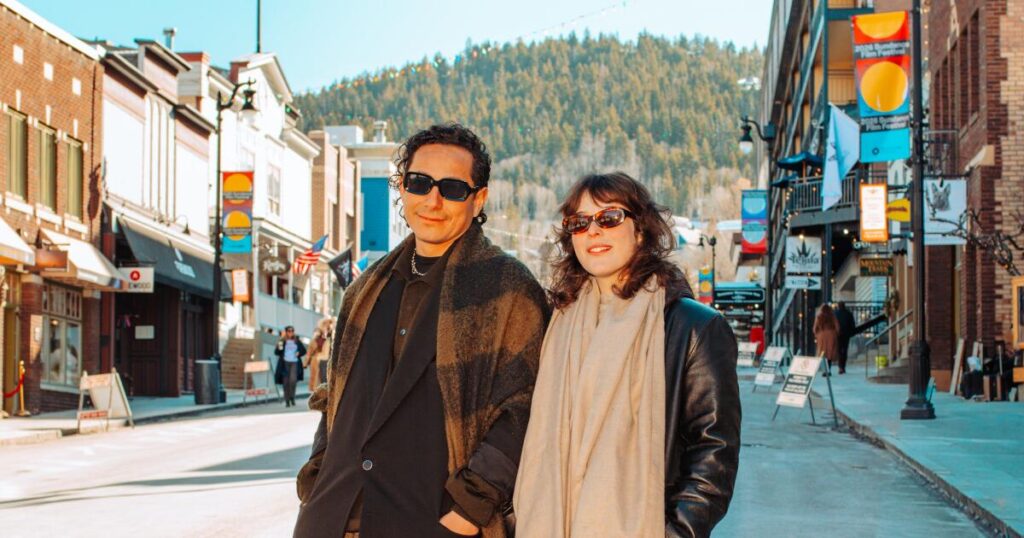
That community would become the cast of “Jaripeo,” the debut documentary feature film by Mojica and co-director Rebecca Zweig, which premiered at this year’s Sundance Film Festival in Park City, Utah. Shot in the style of cinéma vérité, Mojica appears as both a narrator and protagonist. Zweig, who first encountered Mojica in Seattle’s punk scene, follows them behind the lens as they interview members of the LGBTQ community in and around Penjamillo.
“[Mojica] invited me to Michoacán in 2018 to spend Christmas with their family,” Zweig tells The Times, the day after the film’s Jan. 25 premiere. “As soon as I was at the rodeo with them, I became obsessed with the performance of masculinity.”
“[Zweig] was like, ‘How do you feel about making a documentary [about] the rodeos?’” Mojica tells The Times. “I said, ‘Yeah, but it’s got to be gay.’”
Produced by Sarah Strunin, the documentary begins with a pastoral scene from Mojica’s pickup truck as they overlook the grasslands of Michoacán. Pink party lights and techno music are woven into scenes of bandas and revelers in tejana hats, who kick up dust as they dance inside the rodeo ring. The crew flashes strobe lights in the cornfields, lighting up the figures of sexy cowboys sifting through the crops to find one another — drawing parallels to queer nightlife in the cities.
“On New Year’s there’s a rodeo in Acuitzeramo, with like 10,000 people and big speakers with heavy bass,” said Mojica. “What’s the big difference between a city rave and a rancho jaripeo, you know? They’re doing the exact same thing.”
“I wanted to blur all the lines and make these abstract sequences,” says Zweig. “And I thought, how much is that gonna be allowed in a formal [film] institution? I want to shout out public media, [because] when we got the Open Call Fund from ITVS, they took a chance on us as first-time filmmakers. [Marlon Riggs’ documentary] ‘Tongues Untied’ was also funded by ITVS — the legacy of queer cinema and documentaries in the U.S. has been supported by public media.”
Each interview adds more color and dimension to Mojica’s memories of the village they left long ago, no longer suspended in the past. Mojica visits Arturo Calderón, a local rodeo clown known as “La Pirinola,” who performs in drag; Calderón lets the camera roll as he paints his eyelids electric blue.
They later stop by the local church and the disco with Joseph Cerda Bañales, a bearded makeup artist who brandishes long stiletto nails to the rodeos. Despite efforts from the festival organizers, and even a letter from Sen. John Curtis (R-Utah), Cerda was unfortunately not granted entry into the U.S. for the Sundance premiere.
“Joseph is the mayor of his town,” says Mojica. “He’s the president of the church. He runs the folkloric ballet. He does everything. It’s not that there’s no more traditional culture… People just want to keep the community together. [It means] holding a bunch of truths [and] contradictions at the same time.”
Mojica even shares flirtatious moments onscreen while interviewing Noé Margarito Zaragoza, a dashing and stoic ranchero who lives discreetly as a gay man.
“It’s exciting, but at the same time I’m a little nervous,” says Margarito of coming out in the film. “Part of my family doesn’t know what’s going on with my life, so I don’t know how they’re going to take it. But my main family members — my siblings, my dad — well, they feel content and happy [for me], so I’m going forward and giving it my all.”
“We never talked about my queer identity,” says Mojica of their own family, some of whom flew in for the premiere of “Jaripeo” at the Yarrow Theatre in Park City. Mojica planned a belated coming out talk at dinner the night before; the discussion never happened.
“I choked up,” says Mojica. “I thought, ‘OK, I’m just going to give them a little heads up of what the film’s actually about.’ But I could not vocalize a single word. My eyes started tearing up. So I was like, ‘See you tomorrow!’”
It was after the screening, during an open Q&A, when Mojica’s mother quelled the artist’s fears in one fell swoop.
“What was the reception from your family after seeing the film?” an audience member asked Mojica in Spanish — unaware that their family had just watched it for the first time with everyone else in the theater.
To that, Mrs. Mojica Rubio rose from her seat and introduced herself “as a very proud mamá” who loves her child “unconditionally.”
After a beat, she exclaimed: “It’s the 21st century!”
Mrs. Mojica Rubio’s show of support was promptly met with resounding cheers from the audience. “My mom also approached [Margarito] and said, ‘I’m going to give you a mother’s hug, because you deserve it,’” says Mojica, who appears misty-eyed as they recount the scene.
In a time of increasing hostility against LGBTQ people and immigrants in the United States, to behold the strength of a mother’s love — and the solidarity across communities — affirms the purpose of such a film, with a power that transcends states, governments and institutions.
“People in different countries [have] this antiquated idea that Mexico is this little ranchita that’s hateful, that they’re gonna beat you if you’re queer. But we really care for each other,” Mojica says.
“We have to deal with these issues in our towns, and [people] are still not open to receiving that kind of help,” added Margarito. “So let’s hope [the movie is] a success.”
The post Sundance 2026: Queer Mexican rodeo film ‘Jaripeo’ bucks tradition appeared first on Los Angeles Times.