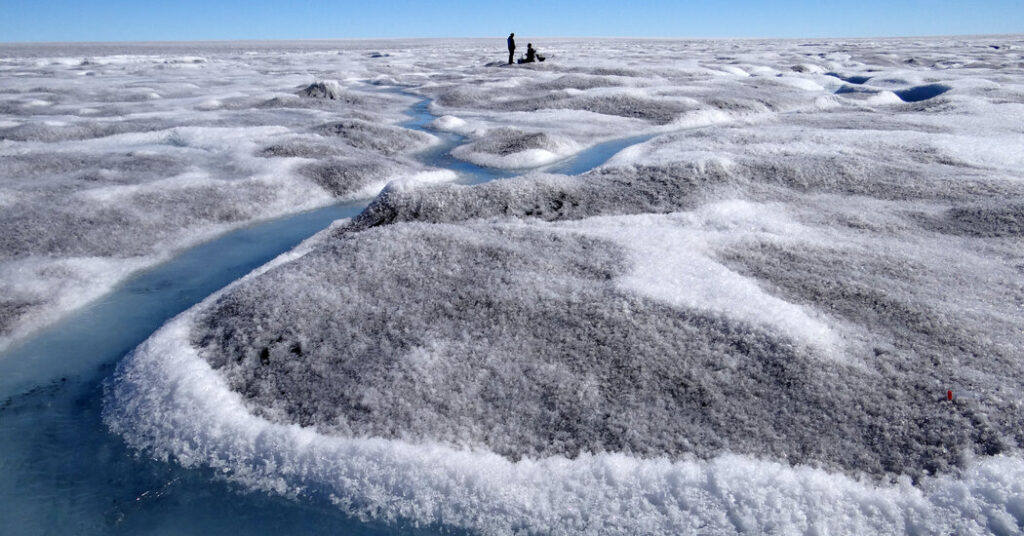
On snow it’s green or red. On ice it’s a brownish gray. And it’s melting the frozen mass that encases Greenland faster and faster. As a warming climate eats away at the ice that covers most of the world’s largest island, algae blooms are speeding up that process, according to two new studies. Greenland is shedding hundreds of billions of tons of ice every year and raising sea levels as it does. Wind picks up phosphorus-laden dust from Greenland’s rocky ground and blows it onto the ice, where it feeds algae blooms. Other nutrients are already trapped in layers of the ice and are released as they melt.
These dark patches of algae block the ice’s ability to reflect the sun’s heat, speeding up melting. And as the landscape thaws, more nutrients are released from newly exposed ground and the depths of the ice in a feedback loop that ensures the slimy spread will continue to grow.
If the ice sheet on Greenland were to disappear entirely, a possibility that some studies have suggested, sea levels could rise by a staggering 23 feet, submerging coastal cities around the world.
The Arctic is warming four times faster than the rest of the planet and the floating sea ice that surrounds Greenland is also vanishing, opening up maritime access and prompting world leaders to consider the possible military vulnerabilities and economic opportunities. President Trump has said he wants to control Greenland, which is a territory of Denmark.
There are ample mineral, oil and gas resources thought to be increasingly accessible beneath Greenland’s vanishing ice, adding to its appeal. Mining and drilling would release other particles, like industrial soot, that could darken the ice and hasten melting.
“There are lots of different factors that contribute to the melting of the ice sheet, and this project was trying to pick those apart,” said Jenine McCutcheon, an assistant professor at the University of Waterloo and lead author of one of the studies, published in the journal Environmental Science and Technology on Jan. 13.
Algae is responsible for some 13 percent of the melt runoff in southwest Greenland, according to Dr. McCutcheon. The area is one of the most quickly melting and home to a well-documented dark zone. Dr. McCutcheon’s 2021 research in the region showed it was made of algae blooms fed by phosphorus in dust. Her new research shows this dust is likely coming from the relatively narrow band of exposed ground around the edge of Greenland, blown inland by the wind.
Scott Hotaling, an assistant professor at Utah State University who has studied algae on snow and was not affiliated with the studies, called the finding fascinating.
The physics of dust and algae on glaciers are often studied separately, but the new paper combined data on both in a meaningful way, he said. The study also found that microscopic traces of algae are carried through the air, giving scientists one of the first clues to how these blooms colonize new patches of ice in the first place.
Another study published Jan. 28 in the journal Nature Communications shows that these windblown nutrients have likely become embedded into each layer of ice and snow as it freezes and builds up over time. The researchers found that phosphorus and nitrogen are liberated as the frozen landscape melts during Arctic summers, providing another food source to algae.
“This is exciting because we know very little about what controls algal growth on ice surfaces,” said Beatriz Olivas, a postdoctoral researcher at Aarhus University in Denmark who led the study. The researchers were surprised to find that even extremely small amounts of nutrients, found deep in the ice, were enough to sustain algae growth.
The two papers indicate a “double whammy,” said Liane Benning, a biogeochemist at the GFZ Helmholtz Centre for Geosciences in Germany and senior author of both papers.
“This is a consequence of melt,” she said. “The more it melts, the more they bloom. But they are not a cause of warming. Really we should just change our habits and not burn so many fossil fuels.”
It’s likely that there’s algae all around the Greenland ice sheet, mostly in the circumference where the nutrients have been able to penetrate inland, Dr. Benning said. Each year, as the ice continues to melt and release nutrients, she expects the algae to encroach farther.
It’s too soon to be able to gauge the full consequences of such algae blooms, said Tyler Jones, an assistant research professor at the Institute of Arctic and Alpine Research at the University of Colorado, who was not involved with the studies.
“We need to know how quickly the darkening of the ice sheet might expand, and how to factor that into what to expect for sea level rise,” he said. “But this is an active area of study, and we just don’t have enough information yet to say for sure.”
Sachi Kitajima Mulkey covers climate and the environment for The Times.
The post Something Dark Is Growing on Greenland’s Ice. And Melting It Faster. appeared first on New York Times.