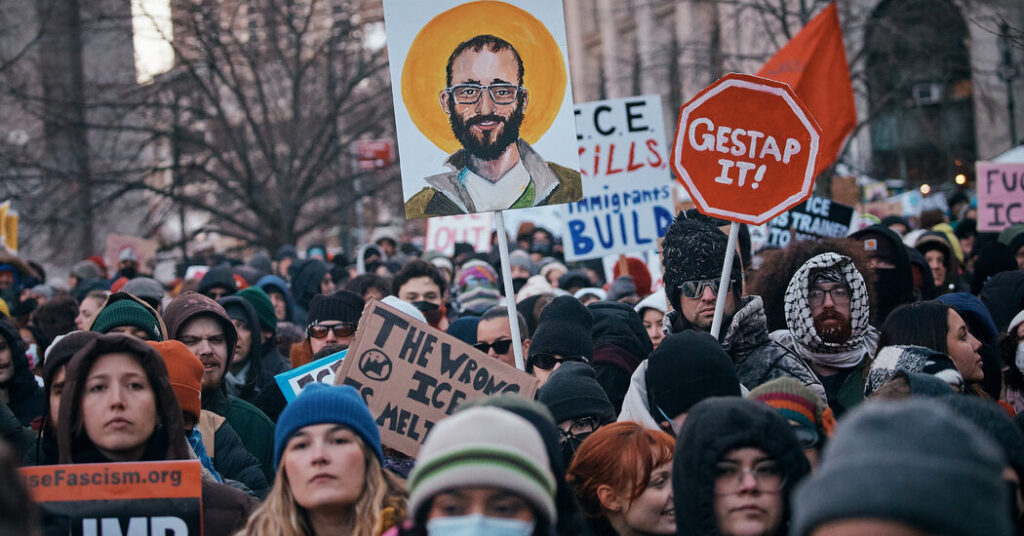
They ditched school in Atlanta. Left work in Philadelphia. Blocked traffic in Los Angeles. And closed businesses in New York. Across the country on Friday, protesters marched, rallied and disrupted their everyday routines in solidarity with Minneapolis residents to demand an end to the Trump administration’s immigration tactics.
The actions, including gatherings that were scheduled in cities and towns from Boise, Idaho, to Gainesville, Fla., were part of what groups of organizers called a national shutdown, encouraging Americans to abstain from work, school and shopping “to stop ICE’s reign of terror” and denounce the recent killings of Renee Good and Alex Pretti in Minneapolis.
The protests reflected widespread fury at the killings, which have endangered President Trump’s political agenda and threaten a government shutdown. The specter of masked men killing American citizens during protests has raised fears of authoritarianism and talk of resistance, with many residents saying America’s 250-year experiment in democracy is imperiled.
In Los Angeles, thousands of protesters, some of them teenagers who had walked out of their schools, rallied in front of City Hall downtown, chanting “ICE Out of L.A.!” and “Whose streets? Our streets!” In Portland, Ore., ice cream shops, restaurants and pet stores shut down, and many small businesses that couldn’t afford to do so said online that they would donate proceeds from the day to immigrant advocacy groups. In Philadelphia, protesters gathered despite icy conditions to make a statement.
Many of those who participated said that after the killings of Ms. Good and Mr. Pretti, standing by and doing nothing was no longer an option.
“People are being killed on the streets, which is something I never thought I would see in America,” said Jane Nevins, 41, who said she was protesting for the first time, outside of Philadelphia’s City Hall at an “ICE Out” rally.
“It’s very disillusioning to see what’s happened in the last several years — especially the last 12 months,” she said.
Some schools closed entirely. In Tucson, Ariz., the local school district canceled classes at 21 schools, citing a “high volume of staff utilizing their personal leave.”
Victoria Bodanyi, one of the educators in the Tucson Unified School District who abstained from teaching, said she did so to support the students in Minnesota who were among those who led the call for a nationwide shutdown. She said around 1,500 other educators in the district had also refused to teach.
Ms. Bodanyi, 41, who has two young children in the district, added that her actions were not just about the turmoil in Minneapolis. She said students across Tucson, a city with a Latino population of more than 40 percent, were terrified to go to school because of the immigration crackdowns happening around the country.
“Our students are scared. Their families are scared,” said Ms. Bodanyi, who teaches American history from a Mexican American perspective at Pueblo High School.
“I know there are quite a few parents who are not real happy with us right now for canceling school and calling out, but we really feel like it’s our duty to do this, to stand up for our kids, stand up for our community members,” she said.
Jack Dempsey, a first-year student at the University of Tennessee at Knoxville, joined a few hundred other college and high school students at a march and rally Friday morning in downtown Knoxville.
Mr. Dempsey, 19, said he was protesting in part because of a friend who is so afraid of getting taken away by agents with Immigration and Customs Enforcement that he won’t come out of his house.
“Hearing that story and the stories nationwide, the terrible, terrible events that happened in Minneapolis, God rest their souls, seeing those things and hearing those stories, that’s what made me act,” he said.
Kelia Harold, a senior at the University of Florida in Gainesville, was one of about a hundred other students who gathered near campus to protest.
Ms. Harold, 22, said the toll inflicted by federal agents, including the death of Mr. Pretti, was what drew her out.
“Instead of sitting on my own and being helpless, it really helps to come out here,” she said.
“If that could happen to him, I don’t see why it couldn’t happen to anyone else.”
Reporting was contributed by Rachel Burchfield from Gainesville., Fla., and Olivia Brandon from Boise, Idaho.
Sonia A. Rao reports on disability issues as a member of the 2025-26 Times Fellowship class, a program for early-career journalists.
The post Protesters Denounce Trump Immigration Tactics in ‘National Shutdown’ appeared first on New York Times.