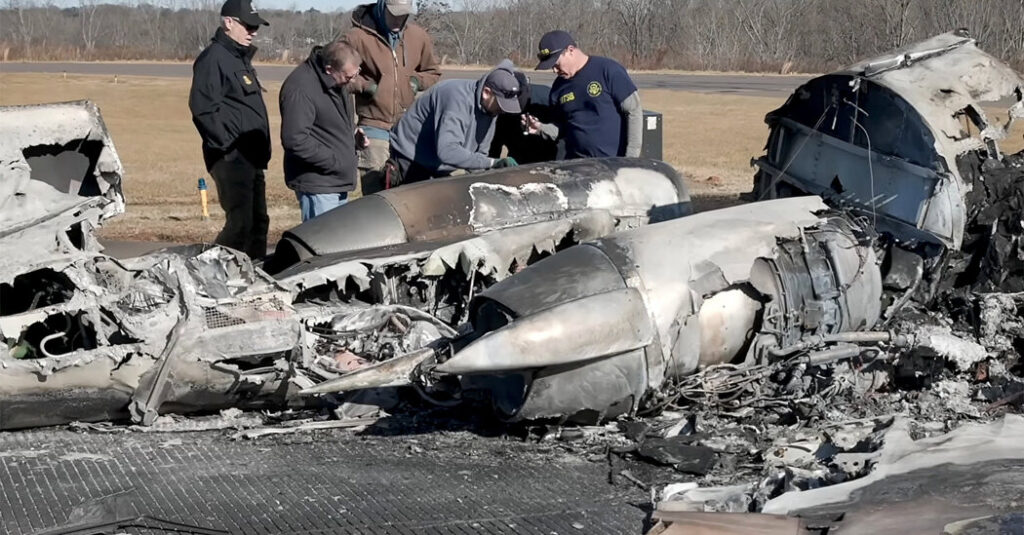
The small passenger jet that crashed in North Carolina last month, killing the NASCAR driver Greg Biffle, his wife and children, and three others, experienced a series of instrument problems in the few minutes it was airborne, according to a preliminary report from the National Transportation Safety Board, which has been investigating the incident.
The successive issues appeared to overwhelm the pilots, who, though experienced, were not qualified to operate the Cessna C550 they were flying on their own, the report said.
The N.T.S.B.’s report indicated that Dennis Dutton and his adult son Jack were at the controls of the Cessna C550, which was registered to Mr. Biffle. Mr. Dutton, whom the report refers to as “the pilot,” served in the Air Force and spent over three decades flying for Delta Air Lines, according to his obituary. But his credentials required him to have a second in command when operating Mr. Biffle’s type of Cessna, the report said, and Jack Dutton — whom the report refers to as “the pilot’s adult son” — was not qualified to serve as a second in command, investigators said.
NASCAR confirmed shortly after the Dec. 18 crash that Mr. Biffle, 55, was among those who died in the crash, alongside his wife, Cristina; his daughter, Emma, 14; and his son, Ryder, 5. The other three passengers were Dennis and Jack Dutton, a father and son; and Craig Wadsworth, NASCAR said.
The N.T.S.B.’s preliminary report draws no conclusions about the cause of the crash, which occurred about 11 minutes after the plane took off from Statesville Regional Airport in North Carolina amid a heavy drizzle and little wind. But the problems appear to have begun even before takeoff.
While taxiing to the runway, the report said, the Duttons and a third person with a pilot’s license, who appeared to be Mr. Biffle, noted that the thrust reverser indicator light for one of the engines was not operational, even though that engine was working. Thrust reversers are used to help slow down an airplane before landing. As the plane accelerated to take off, Mr. Biffle commented that the left engine was producing more power than the right, potentially indicating a faulty gauge. Mr. Dutton continued the takeoff.
About four minutes into the flight, the autopilot disengaged, though the N.T.S.B. could not determine whether that was done intentionally. At about the same time, the cockpit voice recorder audio became unintelligible, a GPS navigation device stopped recording key data and Mr. Dutton noted that his altitude indicator — and possibly other instruments on the left side of the plane — was malfunctioning. He transferred control to his son, seated on the right, as they attempted to circle back to the airport.
About two minutes before impact, the elder Mr. Dutton — whom the N.T.S.B. report indicates had reassumed control of the plane — asked for the landing gear to be deployed. But the gear indicator lights never lit up. About a minute and a half before the crash, the younger Mr. Dutton said on an airport radio frequency that “we’re having some issues here.”
Mr. Biffle then asked Mr. Dutton whether power was flowing to the “alternator” — a device, investigators noted, the Cessna C550 is not equipped with. Seconds later, the audio quality on the cockpit voice recorder was restored, and Mr. Dutton declared that they had identified the “problem,” without specifying what it was.
The pilots caught sight of the runway, and prepared to land. But 1,380 feet shy of the runway, they clipped the bulbs of a light pole, then hit another, and then struck trees before crashing into the ground about 350 feet away from the point of first impact.
While an examination of the wreckage found no evidence of engine failure, the thrust reversers were never deployed. And the thrust levers — which control how much fuel flows to the engine — were in a full-power, forward position, even though investigators found the plane’s airspeed had been decreasing as it approached the runway.
Mr. Biffle’s plane was initially bound for Sarasota, Fla., where he was planning to visit a friend. In 2023, NASCAR named him as one of its 75 best drivers of all time.
Karoun Demirjian is a breaking news reporter for The Times.
The post NASCAR Star’s Plane Had Several Instrument Failures Before Crash appeared first on New York Times.