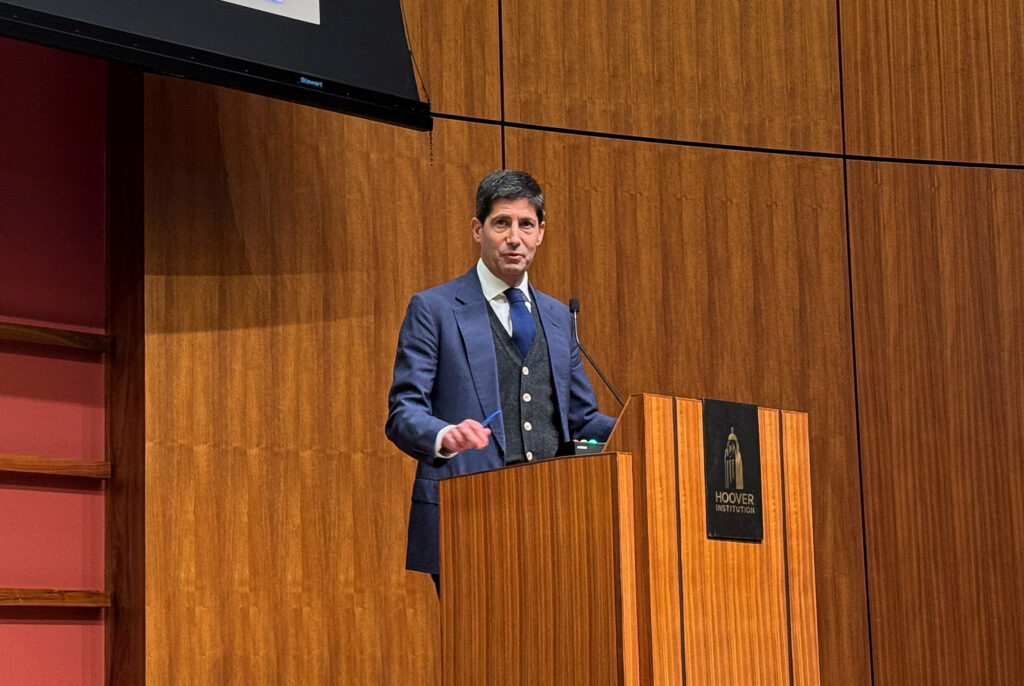
Defusing fears of an unqualified pick, President Donald Trump nominated former Federal Reserve governor Kevin Warsh on Friday to succeed Jerome H. Powell as chairman. Warsh served on the Fed board from 2006 to 2011, a pivotal time in U.S. economic history. The Stanford alumnus has a deep knowledge of financial markets and decades of experience with monetary policy issues.
Now Trump needs to decide what he wants more: Warsh as chairman or his phony criminal investigation of Powell. Sen. Thom Tillis (R-North Carolina) says he believes Warsh to be qualified for the job but that he will block his nomination until the inquiry into Powell is “fully and transparently resolved.”
As a member of the Senate Banking Committee, which considers Fed nominations, Tillis has this power. The committee has 13 Republicans and 11 Democrats. If all other Republicans vote to put the nomination before the whole Senate and Tillis joins all the Democrats to oppose it, the 12-12 tie would mean the nomination does not advance.
This should be an easy decision for Trump: Formally drop the Powell probe, and get your Fed chairman. If no new chair is confirmed when Powell’s term expires in May, Powell would remain in the role.
For Warsh, this is the culmination of years of angling. He has been a critic of the Fed for years, pitching various ideas for reforming the most important central bank in the world. He’s correct to say that the Fed has strayed too far from its congressional mandate, which is stable prices and full employment, not climate change or diversity. The Fed is not supposed to be involved in those areas, and it is poorly equipped to be effective in either. What it can control is interest rates.
Warsh also had a reputation as an inflation hawk, until the monetary dove-in-chief became his best opportunity to get the chairmanship. His intellectual flexibility has been on display in his public commentary.
There isn’t much of a case for rate cuts right now, with the economy growing and unemployment low. Economic growth and low unemployment would ordinarily be the kind of thing a president would celebrate unreservedly, but for Trump it’s a mixed blessing because it means lower interest rates aren’t justified, and the former developer always wants lower rates.
Warsh might give them to him, but he’d still have to convince a majority of the Federal Open Market Committee to go along. Once he’s confirmed for the job, with a term that will outlast Trump’s time in office, he will need to make decisions for the good of the country.
Incidentally, those decisions are also in Trump’s short-term political interest. If unneeded rate cuts spark higher inflation, as economic theory would predict, Republicans will feel the electoral consequences in the midterms and Trump’s approval will take a hit. Inflation remains a top concern for voters and for good reason: It has been above the Fed’s target of 2 percent per year every month since March 2021.
The post Kevin Warsh’s opportunity appeared first on Washington Post.