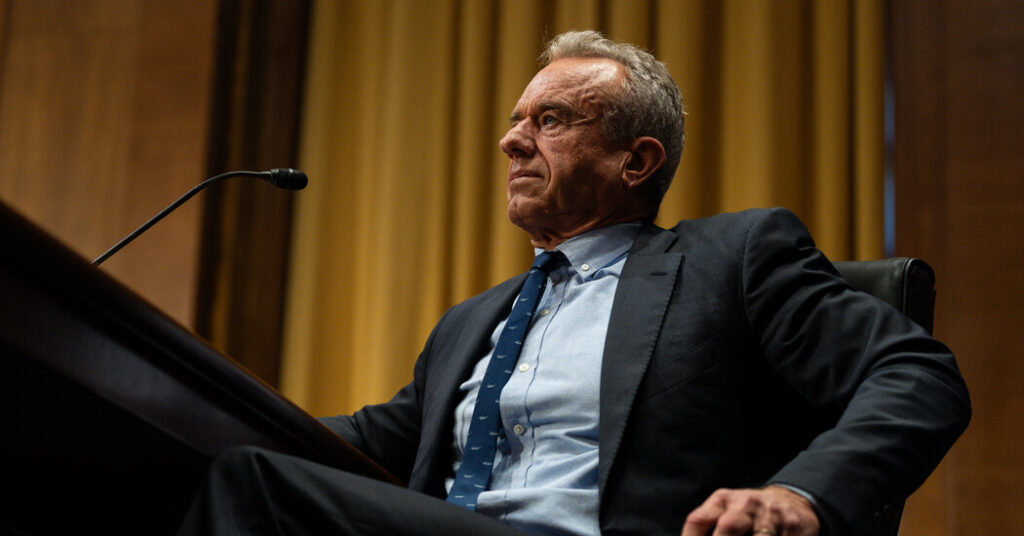
Health Secretary Robert F. Kennedy Jr. has overhauled a panel that helps the federal government set priorities for autism research and social services, installing several members who have said that vaccines can cause autism despite decades of research that has failed to establish such a link.
The panel, the Interagency Autism Coordinating Committee, was established in 2000 and has historically included autistic people, parents, scientists and clinicians, as well as federal employees, who hold public meetings to debate how federal funds should best be allocated to support people with autism.
The 21 new public members selected by Mr. Kennedy include many outspoken activists, among them a former employee of a super PAC that supported Mr. Kennedy’s presidential campaign, a doctor who has been sued over dangerous heavy metal treatments for a young child with autism, a political economist who has testified against vaccines before a congressional committee, and parents who have spoken publicly about their belief that their children’s autism was caused by vaccines.
The group, which also includes 21 government members across many federal agencies, will advise the federal government on how to prioritize the $2 billion allocated by Congress toward autism research and services over the next five years.
Though it’s not yet clear what the committee will do — or what it can do, given that it serves only an advisory function — many longtime autism advocates and researchers said they were alarmed by the fact that the committee seemed stacked to advance Mr. Kennedy’s priorities on vaccines.
“The new committee does not represent the autism community,” said Alison Singer, who served on the committee from 2007 to 2019. Ms. Singer, whose 28-year-old daughter has profound autism, is the head of the Autism Science Foundation. “It disproportionately, excruciatingly so, represents an extremely small subset of families who believe vaccines cause autism.”
The panel has historically been chaired by the director of the National Institute of Mental Health, but the chairwoman of the new panel will be one of the new public members, Dr. Sylvia Fogel, a psychiatrist from Boston who is the mother of a teenager with profound autism.
In an interview on Thursday, Dr. Fogel said she was unaware why she had been chosen to lead the group. “I don’t know how I was selected to be chair, to be perfectly honest,” she said.
She also expressed a more moderate stance toward vaccines than some of her new colleagues on the panel and seemed to push back on the idea that the group would reopen settled science on vaccines and autism.
“Large-scale, population-wide studies of the M.M.R. vaccine and of thimerosal as an ingredient have not demonstrated a causal link with autism,” Dr. Fogel said. “That evidence is important and established. My interest is not in revisiting settled population-level questions, nor in making vaccine recommendations, which is outside the committee’s role.”
But she cited the steadily rising prevalence of autism among U.S. children to argue that more research was needed on whether there are subpopulations that might be vulnerable to vaccines and other environmental exposures. Asked explicitly whether the group might decide to recommend more funding of research into a possible link between vaccines and autism, Dr. Fogel said, “I couldn’t possibly comment on what the committee will recommend at this stage.”
Dr. Joshua Gordon, who served as chair of the committee during his time as the director of the National Institute of Mental Health from 2016 to 2023, said that the new group also showed a striking lack of scientific expertise.
“Not a single scientist that I am familiar with as being an expert in autism research is on that list — and I know many, many such scientists,” Dr. Gordon, who has conducted autism research for 30 years, said.
He added: “There are many important research issues that individuals with autism and their families and their communities care deeply about. Vaccines are not one of them. It is a fringe part of the community, which is overrepresented on this panel.”
The panel has always been highly fractious, reflecting both the very wide spectrum of people with autism — from college graduates who are able to advocate for themselves to the parents of people who cannot speak or live independently — and the many different viewpoints on what the federal government should prioritize to support autistic people.
Former members of the panel also said it had often included some parents who were skeptical of vaccines. Ms. Singer recalled serving alongside Lyn Redwood, a former leader of Children’s Health Defense, the anti-vaccine group founded by Mr. Kennedy, who is now an employee in his Department of Health and Human Services.
She said that those research questions had been entirely valid in the 2000s, when limited data existed on whether there was a link between autism and vaccines. However, several large-scale studies since then have examined the question and found no link, including one that examined the entire child population of Denmark, following more than 650,000 babies born between 1999 and 2010. There was no greater proportional incidence of the diagnosis between vaccinated and unvaccinated children.
Dr. Fogel, the new chair, said the new panel represented many families who had been overlooked by previous iterations of the committee. She cited her own grief as a parent who had seen her 2-year-old son go from a typically developing toddler singing songs and speaking in three- to four-word phrases to, after a respiratory infection, losing all ability to communicate, maintain eye contact or engage socially.
“He was a shell of his former self,” Dr. Fogel said. She was working at Columbia University at the time and recalled: “Nobody could tell me what happened with my son. And no one could offer any treatment.”
She noted that many of the participants on the new panel had shared similar experiences that had not received sufficient research focus. And she argued that genetics research, which has received the bulk of federal autism research funding in the last decade, has not led to meaningful advances for those families.
Some advocates agreed that the new panel reflected a necessary change toward including more voices of people with profound disabilities and their families. But they worried about what the particular members who had been chosen might advocate for instead.
For years, the committee was “led by people on the more high-functioning side of the spectrum,” said Jacqueline Kancir, executive director of the National Council on Severe Autism and the parent of a profoundly autistic 22-year-old daughter.
“There are a lot of parents out there that are jumping for joy, feeling like they’ve finally been heard,” Ms. Kancir said. “However, it also could be retribution. Time really will tell.”
Georgia Gee, Apoorva Mandavilli and Christina Jewett contributed reporting.
Azeen Ghorayshi is a Times science reporter.
The post Kennedy Overhauls Federal Autism Panel in His Own Image appeared first on New York Times.