Since the 1960s, a familiar pattern has unfolded when law-enforcement officers kill or brutalize American civilians. State or local police are accused of excessive force; local residents protest, demanding accountability; the federal government steps in to undertake its own civil rights investigation to provide a measure of justice and restore calm. Think of George Floyd’s murder in 2020; Rodney King’s beating in 1991; the disappearance of James Chaney, Andrew Goodman and Michael Schwerner in Mississippi in 1964.
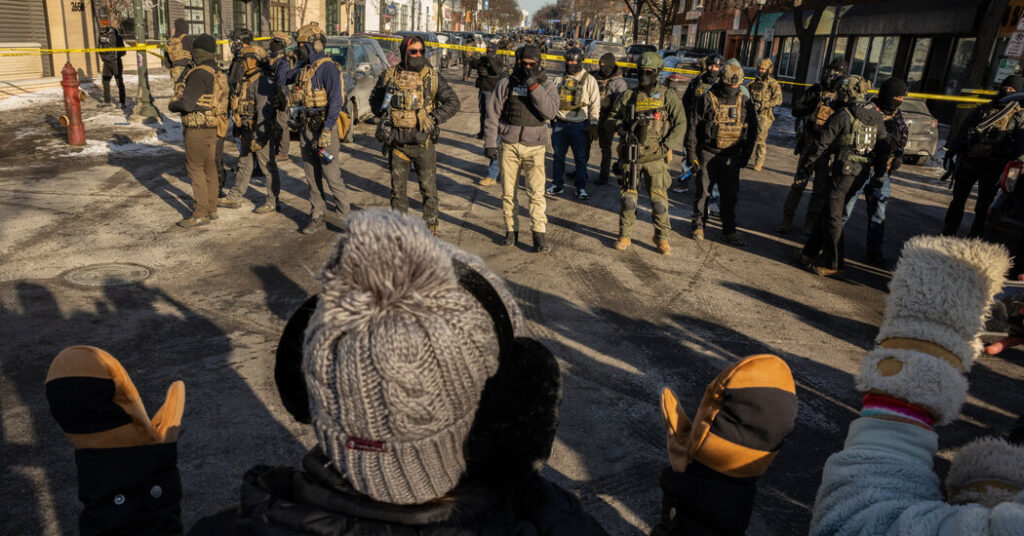
The killings this month of Renee Good and Alex Pretti by federal immigration-enforcement officials have turned this dynamic upside down. And the fight over who will investigate these killings — and if anyone will be held accountable — are part of a growing confrontation between federal and state governments. The balance of power between Washington and the states has been one of America’s central political dramas from the nation’s founding. Now, as it has before at certain dim moments in the country’s history, that delicate system is cracking.
Minnesota is trying to assert its prerogatives by taking the Trump administration to court. One suit seeks access to the evidence related to Pretti’s killing, which the administration has barred state investigators and the county prosecutor from reviewing — while opening only narrowly circumscribed inquiries into the agents’ use of force in killing Pretti and Good.
Minnesota officials have reason to fear that if the state cannot do a full and independent investigation, no one will. Kristi Noem, secretary of the Department of Homeland Security, made the outcome of any investigation sound like a foregone conclusion by accusing Good and Pretti of attacking the agents who killed them — despite all the video evidence to the contrary. Then the Trump administration took the unusual step of putting Noem’s agency in charge of the investigation, asking the public to trust that D.H.S. will oversee itself. The decision to box out state and local officials is “contrary to core principles of federalism embodied in the U.S. Constitution,” the complaint states, relying on the 10th Amendment. Minnesota “has a core sovereign interest in investigating and enforcing its own criminal laws.” Another suit, also citing the 10th Amendment, challenges the federal immigration surge as a violation of state sovereignty.
The 10th Amendment, which reserves to the states or the people the powers that the Constitution does not delegate to the federal government, is the legacy of James Madison. He was the Virginia framer who would worry most after the founding about protecting states from federal overreach. Madison saw the United States as a “compound republic,” ascribing to the national government “few and defined” powers, mostly over war and foreign relations, he wrote in the Federalist Papers in 1788, and reserving “numerous and indefinite” authority over “the lives, liberties and properties for the people” to the states.
When President John Adams expanded federal power a decade after the founding, by backing the Alien and Sedition Acts — which made it a federal crime to criticize the president or Congress — Madison urged states to fulfill the right and duty to protect their citizens against a “dangerous exercise” of unconstitutional federal power.
But then states’ rights became a tool of the antebellum South. In the 1830s, John C. Calhoun of South Carolina, a former vice president, said the states could “veto” federal tariffs. Jefferson Davis, president of the Confederacy, said in the run-up to the Civil War that the 10th Amendment allowed for secession because the states didn’t give the federal government the power to suppress it.
When the war ended, federal authority was necessary to stitch the country back together and, for a brief time, implement Reconstruction. And in response to a wave of terror against Black people that Southern states abetted, Congress made it a federal crime in 1866 for anyone acting “under color of law to willfully deprive another of rights protected by the Constitution.” When Congress and the states ratified the 14th Amendment in 1868, the federal government became the guardian more broadly of civil rights.
The federal government rarely enforced the 1866 law during the era of Jim Crow and has never done so perfectly. But the lesson of Minneapolis in the last few weeks is that trying to resurrect Madison’s construction of state power, as a bulwark against federal abuse, is fraught. That’s not only because states’-rights arguments remain associated with discredited causes like the fight against desegregation. It’s also because in the decades when the federal government was protecting civil rights, it amassed enormous power.
The 10th Amendment isn’t dead. But the Supremacy Clause in the Constitution, which gives primacy to federal law, has gained more sway. Since the New Deal, under which federal agencies expanded, the Supreme Court has ruled that federal laws pre-empt state laws if they conflict.
However unfortunate it would seem to Madison, today there is no easy path for a state to vindicate the rights of its residents when the federal government is accused of trampling them. “Minnesota versus the federal government is a David-versus-Goliath story,” said Jefferson Cowie, a historian at Vanderbilt University and the author of “Freedom’s Dominion.” “Maybe you get a one-off win here or there. But it’s not a long-term strategy.”
Making Up for Lapses in Justice
After Reconstruction, for many decades the federal government did little about state-perpetrated violence. Southern sheriffs, for example, had relative impunity to abet lynchings and beatings of Black Americans. Then in 1957, the Justice Department started a civil rights division. Its first leader, John Doar, lived in a dorm for weeks with James Meredith during his struggle to register for classes in 1962 as the first Black student at the University of Mississippi.
Two years later, Chaney, Goodman and Schwerner were in Mississippi to register Black voters when they disappeared after a county deputy sheriff, Cecil Price, arrested them for speeding. He later tipped off the Ku Klux Klan to their whereabouts (or handed them over).
When the state failed to investigate, the F.B.I. flooded the area with agents. With the help of an informant, the men’s bodies were found in an earthen dam. The state refused to charge anyone in connection with the murders. Doar conducted a civil rights investigation based on the 1866 law, and seven men were convicted, including Price, who served four and a half years in prison. “That’s how some justice movements started to get recourse from the federal government,” says Joshua Clark Davis, a historian at the University of Baltimore and the author of the new book “Police Against the Movement.” “It was a travesty that the defendants were never charged with murder. But convicting them of civil rights violations was much better than nothing.”
Since then, the F.B.I. and the Justice Department’s civil rights division effectively made up for state lapses in response to a series of law-enforcement shootings that threatened to set communities, or the country, on fire. Democratic presidents tended to be more likely than Republicans to investigate a whole police department for a “pattern or practice” of discrimination, as federal law also allows. But Republican administrations have also been aggressive about pursuing individual police officers in instances of state-based violence. Various officers who committed crimes — the ones who beat Rodney King in 1991, those who shot six unarmed civilians on a New Orleans bridge after Hurricane Katrina in 2005 and those who murdered George Floyd in 2020 — received prison sentences based on civil rights investigations opened by the respective Justice Departments of George H.W. Bush, George W. Bush and Donald Trump in his first term.
At the same time, it’s notable that many federal investigations of shootings by law enforcement conclude without a prosecution. The standard for bringing charges is high: Officers are authorized to use deadly force when they reasonably perceive a serious threat. The law leans in their favor given the split-second decisions they make in the line of duty. “These cases are hard to prosecute,” says Vanita Gupta, a Justice Department official in the Obama and Biden administrations. “I had to close investigations any number of times. But the public could have confidence that the Civil Rights Division had conducted an independent, full, and fair investigation. Until now.”
One difference regarding the deaths of Good and Pretti is that federal agents, not state or local law enforcement, did the killing. In a sense, the 1993 federal siege of the Branch Davidian compound in Waco, Texas, is an antecedent — and though the Davidians were largely blamed for starting the fires and gun battle that ended in mass deaths, Attorney General Janet Reno appointed a special counsel to investigate. In the absence of an independent Justice Department investigation, Gupta warned, federal agents “can act with impunity, and that is incredibly dangerous.”
Drew Evans, the superintendent of the Minnesota Bureau of Criminal Apprehension, which usually investigates an officer’s use of deadly force, has vowed the state will continue its inquiry. Mary Moriarty, the local prosecutor, directed people to submit video evidence through an online portal. On Tuesday, following a barrage of bipartisan criticism, Trump promised a “very honorable and honest” inquiry. But the president continued to blame Pretti for legally carrying a gun at a protest, even though one federal officer had already seized it before another opened fire. And there’s no federal civil rights investigation.
The Coming Clashes With the States
The investigations into Good and Pretti’s deaths are the most urgent clash between Minnesota and Washington, but others are building.
From the Trump administration’s point of view, state and local officials are the lawless ones, impeding the federal government from enforcing the nation’s immigration statutes.
The tension stems from the sanctuary cities movement. In December, Minneapolis strengthened the ordinances that restrict cooperation with federal immigration enforcement, barring the use of any city resources or data-sharing. The police aren’t allowed to set up perimeters or control traffic when ICE and border-patrol agents conduct arrests. (The Supreme Court has ruled that the federal government can’t commandeer state officials to perform federal duties.)
More states and cities are considering such laws. A new list of bills would directly challenge federal tactics, for example, by banning the masks that federal agents now commonly use to hide their identities. A group of progressive prosecutors including Mary Moriarity, the county attorney with jurisdiction in Minneapolis, announced this week that they’re banding together to assist in prosecuting federal officers who break state laws. The idea, Moriarty said, is to share knowledge across cities and reduce the sense of isolation that comes with crisis.
Her office would certainly face legal hurdles to prosecuting the officers who killed Good and Pretti. Among other issues, federal officers have some immunity from state prosecution. “But I keep saying it’s not absolute,” Moriarty said. “There has to be some form of accountability. You don’t get deterrence by saying to ICE, ‘No one can touch you.’ ”
It’s telling that after Good’s death, the Trump administration trained its power of criminal investigation on several Minnesota officials, including Gov. Tim Walz, Minneapolis mayor Jacob Frey, state Attorney General Keith Ellison and Moriarty. The F.B.I.’s top public-corruption agent in Minneapolis resigned rather than conduct the inquiry. Six federal prosecutors resigned in mid-January over an order to investigate Renee Good’s widow. A seventh resigned this week, and more are considering doing so.
As the federal and state moves and countermoves multiply, it’s a sign of how the federalist compact is splintering. And yet state and local power are important as a counterweight when the president uses the national government to act like an authoritarian. Madison was right about that.
“We can’t stop what the federal government is doing,” Moriarty said. “Our actions may seem like a small piece. But they are a big piece to people here. They are showing up for each other, and trying to stand up to their own federal government, and they are asking, ‘Who is here to protect us?’ We have a lane here. We are doing our job.”
The post In Minnesota, America’s Federal System Is Coming Apart appeared first on New York Times.