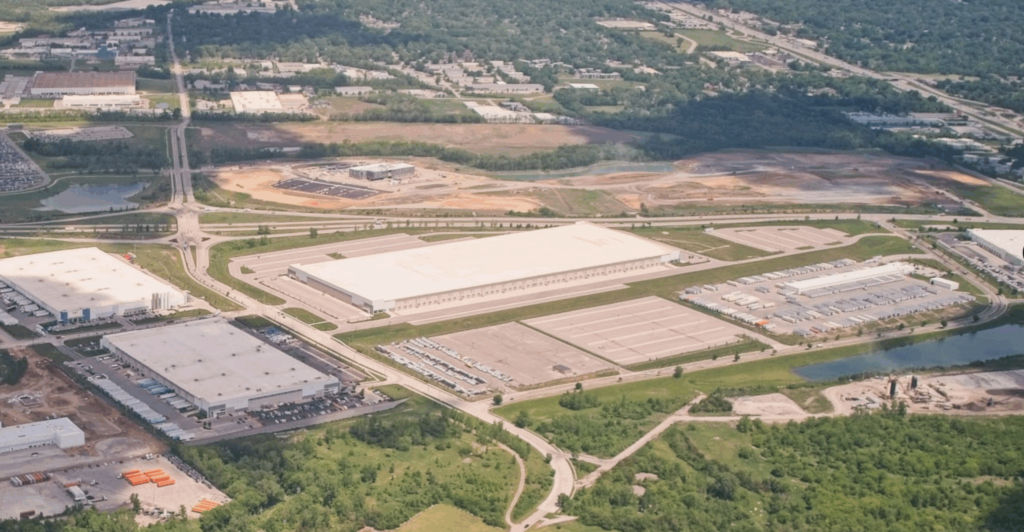
One industrial building the federal government plans to overhaul into an immigrant detention center, in Roxbury, New Jersey, draws groundwater from a small town that uses nearly all of its daily limit.
Another proposed detention site is a warehouse in Oklahoma City that would hold up to 1,500 people a little more than a mile from an elementary school and a Pentecostal church.
A third location, previously an auto parts distribution center in Chester, New York, became so unbearably hot during summer months that two people who used to work there said it was akin to being stuck inside an aluminum shed.
Those are a few of the logistical and humanitarian concerns raised by residents and local officials in some of the 23 towns where U.S. Immigration and Customs Enforcement plans to convert industrial buildings into detention centers that would combined hold up to 80,000 people. ICE has offered few details about its plan since The Washington Post first reported on it last month.
As specific sites have surfaced in news reports, people in those communities have taken steps to block the projects.
“I’m not sure that this is the type of detention that is humane,” Quinton Lucas, the mayor of Kansas City, Missouri, said in an interview about plans to transform a warehouse there into an ICE facility that could hold up to 7,500 people. On Jan. 15, the same day that local news photographers documented ICE officials inspecting the building, the city council passed a five-year ban on all new nonmunicipal detention facilities.
ICE expects to hold between 1,500 and 10,000 detainees in each of these 23 warehouses at a time, according to documents and interviews. But some experts have warned that it will be difficult to bring the industrial buildings up to federal standards for detention facilities in the short time before ICE plans to begin housing people in them.
The expansion of ICE’s detention system would help fulfill President Trump’s goal of deporting millions of people by creating a hub-and-spoke model capable of booking migrants into processing centers for a few weeks and then transporting them to large-scale facilities where they would await deportation.
Tricia McLaughlin, an assistant secretary at the Department of Homeland Security, declined to answer questions about specific properties, or about whether they can be converted to meet standards, but said the agency “has new funding to expand detention space to keep these criminals off American streets before they are removed for good from our communities.”
“It should not come as news that ICE will be making arrests in states across the U.S. and is actively working to expand detention space,” McLaughlin said in the statement.
DHS bought two warehouses this month, one in Williamsport, Maryland, for $102 million and another in Surprise, Arizona, for $70 million, deed records show. In recent weeks, ICE officials have also begun notifying warehouse owners and local officials in several other cities of their interest in specific properties.
Located in areas zoned for industrial uses near interstates and airports, most of the buildings under consideration are currently vacant shells — little more than walls, a thick concrete floor and a ceiling supported by dozens of internal beams, according to promotional materials and commercial real estate databases.
Last month, a DHS official wrote to Oklahoma City’s planning department of its intent “to purchase, occupy and rehabilitate a 26.8-acre warehouse property” into an ICE processing center. The agency said renovations may include the construction of holding spaces, offices, visitor areas, cafeterias, bathrooms and medical units, according to the letter, which was first reported by The Oklahoman.
On Thursday, following pushback from residents, Oklahoma City Mayor David Holt said in a Facebook post he had spoken with the building’s owner, who told him they are no longer in talks to sell the building to the federal government.
DHS also wrote to planners in Hanover County, Virginia, about plans to purchase and overhaul a 553,000-square-foot facility in Ashland, according to a copy of the letter provided to The Post and other media. The warehouse was recently built on the site of a former cattle farm, 15 miles north of Richmond.
Earlier this month, television cameras filmed David Venturella, an ICE senior adviser, leaving a 440,000-square-foot building in Orlando as part of a review of the building he described to local television station WFTV as “exploratory.” Orlando officials told The Post the federal government has not contacted them about the plan.
In Williamsport, a town with a population of 2,000 just outside Hagerstown, Maryland, community members found out about plans for a detention center only after ICE purchased an 826,000-square-foot building there. The federal government is not required to get local approval as other developers might because the U.S. Constitution generally exempts it from local laws when it is carrying out a federal duty.
Local leaders in Maryland say DHS notified them two days before the purchase, in a Jan. 14 letter to the county planning department that described some of the agency’s proposed changes to the property, according to a county press release.
“Planning a detention facility behind closed doors is not governance — it is intimidation,” Rep. April McClain Delaney (D) said in a press release on Tuesday. The purchase was first reported by Project Salt Box, a Baltimore newsletter.
Virginia Mungovan, a spokeswoman for the city of Surprise, Arizona., said the city was not notified before DHS’s purchase of a 418,400-square-foot, newly constructed warehouse in the suburb northwest of Phoenix. The transaction was first reported Thursday by AZCentral.
ICE expects the buildings in Williamsport and Surprise to begin accepting detainees by April, according to a person briefed on the plan, who spoke on the condition of anonymity to discuss internal agency matters.
Local officials in Roxbury said DHS informed them of plans to buy a building there, and an ICE official joined a recent warehouse tour in Social Circle, Georgia, according to The Post’s analysis of photos of the visit. The Post obtained a spreadsheet that lists nearly two dozen properties that ICE officials apparently planned to tour this month but could not verify its authenticity. DHS did not respond to questions about it. The Post, however, confirmed ICE’s interest in eight of those facilities, and several building tours occurred at the time and locations specified in the document.
In at least 15 communities, residents have staged protests or packed town council meetings, overwhelming local elected officials with questions about the proposed facilities. Locals have shown up at locations identified on the unconfirmed ICE list, which has circulated on social media, with cameras to document tours.
When Salvatore LaBruna learned from a local news story that ICE planned to take over the former Pep Boys auto parts warehouse near his home in Goshen, New York, he drove his 16-year-old son to see the building. LaBruna, 47, said he used to pack brake pads, struts and motor oil containers into plastic tubs when he worked there a summer after college, more than 25 years ago, and that the building sweltered because of poor ventilation and minimal cooling systems.
David Dalessandro, 37, who worked there from 2020 to 2022, said he routinely had to bring an extra shirt to replace the one he would sweat through.
“It doesn’t seem like it would be suitable for housing people in any way,” LaBruna said.
The auto parts distribution center closed in 2024. The property’s owner said in a promotional flier that it recently completed $3 million in improvements but did not specify them. The owner did not respond to requests for comment.
Some state and local officials have begun girding for battles over the proposed detention centers, saying they would overwhelm local infrastructure, violate zoning laws and potentially threaten the safety of their communities.
Because the auto parts warehouse is in a floodplain, DHS was required to file a public notice that it intended to buy and rehabilitate the building. The county government responded with a legal objection, saying the plan would violate zoning, deprive the community of tax revenue and overwhelm its sewage system.
Lucas, the Kansas City mayor, said he’s prepared to defend the city’s new moratorium against legal challenges, comparing it to a previous ordinance banning landfills. The property, built with $80 million in incentives from the Kansas City port authority, is advertised by the port authority as having tax advantages for stored goods and access to “Class I freight rail services from the Canadian Pacific Kansas City Southern.”
ICE’s plan, envisioned in a December draft of a solicitation document previously reported by The Post, calls for an expansive overhaul of the 23 properties, by adding housing units, kitchens, dining areas, medical care rooms, pharmacies, bathrooms, religious service rooms, mailrooms, phone systems, law libraries with internet access, attorney meeting rooms, and indoor and outdoor recreation areas with basketball hoops and exercise equipment.
Despite the need for extensive upgrades, ICE expects facilities to begin accepting detainees within 30 to 60 days after “final design approval and construction start,” according to the solicitation document.
Meeting federal standards for immigrant detention — which were not written envisioning the use of large open warehouses — could be costly and challenging for some of the buildings ICE is targeting, said Eunice Cho, an attorney who advocates for immigrant detainees at the American Civil Liberties Union’s National Prison Project.
For example, the standards require specialized rooms with negative pressure ventilation to treat people suspected of having tuberculosis. “Rehabbing a warehouse to ensure sufficient airborne infection isolation may be difficult,” Cho said.
Officials in cities including Social Circle and Roxbury have raised concerns about the lack of water to adequately supply the planned facilities given their size. If water is not available from a community source, a state laboratory would have to test samples to comply with potable water standards, the federal standards say. The contractors operating ICE’s makeshift tent encampment in the Florida Everglades deliver drinking water to the site in 2,000-gallon and 6,000-gallon tanker trunks, according to a state planning document included in court records.
ICE already struggles to uphold standards at some existing facilities. Last September, its own inspectors found 60 violations of federal standards at Camp East Montana, a series of large tents erected on a patch of desert in El Paso, in the span of a few months. The facility is now the country’s largest ICE detention center, with 3,800 detainees.
Most owners of the 23 buildings on the list did not respond to The Post’s inquiries or declined to comment on any discussions with the agency. Terry Anderson, co-president and co-founder of Kansas City warehouse owner Platform Ventures, said he’d completed negotiations to sell its 920,000-square-foot building and that the company “does not question prospective buyers on their intent after close, and we will not engage in public conversations involving speculation over future uses.”
PNK Group, the company that owns the Georgia property, a newly built 1 million-square-foot warehouse, said it had heard from several interested buyers and that “any future use of a property following its sale is determined solely by the purchaser.”
ICE has faced local opposition in the places where it operates detention centers, including during prior administrations. But few towns have successfully stopped their development. Courts have frequently sided with the federal government’s authority to circumvent local laws when it can argue that those ordinances obstruct its ability to carry out federal policy, said Rick Su, a law professor at the University of North Carolina.
Seeing the building in Chester, New York again recently and talking about it with his son, LaBruna said the structure now feels like a symbol of how Trump’s immigration crackdown could soon be shaking up his normally quiet town in the Hudson Valley.
“It definitely makes it feel very close to home,” he said.
Aaron Schaffer and Arelis R. Hernández contributed to this report.
The post ICE buys warehouses for mass detention network, rattling locals appeared first on Washington Post.