The reliability of the electric grids that power the United States and Canada is “worsening” and tens of millions of people face a growing risk of blackouts over the next five years, according to a group that monitors most of North America’s electricity system.
That’s because demand for electricity is rising quickly, led by a boom in data centers. At the same time, utilities are retiring older coal- and gas-burning plants and aren’t adding enough generation to dependably meet growing demand, according to an annual assessment released Thursday by the North American Electric Reliability Corporation, a nonprofit organization that works closely with federal regulators.
“We are headed for a reliability crisis, except now the crisis is not over the horizon, but across the street,” Mark Christie, a former U.S. federal grid regulator, said in response to the report.
The people most at risk of electricity shortfalls within the next five years are in areas of Texas, the upper Midwest, the Mid-Atlantic region and the Pacific Northwest, according to the report.
In the worst-case scenario, a shortage of power could mean life-threatening blackouts during an intense heat wave or cold snap when the grid is particularly strained.
The most severe example recently came during a massive winter storm in Texas in 2021. The state’s grid, which is unusual in that it is largely isolated from grids in the rest of the country, lacked sufficient power to meet soaring demand during the cold and suffered extensive blackouts. More than 200 people died during the storm.
The report adds to the continuing political debate over the state of the nation’s electricity system.
President Trump has said that policies to fight climate change and promote wind and solar energy have weakened the reliability of electric grids, since wind turbines and solar panels can’t run at all hours. His administration has declared an energy emergency and pushed to build more natural gas plants and, more contentiously, has used emergency powers to prevent older coal plants from retiring.
Proponents of renewable energy, for their part, say that Trump administration efforts to hinder wind and solar projects are depriving the grid of a fast-growing source of power.
The recent winter storm intensified those arguments.
During periods of particularly bitter cold this week, such as the early hours before dawn, wind turbines and solar panels were often producing relatively little power in parts of the country, and regional grid operators in places like the Mid-Atlantic had to rely overwhelmingly on a mix of coal, gas and nuclear power plants as demand for home heating skyrocketed.
The coal industry and the Trump administration have pointed to that as reason to stop further retirements of coal power plants, which in recent years have often been replaced by cleaner and often cheaper gas, wind and solar power. Last year, the Energy Department ordered eight coal-burning generators that had been headed for retirement to stay open, although at least two are broken and require investment to restart.
“I can say with some confidence hundreds of American lives have been saved because of your leaning in and stopping the killing of coal,” Energy Secretary Chris Wright said to Mr. Trump during a cabinet meeting this week. “Coal over the last few days, where we were at peak demand with electricity, has delivered 20 times more electricity than solar and batteries.”
Coal produces more air pollution and contributes more to global warming than other energy sources. Last year, America’s planet-warming emissions increased after falling for two years because of rising coal use.
Clean-energy groups point out that some coal and gas plants were knocked offline during the recent winter storm, and in places like Texas, batteries helped fill the gap during critical hours. Solar and wind power also helped lower hourly electricity prices in parts of the country when they were operating.
Adding more renewable energy and batteries can “increase resource diversity and support affordability by minimizing fuel-based price spikes,” said Heather O’Neill, president of Advanced Energy United, a trade group whose members include wind, solar and battery companies.
The new report from the North American Electric Reliability Corporation said that grid operators would need to take significant action to avoid extensive power outages in the future.
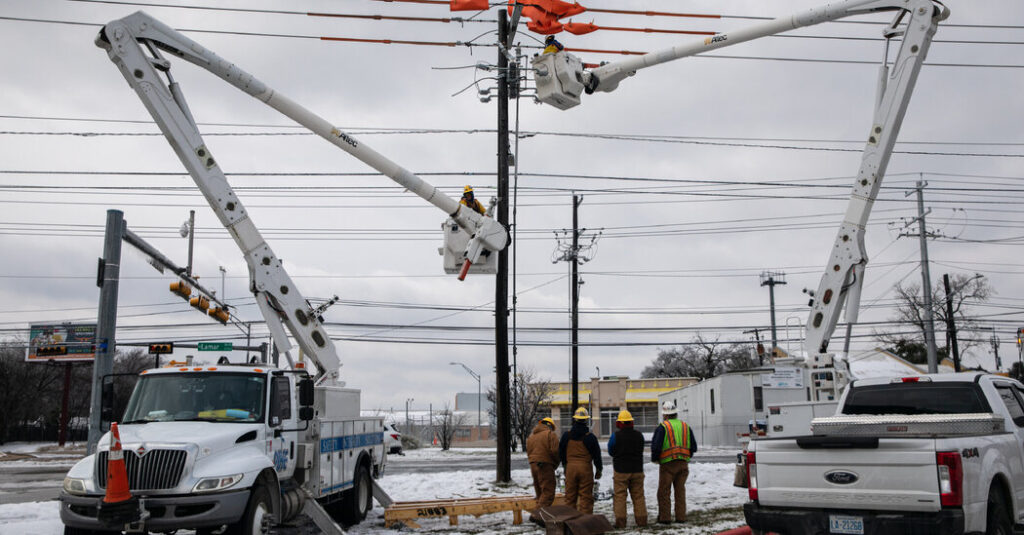
While the vast majority of smaller blackouts happen because of problems on local power lines — such as falling trees or ice — the report focuses on threats to the so-called bulk power system, assessing whether parts of the country might not have sufficient supplies of power to meet periods of peak demand, a situation that can create more widespread problems.
Over the next five years, solar power and batteries are expected to make up most of the new electric generation coming online, while more coal and gas plants are expected to be closed.
That would “increase the complexity of planning and operating a reliable grid,” the report said, because a growing share of generation won’t be able to run at all hours, risking a shortfall when electricity is needed most.
Peak electricity demand during summers and winters is also expected to increase more than 20 percent nationwide between now and 2035, the report said, because of a projected rise in demand from data centers for artificial intelligence, new factories, electric vehicles and electric heat pumps. At the same time, more severe heat waves exacerbated by global warming or unusual cold snaps can put heavy strain on the grid.
Some regions are starting to prepare. In MISO, a grid spanning 15 states in the Midwest and South, more than one-third of coal plants are set to retire by 2030. But the grid operator recently instituted a plan to speed up the connection of new gas plants and batteries over the next five years. If that plan succeeds, the report said, the region should have adequate supplies of electricity even as coal power continues to shrink.
Similarly, California is no longer listed as being at high risk of blackouts, as it was three years ago. The state has added large installations of batteries the size of shipping containers to its electric grid, which can store power from solar panels when it’s plentiful and save it for periods of high demand. Those batteries have helped California reduce the risk of blackouts during hot summer months.
The report recommends other steps to improve grid reliability, including speeding up permitting processes for building new power plants and transmission lines, as well as policies to ensure that large new sources of demand like data centers don’t overwhelm the grid.
It also suggests that utilities and grid operators should be careful about shutting down older coal and gas plants too quickly.
“This assessment is not a prediction of failure, but an early warning,” said John Moura, director of reliability assessment and performance analysis at the North American Electric Reliability Corporation. “The path forward is still manageable but only if planned resources come online and on time.”
Brad Plumer is a Times reporter who covers technology and policy efforts to address global warming.
The post Grids Are Surviving the Storm. But the Next 5 Years Could Be Rough. appeared first on New York Times.