Mayor Zohran Mamdani swept into power with a promise of “fast and free buses,” a slogan that captivated New York City voters and policymakers alike.
But it’s the free part — a proposal that could cost the state more than $1 billion a year in lost fare revenue — that is vexing some transportation experts, who consider the plan implausible or misguided.
Now, one influential planning group is trying to change the mayor’s mind with an even bigger moonshot plan: to expand the city’s century-old subway system.
The money that would be spent to make city buses free could instead fund the construction of 41 miles of subway extensions, according to a report released on Friday by the planning group, the Marron Institute of Urban Management at New York University.
The added stations would be in overlooked parts of the city where new transit options could spur the construction of thousands of new units of affordable housing, the researchers said.
For New Yorkers who have watched the state spend many years digging some of the most expensive subway tunnels in the world, the plan could be hard to fathom.
But Eric Goldwyn, a program director at the institute and an author of the report, said that even if just a fraction of the plan were to be completed, the subway expansion would be a far better use of state funds than the bus subsidy, and it could help tackle the affordability crisis in a more meaningful way.
“Free buses, from my perspective, is not transformative or generational in the way that this is,” Mr. Goldwyn said, arguing that the subway plan would be more likely to hasten real estate development. A citywide zoning change under former Mayor Eric Adams allowed for greater housing density near train stations, and this plan could encourage more building in the neighborhoods, he said.
“People are not leaving New York City because the bus fare is too high. They’re leaving because they can’t afford the rent,” Mr. Goldwyn said.
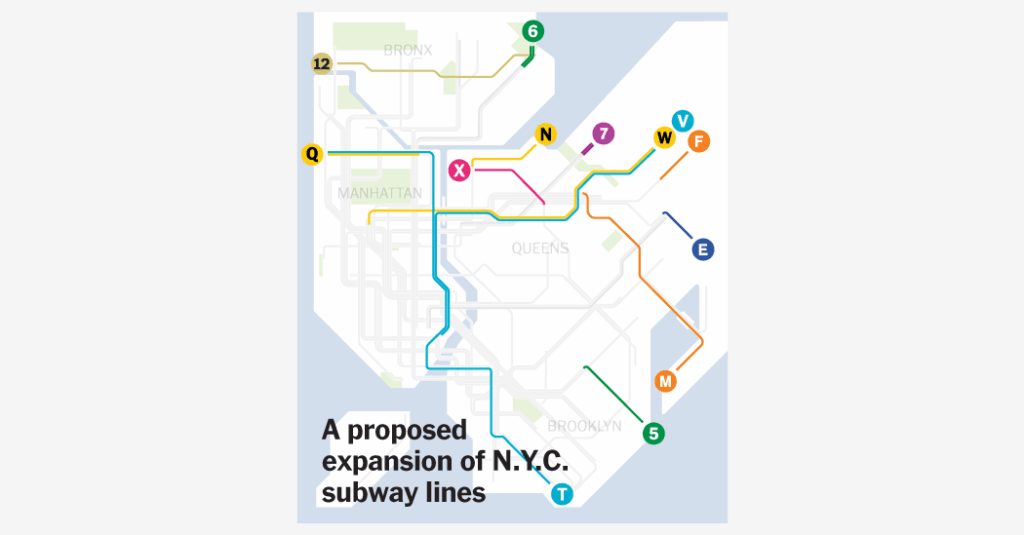
The report, titled “A Better Billion,” details a four-decade plan to embark on 12 subway projects that could add a total of 64 new stations in Manhattan, Queens, Brooklyn and the Bronx. The expansion could lead to the construction of more than 167,000 new apartments near the stations, the researchers said, without major land-use changes, at a time when the city is facing a severe housing shortage.
Mr. Mamdani made free buses a central tenet of his campaign, which focused on making pragmatic changes for New Yorkers who struggle to afford life in the city, and it resonated with voters. His campaign said it could cost $800 million a year to subsidize buses, but transit officials argued that the sum is closer to $1 billion a year.
Like the bus plan, the subway proposal would require the cooperation of Gov. Kathy Hochul and the Metropolitan Transportation Authority, the state agency that runs the transit systems.
“Mayor Mamdani campaigned on making the slowest buses in the country fast and free, and he intends to keep that promise,” Matt Rauschenbach, a spokesman for the mayor, said. “He understands that working New Yorkers need affordable options to get to work, visit friends and family, and explore the city that we all love.”
Mayor Mamdani has said he wants to build 200,000 new homes over the next 10 years.
The first wave of proposed subway projects would include building a Utica Avenue line in Brooklyn, a project the M.T.A. has considered; a westward expansion of the Second Avenue Subway line in Harlem, which Governor Hochul has supported; and reviving long-abandoned rail tracks that connect to the Rockaways, a plan that supporters call QueensLink.
Later enhancements could include a subway line along part of the Long Island Expressway, an extension of the N train to LaGuardia Airport and new 7 train stations in Flushing.
Then there are tantalizing upgrades for map buffs: A No. 12 line in the Bronx, the return of the V train, and an extension of the planned Interborough Express light rail connecting Brooklyn and Queens, depicted in hot pink.
Besides the ambitious construction schedule, there are other obstacles.
The subway plan assumes that the money that would be spent to subsidize free buses can be diverted to these projects. But bus fares help cover the M.T.A.’s $21 billion annual operating budget, which primarily pays for labor and utility costs, not construction.
In April, Governor Hochul approved the authority’s biggest ever capital plan, $68 billion over five years, but a vast majority of that sum will be spent on deferred repairs and improving existing service.
Forging ahead with new projects could distract from the more pressing goal of improving the current subway, a task that could take much more time and money than has been allocated in the current capital plan, said Andrew Rein, the president of the Citizens Budget Commission, a fiscal watchdog group.
“If we don’t do the essentials, we’re going to spend more in the long run, and the system will be crumbling around us,” he said.
Big infrastructure plans also typically rely on large contributions from the federal government, and the Trump administration has already threatened to withhold funding from a number of transportation projects in the state.
Then there is the M.T.A.’s track record with big digs. The first phase of the Second Avenue Subway, completed under former Gov. Andrew M. Cuomo, cost $2.5 billion per mile, making it one of the most expensive tunneling projects of its kind in the world. The project added three new stations; construction took a decade.
Proponents of the bus plan say it has many merits and would be broadly beneficial. One in five New Yorkers struggles to pay for public transit, a burden disproportionately borne by Black and Latino commuters and working mothers, according to a 2024 report by the Community Service Society of New York, an antipoverty group. Bus riders tend to be older and poorer than subway riders.
Some transit experts argue that the bus system’s high rate of fare evasion is another reason to make it free. New York City buses carry 2.6 million riders on an average weekday, but nearly half of them evaded the fare last quarter, according to M.T.A. data.
Riders Alliance, an influential transit advocacy group, supports free buses, as well as an expansion of a city program, Fair Fares, that offers half-cost transit to lower-income commuters.
Danny Pearlstein, a spokesman for Riders Alliance, said support for free buses should not preclude people from also backing an expansion of the subway system. Recent transit investments under Governor Hochul have shored up both capital and operating budgets for the authority, and it should now endeavor to achieve big things, Mr. Pearlstein said.
“We should do both,” he said.
Kate Slevin, the executive vice president of the Regional Plan Association, an urban policy research group, said that while the Marron report asks good questions about the utility of the bus plan, it remains unclear whether the subway expansion proposal is the right alternative.
“Every dollar that’s raised for the transit system is coming from revenue through tolls and fees and fares or some sort of tax,” she said. “That money is hard fought, and it’s not easy to raise additional revenue for transportation.”
Governor Hochul has repeatedly opposed raising taxes, the most likely revenue source for the bus subsidy. And Janno Lieber, the chief executive of the M.T.A., has not endorsed free buses, arguing that the plan needs more study.
A spokesman for the authority declined to comment on the report.
A projected $12.6 billion gap in the city’s budget over the next two fiscal years could also hinder the bus plan, as the mayor aligns his fiscal priorities.
Even as more transit experts raise questions about free buses, there is strong support for Mr. Mamdani’s plan.
Jon Orcutt, a former policy director at the city’s Department of Transportation, said he had reservations about making buses free, but that the proposal was clearly popular, and could provide immediate relief to struggling New Yorkers in a way that long-term plans to build subway lines and housing would not.
A 2025 New York Times/Siena polling experiment surveying two groups of likely voters showed 56 percent supported making the buses free, even as 57 percent said the city “should not do this.”
Still, the promise of free buses was central to Mr. Mamdani’s campaign, Mr. Orcutt said. “You’ve got to give him a shot at this.”
Stefanos Chen is a Times reporter covering New York City’s transit system.
The post Free Buses? How About Expanding the Subway by 41 Miles Instead? appeared first on New York Times.