The two inmates were both staring down decades in prison for murders in New York City that they adamantly denied committing.
One, Allen Porter, had been convicted of a 1991 double murder of a couple sitting in a car parked in a Queens housing project. The other, Jabbar Collins, had been convicted in a 1994 murder of an Orthodox rabbi in Williamsburg, Brooklyn.
They met at Christian services at Green Haven Correctional Facility, a maximum-security prison in upstate New York, Mr. Collins said, and bonded quickly over their devout faith and claims of innocence.
Mr. Collins was working tirelessly in the prison law library to get his conviction overturned, which a federal judge finally did in 2010 after he had served 16 years.
His exoneration helped expose corruption in the Brooklyn district attorney’s office at the time, and he won $13 million in city and state compensation.
Mr. Porter was not so fortunate, even with Mr. Collins’s assistance. But Mr. Collins left prison vowing to keep his longstanding promise to help his prison buddy get exonerated, too. He went on to become a legal researcher with his own firm, and has helped win the release of other wrongfully convicted people.
Mr. Collins’s 27 years of work, both inside prison and out, finally paid off on Friday as a Queens judge overturned the double-murder conviction of Mr. Porter, who has spent nearly 34 years behind bars.
“I never stopped believing that the truth would come out,” Mr. Porter, 54, said in a statement issued by his lawyers.
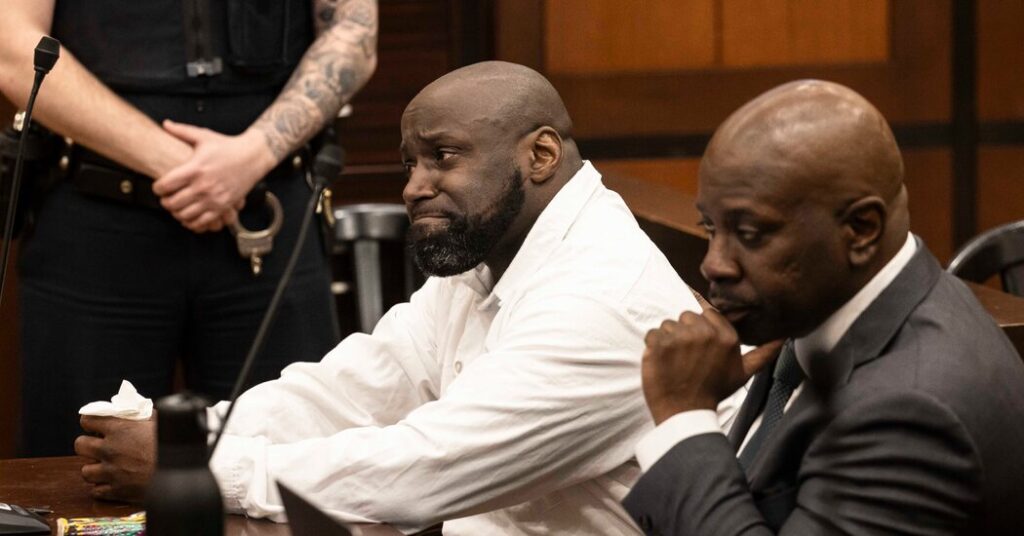
In a courtroom in Queens Supreme Court, Mr. Porter exhaled in relief as Judge Michelle A. Johnson, said she would vacate his conviction.
Mr. Porter had been led in by court officers with his hands cuffed behind his back and was seated next to Mr. Collins.
As the judge elaborated on her decision, Mr. Collins put his arm around his friend’s shoulder.
“I do find that your constitutional rights were violated and you were denied a fair trial,” she said, adding that Mr. Porter was now “entitled to a new trial.”
She scolded prosecutors in the case for “alarming” missteps in withholding evidence.
Prosecutors did not indicate in court if they would seek to try Mr. Porter again but asked Judge Johnson to keep Mr. Porter incarcerated in the meantime.
The judge, however, agreed with Mr. Porter’s lawyers in their request to release him on bail. She said that Mr. Porter should remain under house arrest and wear an electronic monitor.
Karen Newirth, one of Mr. Porter’s lawyers, warned in court that if he was retried, the jury would discover “that not a single one of the prosecution’s witnesses is untainted.”
Brendan Brosh, a spokesman for the Queens district attorney’s office, said in a statement that the office was “reviewing the decision.”
In a 2024 court filing, the office opposed Mr. Porter’s quest for exoneration and described him as a hardened drug dealer who had engaged in a feud with rival dealers during the height of the crack era.
As part of that beef, prosecutors said in the filing, Mr. Porter killed both a rival drug dealer and the dealer’s girlfriend in a Queens housing project.
Mr. Porter’s team described him as a mere low-level dealer who had been framed through a series of corrupt acts.
His lawyers long insisted that the authorities had coerced witnesses into falsely testifying against him and that prosecutors had withheld exculpatory evidence.
For 16 years, Mr. Collins had helped persuade a series of lawyers to help with Mr. Porter’s case pro bono. Mr. Collins often handled the grunt work as a paralegal.
Those efforts involved numerous lawsuits and legal filings over the years to obtain records to establish Mr. Porter’s innocence, including freedom of information suits against the Queens district attorney’s office and the Police Department.
Most recently, Mr. Collins helped to recruit Mr. Porter’s current legal team of Ms. Newirth and Charles Linehan, who both specialize in innocence cases.
In all, Mr. Collins said he had helped secure more than 2,000 pieces of evidence supporting Mr. Porter’s claims of innocence, including key witnesses recanting or changing their testimony.
Mr. Collins’s court filings for Mr. Porter also sought to establish that the district attorney’s office had failed to disclose the trial prosecutor’s own handwritten notes, which described alternate suspects and indicated that Mr. Porter had not been present at the shooting.
In 2023, Mr. Collins filed a motion seeking to overturn Mr. Porter’s case and along with others in Mr. Porter’s legal team obtained new evidence assailing his prosecution.
The Queens district attorney’s office opposed the motion at the time with a lengthy rebuttal.
Prosecutors insisted they did not suppress evidence and that Mr. Porter’s “accusations of prosecutorial misconduct are without merit.” Many of the accusations, even if true, would not have changed the outcome of the trial, they added.
In the rebuttal, the district attorney’s office describes Mr. Porter as belonging to a drug-dealing crew headed by a man nicknamed “Butt-Butt” that kept nearby stash houses for guns.
Not everyone was elated at the judge’s decision. Reached by phone after the hearing, Eric Bland, a brother of the one of the victims, Charles Bland, said he still felt certain that Mr. Porter was the killer.
He said Mr. Porter was envious of his brother’s success as a drug kingpin and had already pulled a gun on him before the killing.
“There’s not a day goes by I don’t think about my brother,” he said, and added about Mr. Porter: “I hope he rots.”
At Green Haven, Mr. Collins and Mr. Porter found they had much in common. Both inmates were in their mid-20s and had grown up in adjacent boroughs in New York City. They also had similar upbringings — with religious mothers praying for them — and similar convictions and plights.
Mr. Collins said that after his conviction, he had immediately resolved to teach himself law in prison to appeal his case.
His reputation as a successful jailhouse lawyer helped him gain the nickname “Johnny Cochrane,” he said, “and if guys got mad at me, they called me ‘Johnny Cockroach.’”
“I began reading his case and saw that he was railroaded,” Mr. Collins said of Mr. Porter. “I knew he was innocent so I made the commitment: I said, ‘Al, I’m going to get you home.’”
Mr. Collins used a wagon to cart piles of law books to his cell, where he would use an aging typewriter to write up his own and Mr. Porter’s cases.
On Mr. Porter’s behalf, Mr. Collins used the same jailhouse strategy of motions, lawsuits and legwork to uncover information that, he argued, poked holes in the prosecution.
Prosecutors relied largely on the testimony of three witnesses. One, a teenage girl who was the sole eyewitness, testified that she had seen Mr. Porter and another man commit the murder. Her testimony appeared to contradict ballistic evidence indicating where the shooters had seemed to fire from, Mr. Jabbar argued.
In 2021, Mr. Collins and Mr. Linehan said they met the woman in Brooklyn and recorded her as she recanted her trial testimony, which she said had been coerced by detectives.
Also that year, Mr. Collins traveled to Georgia to meet another witness in prison who agreed to attest in an affidavit that detectives had coerced him into implicating Mr. Porter.
For a third witness, Mr. Collins obtained documentation establishing that prosecutors had initially intended to charge a woman in the double shooting but agreed to drop the charges if she testified against Mr. Porter.
At the close of the hearing, Mr. Porter was handcuffed again while bail and other release details were sorted out.
Outside the courtroom, Mr. Collins hugged Mr. Porter’s mother, the Rev. Lula Ward-Brewer, who since her son’s conviction has run a ministry to help inmates in New York.
Asked about the prosecution’s unwillingness to rule out trying her son again, she paused and said, “I was told by my parents, ‘If you have nothing good to say, say nothing at all.’”
Mr. Collins said he never thought of giving up on Mr. Porter’s case.
“Between our faith and knowing Allen was falsely convicted,” he said, “there was no way I could turn away.”
Corey Kilgannon is a Times reporter who writes about crime and criminal justice in and around New York City, as well as breaking news and other feature stories.
The post Decades Later, a Man’s Conviction Is Overturned With Ex-Inmate’s Help appeared first on New York Times.