Political maneuvering by candidates for U.S. Senate in Maine — already in high gear since the Trump administration started an immigration crackdown in the state last week — intensified on Thursday with the news that Immigration and Customs Enforcement had abruptly ended its operation there.
As Senator Susan Collins, a Republican seeking re-election in November, took credit for negotiating ICE’s retreat, one of the Democrats seeking to replace her, Graham Platner, staged protests outside her offices in Portland and Bangor, saying Ms. Collins had gotten only a “pinky promise” from the White House. Another Democratic candidate, Gov. Janet Mills, accused Ms. Collins of failing to hold ICE accountable.
Ms. Collins, a five-term senator who is accustomed to walking a careful line in her purple state, suggested in a statement on Thursday morning that she had played a key role in ending the surge by urging Kristi Noem, the homeland security secretary, and other administration officials “to get ICE to reconsider its approach to immigration enforcement in the state.”
She added, “I appreciate the secretary’s willingness to listen to and consider my recommendations.”
Ms. Collins’s Democratic opponents, who have railed against the enforcement wave in recent days, wasted no time drawing attention to her vote on Thursday to advance a bill to fund the Department of Homeland Security, which oversees ICE.
“I have repeatedly called on Susan Collins to use the power she claims to have as chair of the Senate Appropriations Committee to hold ICE accountable until they end their aggressive tactics,” Ms. Mills said in a statement Thursday afternoon. “Instead, she is doing the opposite: leading the charge in handing ICE additional funding with no substantive reforms and no measures of accountability.”
Mr. Platner, a political newcomer and progressive who is vying with Ms. Mills, a more centrist Democrat, to become the party’s nominee in the Senate race, sounded a similar theme as he rallied protesters outside Ms. Collins’s Portland office Thursday morning.
“The people of Maine see what she is doing,” he told the crowd. “We know she would rather fund a fascist agency than stand up to this administration.”
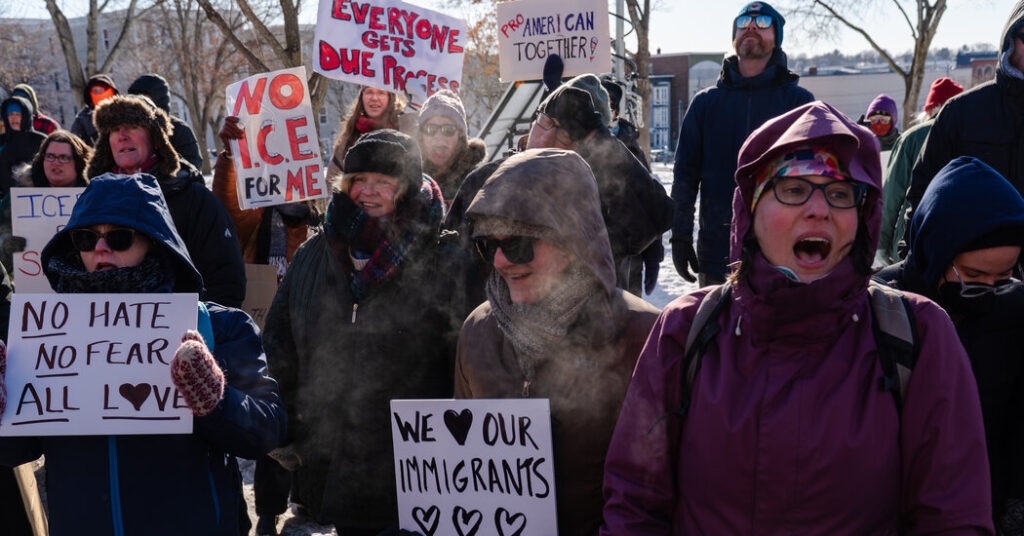
“Not a penny more for ICE,” the protesters chanted, their breath freezing as the temperature hovered around 10 degrees.
Although Ms. Collins said that ICE had “ceased its enhanced operations” in Maine, the agency did not confirm it, spurring worries that the drop in activity may not last. Still, the news brought undeniable relief to Maine immigrant communities that had been seized by fear last week as federal agents pulled over cars and staked out apartment buildings.
In more populous Southern Maine, where much of last week’s ICE activity was focused and where voters lean heavily Democratic, outrage had drowned out support for the increased enforcement. In the rural north, where the state’s politics are more conservative, support for President Trump and his policies is more widespread.
Nicholas F. Jacobs, an assistant professor of government at Colby College in Waterville, Maine, said it was unclear how much ICE’s reduced presence in the state, after just a few days of intense activity, might hurt Ms. Collins with her Republican base. But he said her self-described role in the shift seemed to be a “net win” for her campaign, which is also courting independent voters.
“She’s not saying that ICE should be dismantled, or that surges are a bad thing,” Mr. Jacobs said. “A good number of Republicans are saying that they need to turn the temperature down.”
“It perfectly fits the narrative she ran on, that she’s the seasoned politician, not the showman,” he said.
Kristi Johnston, a spokeswoman for the Maine Democratic Party, called Ms. Collins’s announcement “another calculated political move,” intended to allow her “to save face” while voting for the funding bill.
Leaders of the Maine Republican Party did not respond to questions on Thursday.
Advocates for immigrants said fallout from the 206 arrests that ICE said it made last week in Maine would linger, with families torn apart and neighborhoods in fear that could take weeks or months to subside. They also said they expected ICE to have a continuing presence in some communities.
The operation paralyzed some businesses that depend on immigrant workers. It also drove a spike in school absences, as families stayed home to avoid federal agents. More than 1,000 of Portland’s 6,200 students missed school last Friday.
Patricia Hyde, the deputy assistant director of ICE, said in a statement that the operation had succeeded “despite the organized efforts from activist groups, radical politicians and protesters to thwart our activities.”
Mayors of several Maine cities and towns who met on Wednesday to discuss long-term consequences said they expected a wave of evictions next month in the wake of the arrests among families who lost breadwinners. Sarah Lentz, the chair of the Portland Board of Public Education, said the effects on schools are likely to ripple for days or weeks.
“We still have many community members hiding, losing wages and afraid to send students to school,” she said. “The district is doing everything in our power to help support getting students back into the classroom, but because of the damage that has been created, it will not be quick.”
Residents who were caught in the sweep included some whose employers vouched for their legal status and lack of criminal records. Two Maine sheriffs defended employees who were arrested, as did the Portland schools superintendent, who said a mother of fourwho worked for the district was detained despite having passed a background check to work in schools.
Another man, a civil engineer from Colombia who was legally employed by GEI Consultants, a Portland company, was detained last week, a spokeswoman for the company confirmed.
Advocates said they were still trying to locate and free people who had been taken out of Maine. “We have a lot of work and rebuilding ahead,” Sue Roche, director of the Portland-based Immigrant Legal Advocacy Project, said in a statement. “So many people have completely withdrawn from public life.”
Jenna Russell is the lead reporter covering New England for The Times. She is based near Boston.
The post Collins Took Credit for ICE Leaving Maine. Her Democratic Opponents Pounced. appeared first on New York Times.