Björn Roth, who as assistant, chief collaborator and successor to his father, the artist-provocateur Dieter Roth, became the steward of a unique, long-running family art practice — one that encompassed drinking, smoking, performance, painting, hoarding ephemera, casting portrait busts in chocolate, filling suitcases with cheese and displaying place mats as accidental drawings, as well as building and transporting fully functional bars and other installations — died on Jan. 2 in Reykjavik, Iceland. He was 64.
His family confirmed the death, at a hospital, and attributed it to the effects of advanced alcoholism.
The Roths’ great subject was the relentless passage of time as manifest in fleshly and material decay — or, to put it more optimistically, the breathtaking creative power of sheer endurance. After Dieter died in 1998, Björn and his own sons continued his projects, reprising and expanding existing works as well as creating new ones.
Their first move when installing an exhibition was typically to build either a worktable — which, as it accumulated tools, garbage and various ephemera, would function as an ever-expanding artwork — or a bar, ditto.
“They put a circus on the road,” the art dealer Iwan Wirth, a longtime friend and one of the founders of the gallery Hauser & Wirth, said in an interview.
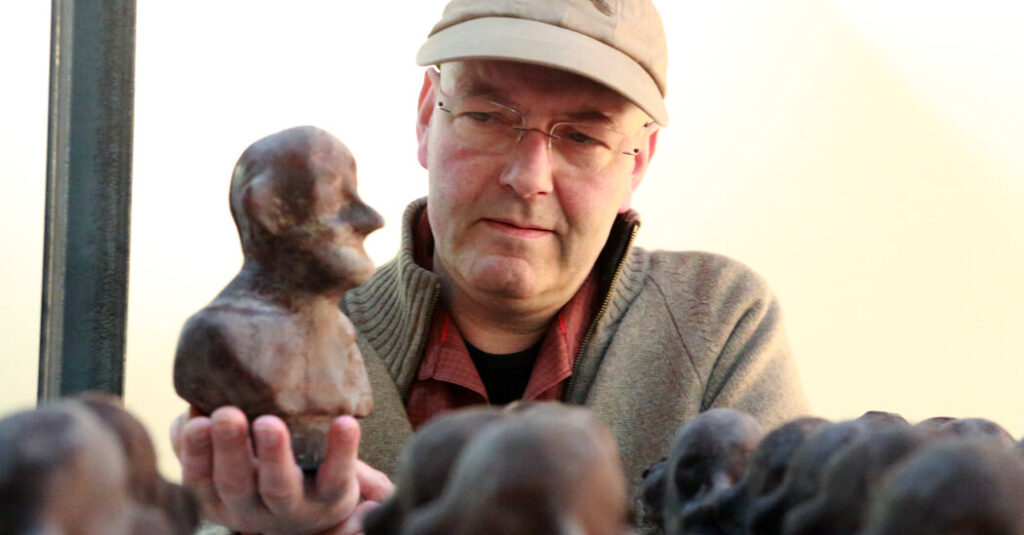
For the 2013 show “Dieter Roth Björn Roth,” at what was then Hauser & Wirth’s brand-new space on 18th Street in Manhattan, Björn Roth and his sons, Oddur and Einar, installed “Roth Bar,” which has remained a gallery fixture through two changes of location; two 39-by-20-foot sections of studio floor from Mosfellsbaer, Iceland, displayed upright on their edges; a piece called “Large Table Ruin”; and “New York Kitchen,” a dangerous collection of hot plates they used to melt chocolate for the hundreds of portrait busts of Dieter Roth that made up another piece, “Self Tower.”
The official creators of these pieces varied. Dieter alone was credited with “Self Tower” — though it was, in fact, executed by his descendants — while the bar, which was all Björn and sons, was credited to them. But in an installation intended to overwhelm such fussy distinctions, precise attribution may have been beside the point.
Writing in The New York Times, Randy Kennedy suggested that the Roths’ constructions weren’t conventional installation art so much as “beachheads in a battle against the ways galleries and museums tend to entomb works of radical art.”
And blurriness of authorship was, for the family, not a concept; it was their actual working practice.
“First I was his assistant,” Mr. Roth said in a 2013 interview about his relationship with his father. “And then I started to sign, together with him, our artworks. And then I was a co-author of things. But it’s difficult to say where the border was.”
He added: “I think it is a little bit special, how close we were and how closely we worked together. And in the end we were like one in what we were doing.”
But if it was Dieter Roth who initiated this way of working, it was Björn who — by taking it up wholeheartedly and, with self-effacing grace, passing it on to his own children — turned it into an institution.
“He taught me a lot of things,” Oddur Roth, Björn’s older son, said in an interview. “Same with him and Dieter. I didn’t realize I was being taught.”
Mr. Roth pursued a solo painting practice as well, making energetic abstractions full of sinuous lines and pools of ghostly color and bright, Rorschach-like watercolors. But these works he showed largely at home, in Iceland. To the wider world, he was a link in the family chain — not that he minded.
“I’m not pretending to be Dieter in this,” Mr. Roth told The Times. “He was a genius, and that’s very rare. And I’m not pretending to be up there where he was. But this is our life, and I think there are things that can be continued.”
Björn Roth was born on April 26, 1961, in Reykjavik, to Sigridur Björnsdóttir, a painter and art therapist, and Dieter Roth.
His parents split when he was 5 and, with his father traveling frequently for his anarchic, often extravagant art, he was raised largely by his mother, in Reykjavik. But his father returned often enough to maintain the relationship.
“Always when he came to Iceland, it was the most desired time,” Mr. Roth said in the 2013 interview, “because then I could stay with my father and do funny things with him. And saying ‘funny things’ means to draw, and build, and do.”
As a teenager, Mr. Roth had a band called Bruni BB, which his son Oddur called “one of the most hated bands in Iceland.” Essentially performance-art provocateurs, the band members decapitated chickens, throwing the heads at audiences, and pretended to menace a live pig with a chain saw. Their concerts were typically very short, Oddur said, “because they were usually arrested before they finished the set.”
Leaving high school without finishing before dropping out of art school, too, Mr. Roth enlisted in the family business more or less full time at 17.
In the catalog for the 2010 show “Work Tables & Tischmatten” at Hauser & Wirth, Mr. Roth described his father’s studio as a “workshop for assembling findings” and as a “kind of laboratory” in which they would “search for beauty in nothing.”
Mr. Roth was also a dedicated if unconventional arts educator, cofounding the art center and retreat Skaftfell in Seydisfjördur, Iceland, where he led workshops, curated shows and oversaw the residents, many of them recent graduates from the Iceland Academy of the Arts.
“When the first workshop took place,” the artist Tinna Gudmunds, Skaftfell’s former director, wrote in a statement on the center’s website, “he bought boots for all groups, he financed two projectors to be used in the exhibition hall, he lent his car, tools and everything possible to make the exhibition installation work.”
In addition to his sons, he is also survived by a daughter, Vera Roth; his mother; and his siblings, Gudrídur Adda, Karl Roth and Vera Roth. His marriage to Thórunn Svavarsdóttir ended in divorce.
Mr. Roth concluded his 2010 catalog essay by mentioning that his father had asked him, before his death, whether he planned to continue their shared endeavor.
“I answered,” Mr. Roth wrote, “that nothing was more obvious, because it was the only thing I knew.”
Oddur Roth concurred.
“The only way onward is upward, I guess — straight off the cliff,” he said in the interview. “We still have a lot of unfinished projects for me to do.”
The post Björn Roth, Steward of an Expansive Family Art Practice, Dies at 64 appeared first on New York Times.