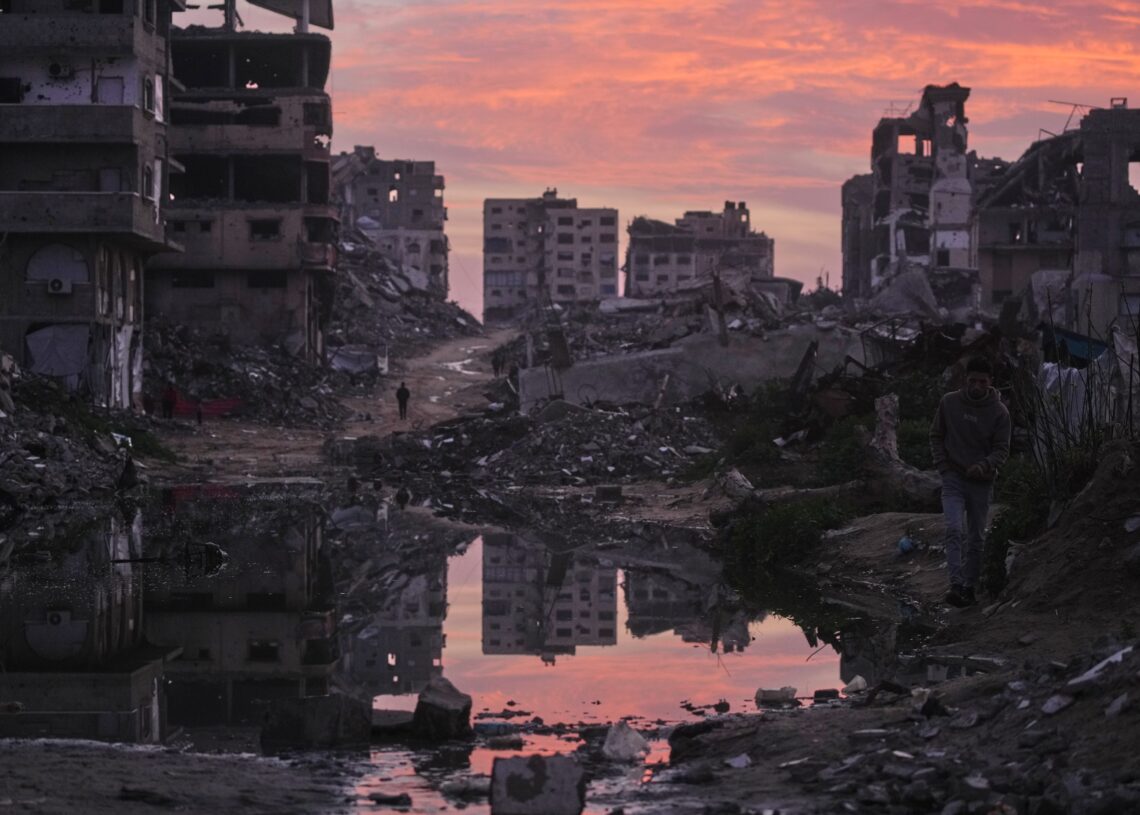
The reason to take Gaza reconstruction seriously isn’t the glossy rendering of a future beachfront resort displayed last week at Davos, but a gray-haired Palestinian civil engineer named Ali Shaath, who will head the “technocratic committee” that next week will begin the long process of rebuilding what has been hell on earth.
“It’s my responsibility to turn this moment into action, to restore order, to rebuild institutions, and to create a future for the people of Gaza,” Shaath said in a video address to the Davos, Switzerland, rollout of the Board of Peace that will oversee the transition. He then switched to Arabic to address Gazan Palestinians: ”You have remained steadfast and preserved your families and your land,” he said, but now is the time “not for looking backward but moving forward.”
The event was organized by Jared Kushner, son-in-law of President Donald Trump and the chief architect of the Gaza plan. He rightly saluted the “bravery” of Shaath and the other members of the committee who will enter Hamas-controlled areas in a few days to begin reconstruction — and disarmament of the militia that has terrorized Israelis and Gazans alike.
The Gaza reconstruction launch was barely noticed amid the furor over Trump’s proposal to buy Greenland. That fracas has been resolved, at least temporarily, but the suffering in Gaza continues. And in this moment, before what may be another Middle East war against Iran, the Gaza plan deserves more attention. It’s a long shot, facing many obstacles, but it’s the best chance I’ve seen in decades to create a Gaza controlled not by Hamas or Israel, but by its people.
“There is a possibility now that we can really create an alternative to Hamas,” argued Dennis Ross in an interview Wednesday. Ross may be America’s most experienced Middle East negotiator, and he has monitored the Gaza work closely. Rob Satloff, head of the Washington Institute for Near East Policy, is similarly hopeful. “For the first time in a long while, there are some bright lights in Gaza,” he told me.
The Board of Peace event looked to some like a Trump stunt, with its pay-to-play board and its AI renderings of a futuristic “New Gaza” meant to invoke the wonders of Doha and Dubai. But there’s a real plan here, anchored in a U.N. resolution and backed by a burgeoning “Civil-Military Coordination Center,” based just east of Gaza in Kiryat Gat and run by U.S. Central Command, that now includes troops from 20 countries.
Ross, who recently visited the Centcom command post, says he was “enormously impressed with it.” With drones and other surveillance, it can monitor every inch of Gaza. It can oversee and coordinate the flow of humanitarian aid that now totals about 4,200 trucks a week, according to the Board of Peace. And it has the order and precision that only the U.S. military can provide.
The Gaza effort displays what is often missing in Trump foreign policy efforts: an attempt at systematic implementation. Trump proclaimed the Gaza ceasefire in October and took a victory lap in Israel. And then, silence: Hamas power seemed to grow again, despite military defeat.
But behind the scenes, work moved ahead. The U.N. Security Council in November endorsed Trump’s Board of Peace as a “transitional administration” to rule Gaza until a reformed Palestinian Authority could take over. Nickolay Mladenov, a Bulgarian diplomat widely respected for his U.N. work in the region, was selected as the board’s director-general. And Shaath was named to head the 12-person National Committee for the Administration of Gaza. Egypt helped recruit the members and checked the names with all key Palestinian factions, to get buy-in.
When the technocrats enter Gaza next week, officials say, their top priority will be starting to repair sewage and water facilities and removing 60 million tons of rubble. At the same time, Shaath’s committee must begin to take power from Hamas, politically and militarily. More than 1,000 Palestinians have been trained in Jordan and Egypt for a Gaza police force, and a top U.S. negotiator believes this force can quickly grow to as many as 10,000 by drawing on other non-Hamas recruits.
“The key is demilitarization,” Ross told me. Hamas agreed in principle to disarm when it signed Trump’s 20-point plan, which proposed a buyback of Hamas weapons. The Board of Peace announced in Davos that this “disarmament [will be] rewarded with amnesty & reintegration, or safe passage.”
The plan is to disarm in two stages: first, the missiles and heavy weapons that threaten Israel; then the AK-47s and other small arms that threaten Gazans. Both stages are essential, because a new Gaza requires a “monopoly on force” by the governing authority, as the Board of Peace argues. Hamas will also have to turn over maps of its underground maze of tunnels and destroy its weapons-making facilities.
Will a group whose very existence is about armed struggle really agree to neuter itself? That’s the most important but also shakiest pole in the New Gaza tent. The Trump team thinks it has a chance because Qatar and Turkey, two of Hamas’s biggest backers other than Iran, are members of the board and pressured Hamas to sign the deal. And if reconstruction can begin, even Hamas militants will want a share of what the board projects will be at least $25 billion in investment in new utilities and public services and more than 500,000 jobs.
What’s interesting about Trump’s plans for Gaza is that Israel doesn’t play a big role. The key partners are Egypt, Qatar, Turkey, Saudi Arabia and the United Arab Emirates. That’s one reason right-wing Israelis have blasted the plan. But the premise of the plan is that Gaza isn’t Israel’s problem anymore, but Trump’s and the international community’s.
Kushner’s role has been interesting to watch, too. He has deep business interests in the region, which rankles critics. But as architect of the Abraham Accords, he has a personal stake in expanding the peace process. His first idea for rebuilding Gaza was Israel-centered — a plan to create “Alternative Safe Communities” in the parts of Gaza that Israel still occupied, in the hope they would be a magnet for change in the Hamas-controlled areas where 85 percent of Gazans lived. But he switched to the new, far more ambitious Palestinian-centered model announced in Davos. It’s higher risk, but much higher reward.
I hope the Trump team’s staying power in Gaza is matched in the Ukraine peace negotiations, which may be nearing a make-or-break stage. Sources told me Thursday that President Vladimir Putin has agreed to a one-week halt in bombing of the Kyiv area, following last weekend’s U.S.-Ukraine-Russia military talks in Abu Dhabi. Maybe Putin is finally realizing that the total victory he craves is impossible.
Predicting success in Middle East negotiations is often a mistake. As a colleague warned me 45 years ago, when it comes to this region, “pessimism pays.” But the Gaza reconstruction effort is better organized than many commentators seem to realize, and any sensible person should wish success for the Board of Peace and its courageous Palestinian representatives.
The post Behind the scenes, a real plan is underway for rebuilding Gaza appeared first on Washington Post.