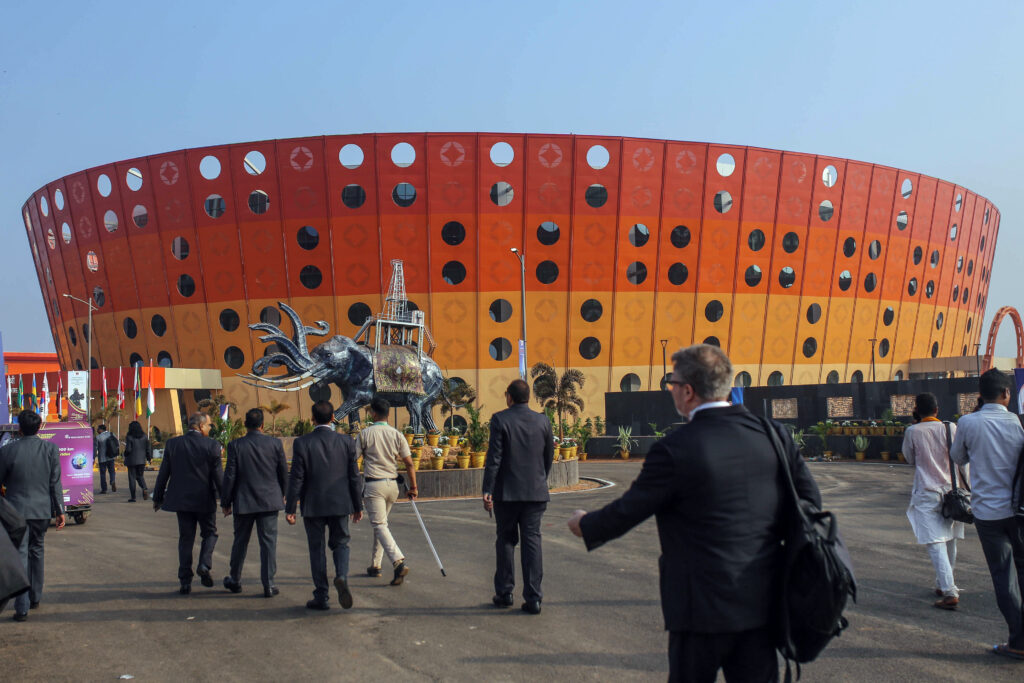
CANAGUINIM, India — Barely an hour into India’s high-profile energy summit in the southern state of Goa, conversation turned to the emergent global order — one without America at the center.
“What is happening in the world today is not a gradual economic transition, it is a rupture,” said Canada’s energy minister, Tim Hodgson, echoing the words of Prime Minister Mark Carney, who electrified the crowd in Davos last week by sounding the death knell of the postwar international system.
Sitting center stage in a cavernous convention center with his Indian counterpart, Hodgson spoke bluntly of the world being wrought by President Donald Trump, where “hegemons use tariffs as leverage.” The solution, he proposed, “the way to resist … is to build multilateral relationships.”
In the first year of his second term, Trump has alienated many traditional U.S. allies. Relations with Canada have frayed over tariffs and threats of annexation. Ties with the European Union sank to new lows after he demanded ownership of Greenland. The U.S.-India bond, a bright spot during Trump’s first presidency, has been badly strained by trade disagreements and diplomatic missteps.
From the Swiss Alps to coastal India, global leaders are now speaking openly of these new geopolitical realities, largely abandoning their strategy of appeasing Trump and, instead, considering what is possible without him. In one sign of the changing times, New Delhi inked a sweeping trade deal this week with the E.U., even as talks with Washington languished.
No American official offered remarks at the opening of the Goa summit, where Canada and the United Arab Emirates were given top billing. Throughout the nearly weeklong conference, oil officials and experts stressed that energy pacts will be a central part of the international realignment. And India, the third largest energy consumer in the world after the United States and China, will be a central player.
“There is turbulence,” said Hardeep Singh Puri, the Indian minister of petroleum and natural gas, “and we have to adapt.”
‘Age of walls’
Held on a swath of formerly industrial land near Goa’s famous beaches, India Energy Week attracted some 75,000 attendees, including oil ministers, diplomats and energy executives, organizers said.
During the breakout sessions, recurring themes emerged, with several discussions focused on “turbulence” and “disruption.” In a session about energy diplomacy, representatives from Norway, Denmark, Paraguay and Finland talked about India’s enormous needs and how their countries could help meet them.
May-Elin Stener, the Norwegian ambassador to New Delhi, said a slew of energy companies from her country had come to Goa because they want to take part in India’s plans.
The hosts appeared receptive: “We need more partners,” said Dammu Ravi, a former high-ranking official at India’s Ministry of External Affairs, noting the country’s power grid can produce only 500 gigawatts of energy — a fraction of the 3.2 terawatts generated by China.
India relies heavily on coal, which accounts for about 40 percent of its energy supply, according to estimates from the International Energy Agency. Roughly 25 percent is from crude oil, the analysis showed. And sourcing crude has become a problem.
For the past four years, India’s top provider of the commodity has been Russia. Russian crude came at a discount after Western nations implemented a $60 per barrel price cap, a way of punishing President Vladimir Putin for his full-scale invasion of Ukraine without wreaking havoc on global energy markets.
New Delhi was encouraged by Washington to take advantage of the lower prices: “We’re happy to have India get that bargain,” then-U.S. Treasury Secretary Janet L. Yellen said in late 2022.
The tune changed under Trump, who in August accused India of fueling Moscow’s war machine with its purchases of Russian oil and imposed an additional 25 percent levy, bringing the total tariffs on many Indian goods to 50 percent.
India, under growing pressure from the White House, has tried to wean itself off Russian crude. The country imported 1.2 million barrels per day in December, according to data from the Center for Research on Energy and Clean Air. As of Jan. 15, the figure had fallen below 600,000 barrels per day, the data showed.
All the while, India’s energy needs are surging. The country roughly imports 5.6 million barrels of oil daily, Puri said, up from 5 million barrels in 2021. Demand could soon exceed 6 million barrels each day, India’s Oil Ministry predicted in October.
Nations from the Middle East to Europe lined up in Goa looking to tap into the Indian market. Canada, in particular, made a full-court press. Hodgson said his country is one of the largest energy producers in the world, particularly when it comes to the critical minerals needed for green energy — an area of growing focus for India. One bonus of partnering with Ottawa, he said, is reliability, making a not-so-veiled reference to Canada’s southern neighbor.
“We’re not going to live in a world where might makes right. We’re not going to live in a world where the strongest put tariffs on everyone else,” he said. “We’re going to live in a world where we believe in free trade, where we believe in trusted relationships.”
Michael Kugelman, a senior fellow for South Asia at the Atlantic Council, said these dynamics are a “reflection of growing discontent” with the U.S., which “predates but has been intensified by Trump’s return.” Countries are pushing for new multipolar compacts that neutralize American power, he said, and “it appears to be spreading to the energy realm.”
Sultan Al Jaber, the UAE’s minister of industry, came to the conference with his own pitch to India. In his keynote address, he noted that New Delhi has become the country’s top customer for natural gas, and its national oil company was aiming to provide more crude as well.
“In an age of walls, our message is simple,” Al Jaber said. “Build doors, and the world will walk through them.”
Supriya Kumar contributed to this report from New Delhi.
The post At India’s main energy summit, signs of a new world order without Trump appeared first on Washington Post.