BAGHDAD — As some of Iraq’s most powerful political leaders met to formally nominate the next prime minister at a private gathering last weekend, Ammar al-Hakim, an Iraqi cleric and one of the country’s most influential politicians, read out an extraordinary letter he had received from the Trump administration, according to people in attendance.
The missive indicated that the Trump administration would oppose the selection of Nouri al-Maliki, the leading candidate, and said it viewed his previous tenure in that position more than a decade ago “negatively.”
The letter represented an initial salvo in the administration’s intervention into domestic Iraqi politics aimed at heading off the selection of Maliki, who is widely viewed by U.S. officials as too close to Iran, the chief rival to the United States for influence in Iraq. He is closely associated with the pro-Iranian militias that wield outsize sway in Iraqi politics.
Maliki was “astonished” when the letter was read out at the meeting of leaders of the Coordination Framework, a political coalition made up of Shiite Muslim factions that won the most seats in the November elections, according to one person in attendance, who, like others, spoke on the condition of anonymity to discuss the closed door discussions.
The letter was the “first of its kind,” and some participants asked where in the U.S. government it had come from, the person said. It had been sent by Joshua Harris, the chargé d’affaires at the U.S. Embassy in Baghdad, according to another person familiar with the communications.
“The selection of the prime minister-designate and other leadership positions is a sovereign Iraqi decision, and likewise, the United States will make its sovereign decisions regarding the next government in accordance with U.S. interests,” warned the letter, which was reviewed by The Washington Post and confirmed by three meeting attendees. It said the U.S. wanted to see an Iraqi government that “weakens Iranian-backed terrorism” and “dismantles terrorist militias.”
Despite the U.S. directive, the leaders of the Coordination Framework pushed ahead with Maliki’s nomination, though several participants abstained. Maliki did not consider the U.S. warning to be serious, attendees said.
It did not take long to find out that it was. On Tuesday, President Donald Trump personally escalated the pressure, posting on social media that the United States would “no longer help” Iraq if Maliki returned to the post of prime minister. Trump called Maliki’s policies and ideologies “insane.”
The U.S. Embassy in Baghdad did not respond to a request for comment.
The American strong-arming comes as the U.S. is intensifying efforts to roll back Iranian influence in Iraq, including by seeking to curb money flows from Iran. The Trump administration is also currently considering military strikes against Iran, with the U.S. aircraft carrier Abraham Lincoln arriving in the region this week along with additional warships.
Since the ouster of President Saddam Hussein by the 2003 U.S. led-invasion, both the U.S. and Iran have tried to influence the makeup of Iraqi governments. But Trump’s social media post gave such intervention unprecedented visibility.
Top Iraqi officials are now left weighing whether to make a humiliating reversal by ditching Maliki or facing the wrath of the Trump administration.
Maliki, known for his unrelenting character, appeared to dig in his heels on Wednesday, saying he rejected the “blatant American interference in Iraq’s internal affairs” and said he would continue “work until we reach the end.”
Despite Maliki’s public resistance, it’s hard to see how the Shiite coalition leaders can now proceed with his nomination, said Victoria Taylor, a former U.S. deputy assistant secretary of state for Iraq and Iran. “I can’t imagine they would risk the significant economic and political consequence of such a decision,” she said. “It would be tantamount to picking the Iranian side in the eyes of this administration.”
An endorsement of Maliki’s candidacy by Iran may have cemented the American objections. During a visit to Baghdad earlier this month, Brig. Gen. Ismail Qaani, who heads Iran’s elite Quds Force, delivered a letter from Iran’s Supreme Leader Ayatollah Khamenei blessing the Framework’s choice of candidate, according to people familiar with the communication. Tehran believed that the Shiite political leaders had reached a consensus decision on Maliki, the people said.
Iraqi officials say they now fear that ignoring Washington’s demands could lead to dire economic repercussions, for instance the imposition of sanctions or a cut in the country’s access to dollars. Iraq’s oil revenue is deposited directly into the U.S. Federal Reserve, which then distributes dollars to Baghdad each month to meet its budget requirements.
“The decision is up to Maliki,” said Ezzat al-Shahbandar, a veteran Iraqi politician close to the Shiite political coalition. “If he chooses to withdraw for the national interest, it’s up to him,” he said. If not: “It’s going to be very hard to handle it, but we will have to handle it.”
Aqeel al-Fatlawi, a spokesman for Maliki’s State of Law coalition, told Iraq’s UTV channel there was hope Trump would reverse his objections. Fatlawi cited Trump’s evolving relationship with Ukrainian President Volodymyr Zelensky as a precedent.
“Maliki’s relationship with the Americans is strong,” he said. “I believe they will change their stance in the coming period, and even if they do not, we will move forward, and the Iraqi people will not accept external interference.”
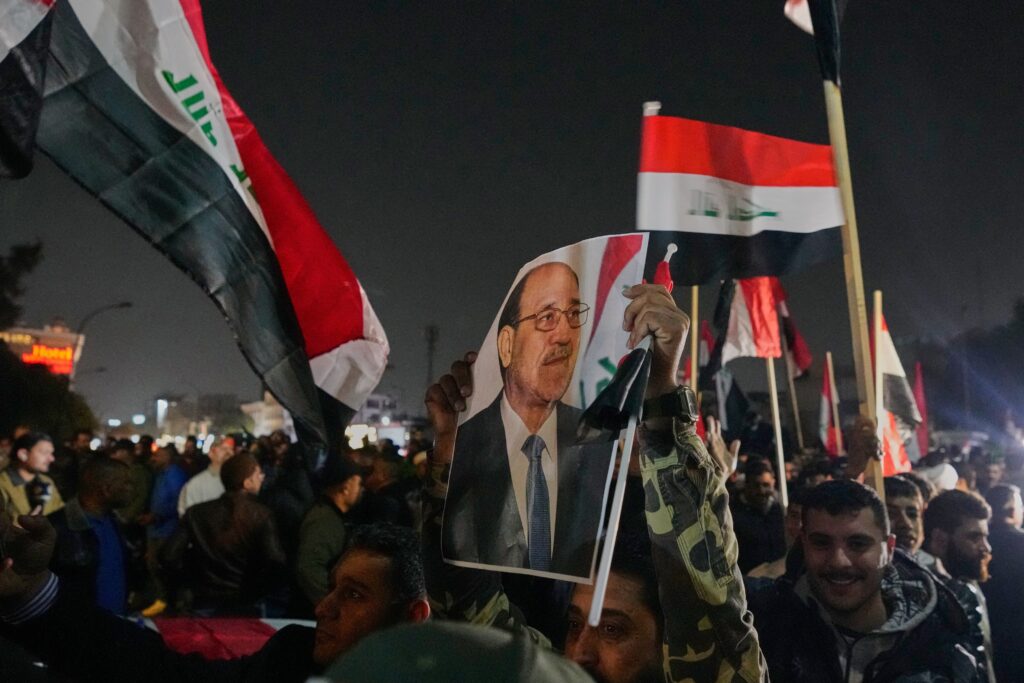
In recent days, Iranian-backed militias in Iraq put out angry statements rejecting U.S. interference. But a demonstration they called in the capital on Wednesday drew a crowd of a little more than a hundred people.
Maliki served two terms as Iraq’s prime minister, from 2006 to 2014, a period marred by religious sectarianism that many blame for laying the ground for the Islamic State’s rise. After backing him for his second term, U.S. officials pressed for his departure in 2014, viewing him as an obstacle to overcoming sectarian divisions.
U.S. officials have repeatedly signaled they do not want to see the new Iraqi government include any affiliates of groups the U.S. has designated as terrorist organizations. That poses a challenge because the Coordination Framework includes the parliamentary wings of Iran-aligned militias. Among the Shiite leaders who are tasked with nominating the next prime minister is Qais al-Khazali, the founder and secretary general of Asa’ib Ahl al-Haq, which launched thousands of attacks against U.S. forces after the 2003 invasion and remains blacklisted.
U.S. officials were infuriated earlier this month when Adnan Fayhan, a member of the group implicated in the 2007 abduction and killing of five U.S. soldiers, was selected as the first deputy speaker of parliament, Iraqi officials said.
The Trump administration letter detailed Washington’s position that a government which dismantles militias and does not include any U.S. designated groups “would be a government we can work with to the benefit of both Iraqis and Americans.” Mark Savaya, the U.S. special envoy to Iraq, has repeatedly used his social media accounts to voice opposition to any militia participation in the government.
But Taylor said the Shiite leaders misunderstood “how strongly the U.S. felt” about Maliki’s nomination. The letter also said Washington’s focus was on “interests, not individuals.”
The emergence of Maliki as a leading candidate took many in Iraqi political circles as a surprise. Earlier this month, incumbent Prime Minister Mohammed Shia al-Sudani had endorsed Maliki — a maneuver that political observers said appeared to be intended to boost Sudani’s own prospects of remaining in the job. The thinking, they said, was that Maliki would be blocked for being too controversial, clearing the way for Sudani, who has himself faced criticism from within his own bloc. It was a case of “I’ll show you death so you’ll accept a fever,” said an Iraqi official, using an old Iraqi saying to sum up the assumed strategy.
A Sudani spokesman did not respond to requests for comment.
Now, the atmosphere among Framework leaders is “confusion and hesitation,” said one of the participants in the Saturday meeting.
The post A U.S. letter opposed Iraqis’ choice of prime minister. They went ahead anyway. appeared first on Washington Post.