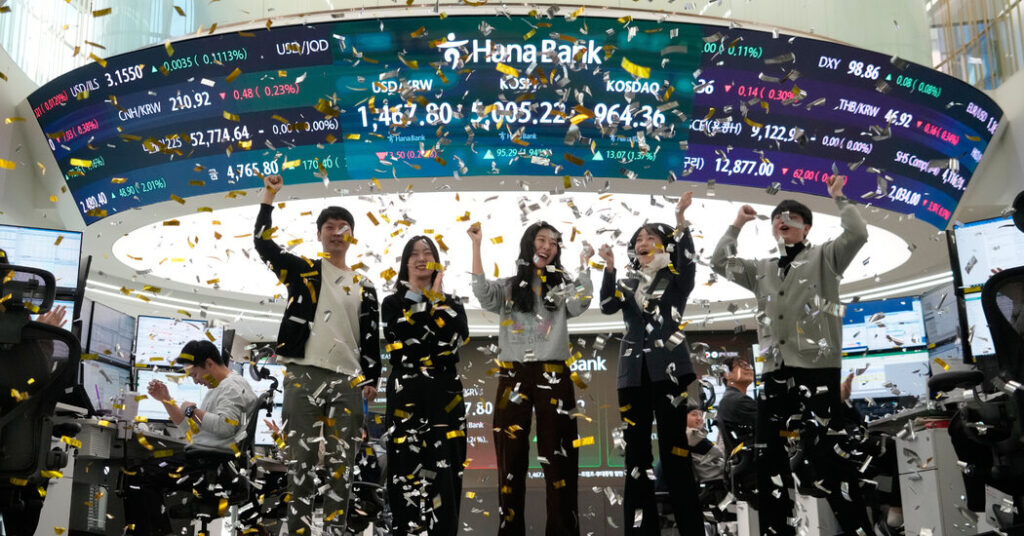
The South Korean stock market rose for three straight days this week, even after President Trump threatened to hike tariffs on the nation’s exports, setting a fresh record each day.
It was a reflection of the exuberance that has gripped South Korea in recent months. The benchmark Kospi index has set one record after the other, doubling over the past year, outpacing every other major index in the world.
For the first time in years, Koreans are focused on investing at home as abroad, where performance has usually been better, experts say.
The number of active stock trading accounts in the nation jumped last year, industry data show. Individual investors are trying to cash in on the boom by learning more about stocks: Online courses on stocks have become more popular, books on share investing are on best-seller lists and videos about the market have gone viral on social media.
“Korean investors, especially the retail segment, engage deeply with prevailing trends,” said Ohad Topor, the founder of TCK Investments, a firm with offices in Seoul and London. “Respecting that momentum has proven to be a prudent strategy.”
Still, anxieties about the economy and the widening income gap persist. Data released last week showed that the South Korean economy had unexpectedly contracted in the fourth quarter of 2025 from the previous three months.
One of the biggest cheerleaders for the market has been President Lee Jae Myung, who was elected last year. His campaign included pledges to pass investor-friendly reforms that would help push the Kospi to the level of 5,000.
The index closed above that threshold for the first time on Tuesday, just over seven months into Mr. Lee’s term. Shares in two companies, the chipmakers Samsung Electronics and SK Hynix, have largely driven the gains in the index. The Kospi has climbed 24 percent so far this month, as of Thursday.
“This is the Kospi’s strongest start since 1998, with the index doubling in a year— a trajectory we haven’t seen since the dot-com era,” Mr. Topor said.
Overall, the value of the South Korean stock market has increased about $1.7 trillion since January 2025, according to data compiled by Bloomberg.
In 2025, net purchases of the Kospi by individual investors rose by 54 percent from 2024, according to data from the Korea Exchange.
The rally has attracted many young people in the country who say they cannot afford to invest in real estate to build a nest egg the way earlier generations did, a reflection of widespread economic anxiety.
Han Sung-hoon, a 32-year-old doctoral student in chemical engineering in Seoul, began investing in South Korean stocks last year. He understood the importance. “These days, it’s impossible for people here to become a homeowner on a salary,” he said.
Almost three-quarters of South Koreans in the 19-34 age group who are employed are dissatisfied with how much they earn, according to a government survey. The average monthly income for all South Koreans last year was around 4.2 million won — just under $3,000 — according to government data.
South Koreans “are incentivized to invest and rely on the Korean stock market,” Mr. Han said.
Until recently, many Koreans preferred to invest in U.S. stocks, which had better returns than their Korean counterparts, said Kim Young-ick, a retired economics professor at Sogang University in Seoul. But Mr. Trump’s tariff threats have put new pressure on the South Korean currency, the won, which has depreciated against the dollar to record low levels.
The weak won has made investing abroad tougher for many Koreans.
At home, Mr. Lee’s government has pushed through laws to address a perennial issue known as the “Korea discount.” That refers to a pattern where Korean stocks trade at lower values than their peers overseas, partly because shareholders have weak rights and have traditionally played second fiddle to the families that control the country’s chaebols, sprawling conglomerates like Samsung, LG and Hyundai.
Mr. Lee has also pushed for tax incentives to encourage companies to pay out bigger dividends.
The artificial intelligence boom — and its demand for computer chips — is also playing a big role in the stock market rally in South Korea, which is among the world’s top chipmakers. Last year, semiconductors made up nearly a quarter of the nation’s exports, the largest slice of the export pie they have ever had, according to government data.
That heft is reflected in the shares of Samsung Electronics and SK Hynix, which have more than tripled and quadrupled, respectively, in the past year.
Investors are starting to “believe in Korean companies and their ability to compete globally,” said Younggon Lee, an analyst at Toss Securities in Seoul.
Some analysts expect the Kospi to continue rising through this year.
Lee Jae-sung, an energy researcher said he began investing heavily in Korean blue-chip companies last year. He described himself as a “super conservative” investor but said he wanted to take advantage of the bullish domestic market while it lasts.
“My main goal,” he added, “is to fight the urge to put all my eggs in one basket.”
Jin Yu Young is a reporter and researcher for The Times, based in Seoul, covering South Korea and international breaking news.
The post A Stock Market Fervor Takes Hold in South Korea appeared first on New York Times.