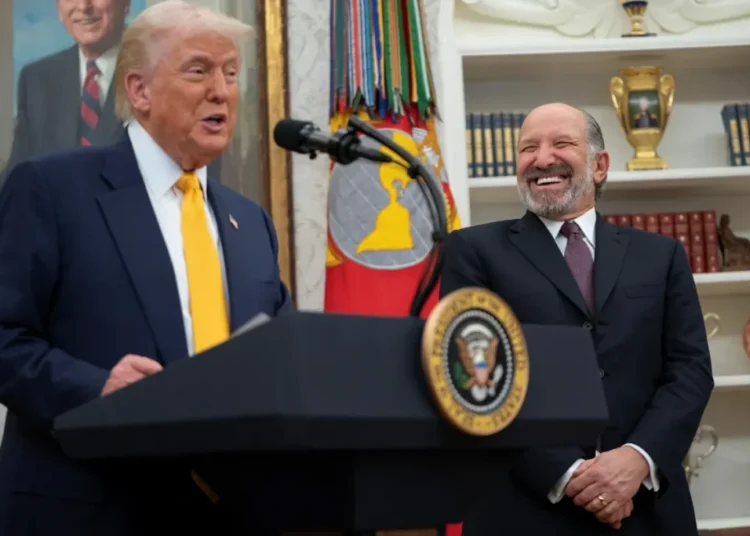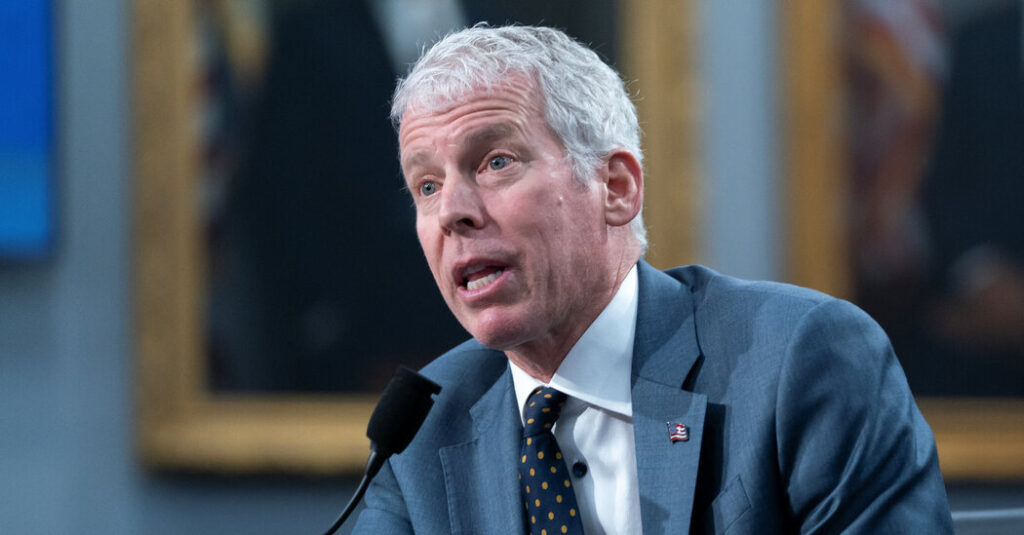
A federal judge on Friday ruled the Department of Energy violated the law when Secretary Chris Wright handpicked five researchers who reject the scientific consensus on climate change to work in secret on a sweeping government report on global warming.
The Energy Department issued the report, which downplayed the dangers of warming, in late July without having held any public meetings or made records available to the public. Lee Zeldin, the administrator of the Environmental Protection Agency, then cited the report to justify a plan to repeal the endangerment finding, a landmark scientific determination that serves as the legal foundation for regulating climate pollution.
But the Federal Advisory Committee Act of 1972 does not allow agencies to recruit or rely on secret groups for the purposes of policymaking. Judge William Young of the U.S. District Court for the District of Massachusetts said the Energy Department did not deny that it had failed to hold open meetings or assemble a balance of viewpoints, as the law requires, when it created the panel, known as the Climate Working Group.
“These violations are now established as a matter of law,” wrote Judge Young, who was nominated to the bench by Ronald Reagan. He said the Climate Working Group was, in fact, a federal advisory committee designed to inform policy, and not, as the Energy Department claimed, merely “assembled to exchange facts or information.”
Erin Murphy, a senior attorney with the Environmental Defense Fund, which brought the lawsuit together with the Union of Concerned Scientists, said the ruling should undercut the Trump administration’s efforts to eliminate climate regulations.
Ms. Murphy said that emails and other internal documents made public under the judge’s orders showed that Energy Department political appointees had coordinated with the E.P.A. and relayed instructions to the climate researchers to produce what she called a “slanted” scientific report.
“It was powerful for the court to issue this order making it clear that this is a legal violation and not how the government should be approaching policy,” she said.
The Department of Energy did not immediately respond to a request for comment. The agency disbanded the Climate Working Group shortly after environmental groups sued.
Hundreds of scientists, including researchers from the American Meteorological Society, a leading climate science organization, denounced the group’s findings as riddled with errors and misrepresentations.
The members of the Climate Working Group were Steven E. Koonin, a physicist and author; John Christy, an atmospheric scientist; Judith Curry, a climatologist; Roy Spencer, a meteorologist; and Ross McKitrick, an economics professor. All of them have questioned the scientific consensus that climate change poses severe risks to the planet and to human health.
Thousands of pages of emails and internal Department of Energy documents made public under the judge’s orders showed that the group had worked diligently to keep its existence shielded and met in secret more than a dozen times.
In April, shortly after the group was convened, Travis Fisher, the director of energy and environmental policy studies at the Cato Institute, who coordinated the Energy Department report, emailed the researchers from a personal email account.
He said the “exact charge” of the panel was to provide an update on science as it applies to the endangerment finding. He also informed them that the Environmental Protection Agency had asked that the document be “D.O.E.-branded.”
Mr. Fisher on Friday declined to comment.
The lawsuit named both the D.O.E. and the E.P.A. Judge Young on Friday wrote that he had found “no persuasive evidence” that the E.P.A. violated the advisory committee law.
Lisa Friedman is a Times reporter who writes about how governments are addressing climate change and the effects of those policies on communities.
The post A Secret Panel to Question Climate Science Was Unlawful, Judge Rules appeared first on New York Times.