Hundreds of mayors from around the country converged this week on Washington and another city dominated the conversation — Minneapolis.
The annual winter meeting of the U.S. Conference of Mayors often revolves around everyday responsibilities such as economic development, law enforcement and budgeting. This year, the added dimensions included tariffs, the withholding of federal funds to cities, and especially immigration enforcement as the Department of Homeland Security and its Immigration and Customs Enforcement and Customs and Border Protection agencies continue Operation Metro Surge in the Twin Cities.
Democrats predominate in large and medium-size cities, and many mayors voiced worry over the potential fraying of trust between their communities and law enforcement agencies. Some no longer saw the federal government as a reliable partner.
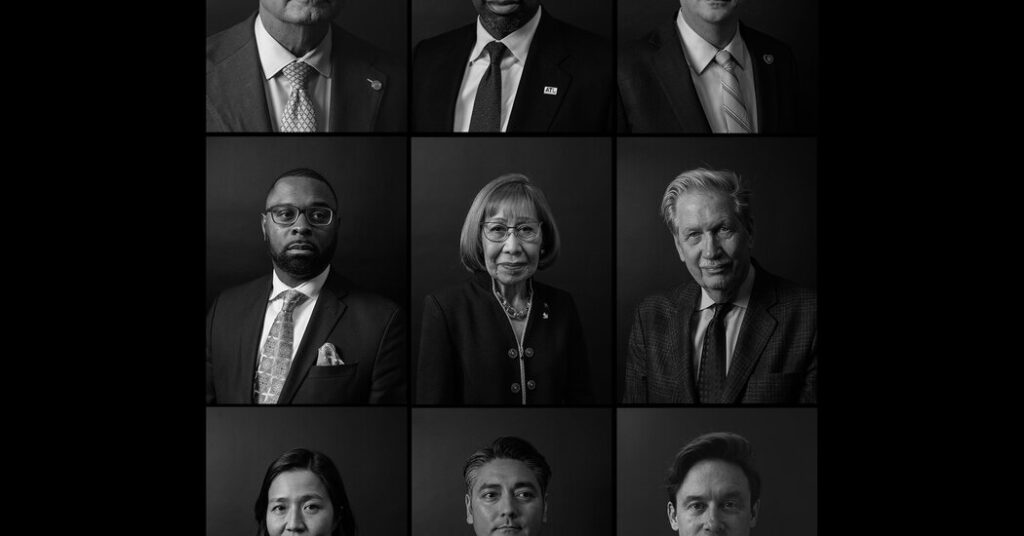
This is how mayors in both parties view their jobs at the moment, with some minor editing to condense their thoughts.
Oklahoma City
David Holt (R)
Is there a sense of fear among your constituents about immigration enforcement?
Yes. Even months ago, when it really didn’t seem like there was any visible escalation, they’d seen what was happening around the country. With what’s happening in Minneapolis, a lot of people are afraid. People who are citizens are afraid. Everybody’s afraid.
We have enforced immigration laws in this country for over a century. ICE has been around for over two decades. There’s even a previous Trump term where immigration enforcement seemed not to cause a nationwide reaction. Let’s get back to an era of immigration enforcement that is manageable, legal and acceptable to a majority of Americans.
Boston
Michelle Wu (D)
How are you approaching your job in this climate?
I remember when city government was about filling potholes, keeping the streetlights working, picking up the trash efficiently and supporting our public safety and public education efforts. Now, doing all that is even more important, because there are so many other places where life is being destabilized. And we have to combat all of the attacks that are coming at our communities. So, I’m up at night worrying about the safety of my community.
Fresno, Calif.
Jerry Dyer (R)
How are the Trump administration’s immigration actions affecting public safety in your city?
I spent 40 years in the police department, the last 18 as a chief. I learned a long time ago of the value of trust in neighborhoods. If people don’t trust you, if they don’t give you permission to police their neighborhoods, you’re going to be seen as an occupying force. You’re not going to be well received. In fact, you’re going to be rejected. And that’s what we’re seeing today in communities in which ICE has come in. There’s a rejection. They don’t trust them, because of some of the tactics that they’ve utilized, and the lack of sensitivity in dealing with people.
Talk about the disconnect you see between what happens locally and Washington’s understanding of events.
Things are occurring in neighborhoods across our country that maybe the president isn’t completely aware of. And it’s our hope, collectively as mayors, that we can share that with him. One thing we agree on as mayors is the need for comprehensive immigration reform. I think this president, the administration, has done an incredible job of securing our borders like never before. We also believe that there should be a pathway to citizenship [for some undocumented immigrants] that’s timely. We all agree that if you have serious criminals in your community that are undocumented, they need to be dealt with. They need to be arrested, they need to be deported. We all agree. The question is, how? Do you cast a wide net into neighborhoods and end up arresting non-criminals, along with those criminals? Because that’s what we’re seeing.
Cincinnati
Aftab Pureval (D)
What’s it like to manage your relationship with the federal government?
Our city, our region, has a lot of federal workers. As mayor, you’re constantly thinking about creating jobs, and keeping people in their jobs, and so, with the stroke of the pen, almost overnight, cutting thousands of jobs across the country had a really big effect.
What are the stakes for cities and for the country at large?
There’s no doubt in my mind that the activities of ICE in Minneapolis and in other cities are not creating public safety, but are actually, in instances that I’ve seen, instigating the violence, and making our communities less safe. What that leads to, over time, is not just a mistrust of D.H.S., Border Patrol and ICE, but also the destruction of decades of work that local law enforcement agencies have done to build trust with their communities. My fear, and many other mayors’ fears, is that the lack of trust will start to seep into our local law enforcement agencies and make it even more difficult for them to do their job. The federal government has to invest in training these ICE officers, particularly if they’re going to be in American cities, in the same way that we train our police force.
Atlanta
Andre Dickens (D)
What has your experience been like as mayor of a major American city?
We used to call the White House and get resources, get ideas. We had a direct line to every secretary of the various departments that we were looking for funds or policies from. And you got a listening ear. What used to be a group project — federal, state and local — feels like in some cases, the federal government has left the group project.
Denver
Mike Johnston (D)
How has your relationship with the Trump administration evolved?
You have the perpetual threat of persecution if you raise your voice on anything that you think is immoral, illegal or unconstitutional. That [risk] doesn’t just hurt you — it hurts your residents. What our city has said over and over is, Our values are not up for debate, and we’re not going to be bullied or blackmailed into changing them. I’ve sat with our entire cabinet and said the administration was going to want us to step back from our commitment to diversity, equity and inclusion, to step back from our support of the L.G.B.T.Q. community, to step back from our belief that we are a welcoming city. And if we don’t do that, we’re going to risk losing funds.
How has the second Trump administration changed your job?
Previously, you assumed you had a partner in the federal government in trying to solve people’s needs. And now what you have is a federal government that you don’t assume to be an ally. We had always just assumed that things like getting a safe bridge built were part of a shared agenda.
Memphis
Paul Young, (D)
Kristi Noem, the secretary of homeland security, held Memphis up as an example of what she liked to see regarding federal cooperation with local governments. What did you think?
We have our organized crime unit, our multiagency gang unit, working with those federal agencies, and the federal agencies include the F.B.I., Drug Enforcement Administration, U.S. marshals, and it does include Homeland Security as well. And so the more we’re able to keep the task force focused on those things, the less we see with regards to the immigration front.
I took her comments as describing the partnership that we’ve had on the broader issues around public safety, not specific to immigration, because the city of Memphis and our police department does not assist ICE on any of the immigration issues.
Has the federal government tried to focus more on immigration?
There have been moments where they have gone pretty hard on the immigration front, and those are the moments when I was reaching out to them to try to pull them toward the violent-crime piece. Unlike what we’ve seen in some of the other cities, their presence is not a pure immigration surge.
Burnsville, Minn.
Elizabeth Kautz (R)
What went into your decision to carry a passport?
When profiling happened in my community, when people were just pulled out of grocery stores just because they were brown. I wanted to make sure that I could say, I’m a citizen. And I also carry my city badge, to show people that, just in case.
What’s it been like trying to do your job?
It’s difficult. We’re trying to find ways to help our people with housing because they’re not working, they’re afraid to go to work. They can’t pay their rent, they can’t pay their mortgages, their car payments, and we’re working with our faith community to deliver food to them two or three times a week. They’re wonderful people working hard to take care of themselves and their families. And they are a critical part of the fabric of my community.
Edina, Minn.
Jim Hovland, D
What has been your experience as a mayor in a suburb adjacent to Minneapolis?
We’ve helped the country address some things that were more than just about Minnesota. George Floyd, and the aftermath, effectively changed policing, I think, all over the country. At the end of the day, with this resilience that Minnesotans have, I think we can maybe help bend the arc of immigration enforcement.
Clyde McGrady reports for The Times on how race and identity shape American culture.
The post 9 Mayors Discuss Safety and Trust in their Cities Under Trump appeared first on New York Times.