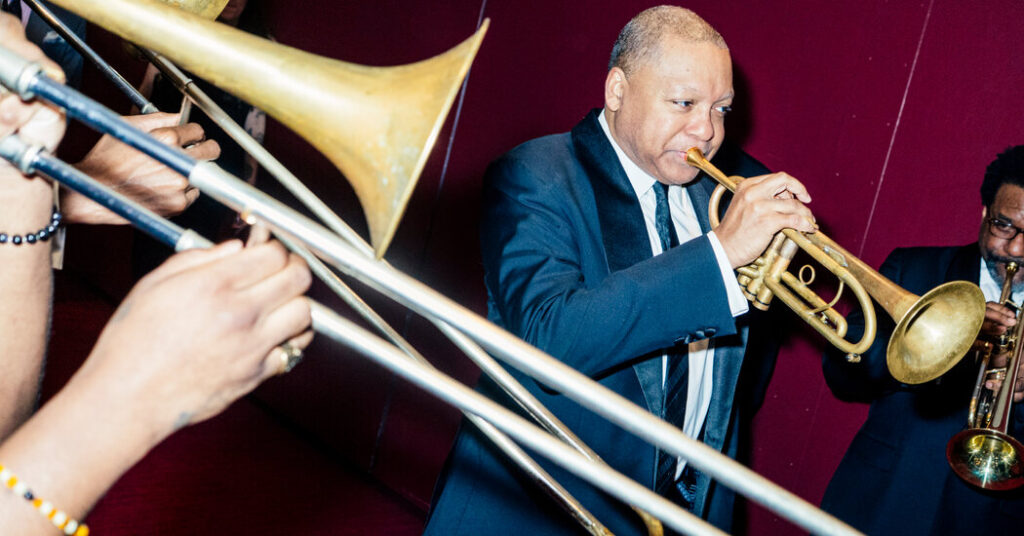
After nearly 40 years as the charismatic founder and recognizable face of Jazz at Lincoln Center, Wynton Marsalis will step down as managing and artistic director next year, the organization announced on Thursday, ending a transformative tenure that raised the profile of jazz nationwide.
“It’s the perfect time to identify the next generation of leadership,” Marsalis, 64, said in an interview. “We want to make sure that we do what we can to nurture what we’ve already built with the understanding that this is an art form and it will continue to grow and the organization will continue to flourish.”
Marsalis’s larger-than-life presence and prominence will not be easy to replicate. He has become a worldwide ambassador for jazz, as comfortable schmoozing with celebrities like Spike Lee and Barack Obama as he is explaining Dizzy Gillespie or Miles Davis to middle schoolers.
“He’s an orchestra leader, he’s a trumpet player, he’s our biggest fund-raiser,” said Gordon J. Davis, the founding chairman of Jazz at Lincoln Center. “Jazz was dead in this country. Wynton raised it up to make it what it should be: a true art of American culture.”
As part of a phased transition plan, Marsalis will step down as artistic director in July 2027 and then serve in an advisory role through the end of his contract in June 2028. Marsalis, who will retain a board position in perpetuity, said he intended to provide “institutional memory and insight, but not oversight.”
Although Marsalis will continue to perform with the Jazz at Lincoln Center Orchestra on occasion, his absence will be palpable. While he has never demanded the spotlight — playing in the back row — his searing and singular horn solos have been a highlight of the ensemble’s concerts.
“Wynton will continue to be an important contributor,” Clarence Otis, the chairman of the board, said. “What we are proud of is the fact that we’ve been able to institutionalize Jazz at Lincoln Center.”
Jazz at Lincoln Center originated in 1987 as a summer jazz concert series and eventually constructed its own permanent and self-described “House of Swing,” which opened in 2004 at the Time Warner Center — now the Deutsche Bank Center — at Columbus Circle. The venue, Frederick P. Rose Hall, includes Rose Theater; the Appel Room, which has a glass wall overlooking Columbus Circle; and Dizzy’s Club.
Jazz at Lincoln Center had its share of growing pains. The organization initially struggled to manage explosive growth after moving into its $131 million home. Jazz at Lincoln Center quickly tripled its budget with the three stages; prior, it did not have even one. Over the next three years, the organization cycled through six executive directors before landing on Adrian Ellis in 2007 and then Greg Scholl in 2012.
The institution stabilized in large part because the board changed the leadership structure, having the executive director report to Marsalis. “I picked almost every song we played at every concert,” he told The New York Times in 2015.
To prepare for Marsalis’s departure, Jazz at Lincoln Center has established two special committees: One will collaborate with him to identify the next generation of artistic leadership, another will lead the search for the next executive director, who would replace Scholl after he leaves in June.
While Marsalis remains the most widely known member of Jazz at Lincoln Center, he named several key contributors to the institution’s growth and success, including Carlos Henriquez, Ted Nash, Victor Goines, Walter Blanding and Rodney Whitaker. Even when musicians have left the orchestra, they remain connected through arranging, composing and performing. “We stay around each other,” Marsalis said.
There is also a fertile crop of young leaders who have grown up with Jazz at Lincoln Center — some of them now in their 40s — “who will nurture the mission and the vision,” Marsalis said. “My job at this time is to get out of the way and follow their leadership.”
Under Marsalis, who started his tenure when he was 26, the organization has expanded its season and increased its education programs, including the Essentially Ellington competition for high school bands from all over the world.
In addition, its “Let Freedom Swing” program serves elementary school students; its annual Jazz Congress convenes jazz artists and industry leaders; and with Blue Engine Records, Jazz at Lincoln Center releases work drawn from its digitized archive of performances.
The leaders of the organization said that, going forward, they hoped to raise $150 million for its endowment; to perform more often in its halls rather than filling them with rentals; and to upgrade its physical infrastructure.
Marsalis said he was proud to have made the “House of Swing” a cultural landmark, one he believes will outlast him.
“We’ve never been healthier — we’re in an unbelievably good position,” he said. “The institution is not Wynton Marsalis at Lincoln Center. It’s Jazz at Lincoln Center.”
Robin Pogrebin, who has been a reporter for The Times for 30 years, covers arts and culture.
The post Wynton Marsalis, Founder of Jazz at Lincoln Center, to Step Down appeared first on New York Times.