Storm Bear Williams couldn’t cook with gas at his new home even if he wanted to. And he emphatically does not.
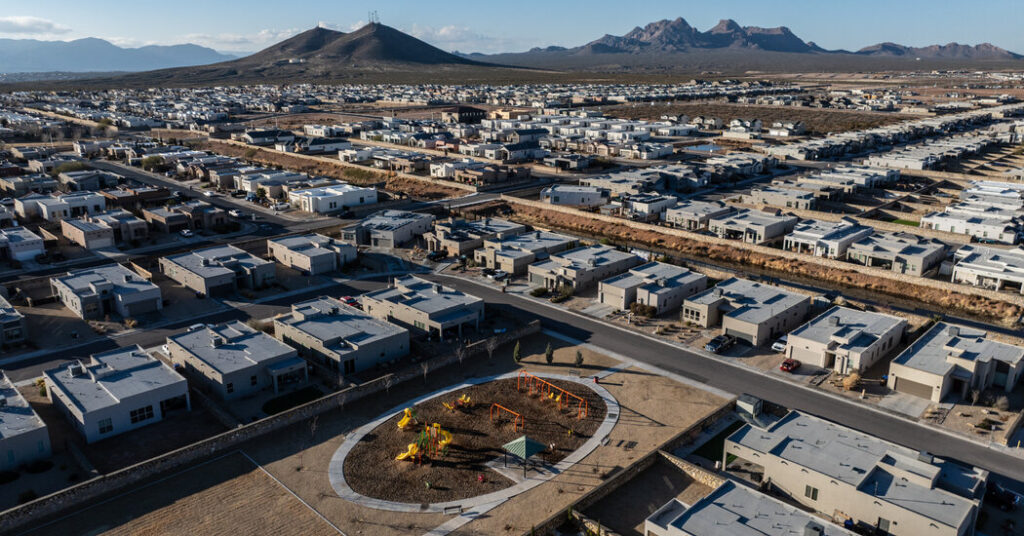
Last fall, Mr. Williams bought a new four-bedroom home in Metro Verde, a 2,200-acre development in Las Cruces, N.M., in the Chihuahuan Desert. He was drawn by the backdrop of the rugged, majestic Organ Mountains. And he loved that the home was all electric. It has a heat pump,chargers in the garage for his electric cars and an induction stove perfect for the cast-iron skillets he inherited from his great-grandmother. It came wired for the solar panels Mr. Williams plans to install on the roof.
There are no nearby gas lines to connect to. That’s because Metro Verde’s lead developer, John Moscato, decided four years ago that, whenever feasible, his company would no longer install natural gas lines for heating, hot water or cooking. While the initial roughly 2,500 homes at Metro Verde already had gas, the approximately 4,000 remaining sites would not.
Unlike some municipalities that have banned new gas hookups for environmental reasons, Mr. Moscato quit gas because of the hassle and the costs. Forgoing gas saves his company $3,000 per lot, and allowed it to deliver the sites to homebuilders more quickly, lowering construction costs and yielding a faster investment return. His company is developing another all-electric community in Las Cruces that is expected to break ground later this year.
“If we had done this sooner, it would have been better,” said Mr. Moscato, who was born in the Bronx and has developed thousands of home sites in and around Las Cruces since 1990. “But now that we’re developing this way, we’re very pleased.”
It was a bold move: New Mexico is a major producer of oil and gas, and about 60 percent of households use natural gas as their prime heating source, according to the Energy Information Administration, a government statistical agency.
But according to RMI, the research group formerly known as the Rocky Mountain Institute, the share of all-electric homes in the United States rose to 25 percent in 2020 from 18.8 percent in 2009. The number of new homes with gas heating has been steadily falling, while the percentage of new single-family homes with electric space heating doubled from 2000 to 2024 to 52 percent, and grew to 76 percent in new multifamily homes.
There are many reasons developers stop using gas, among them the surging popularity of heat pumps, which are one of the most energy efficient ways to both heat and cool a building. Panama Bartholomy, executive director of the Building Decarbonization Coalition, an advocacy group, said developers found it faster and cheaper to build all-electric structures.
“You don’t have to put in the gas line to the building,” Mr. Bartholomy said in an interview. “You don’t have to do all of the pipe in the building. You don’t have to do all the vents to get all the pollution out of the building. You’re just immediately saving money, not having to do that.”
The main ingredient in natural gas is methane, a potent greenhouse gas and harmful pollutant, and efforts to curtail its use have become politicized. While roughly 130 local governments have passed ordinances encouraging or requiring new and existing buildings to move away from gas, at least 26 states have laws pre-empting such bans, according to the Building Decarbonization Coalition.
Mr. Moscato said he had no opinions on such laws, none of which apply to him anyway.
“It was just an ongoing headache,” Mr. Moscato said of installing gas.
Mr. Moscato’s company develops land into lots that are sold to homebuilders, and is responsible for grading the land and installing utilities, curbs, gutters and the like. Installing gas lines invariably led to expensive delays, he said. Crews weren’t permitted to weld gas pipes on particularly windy days, and the gas lines required repeated inspections, all of which added months to the construction schedule, he said.
When he announced that the new sites at Metro Verde would be all-electric, a few of the homebuilders buying his lots were skeptical and nervous. Sales agents worried that home buyers would balk at not having the option of gas cooktops.
“People really care about the range in the home,” said Erik Maese, a salesman with French Brothers, which built 20 all-electric homes in Metro Verde. “Just trying to get that buy-in was kind of challenging initially.”
Quint Lears, a sales agent with Hakes Brothers, which has more than 1,200 homes in Metro Verde, said a few buyers had walked away because the new homes didn’t have gas. Still, he said sales had not slowed. Because his company did not have to install gas lines or arrange for gas inspections, it was able to bring the homes to market faster.
“Even if they would have preferred a gas now they’re like, Well, hey, it’s brand-new. It’s ready. It comes with a warranty,” Mr. Lears said. “And it’s better technology, style, design, energy efficiency.”
Mr. Williams, 62, an electric engineer, was drawn to his new home because he prizes energy efficiency. He also grew up near the coal fields of West Virginia, which left him with a deep aversion to fossil fuels. “All my relatives that worked in the coal mines died because of coal-related injuries,” he said. His grandfather, he added, died of black lung disease.
Mr. Maese, the sales agent, said his clients in the new all-electric homes tended to have more stable utility bills, thanks to high-efficiency appliances and tight building enclosures. Chris Thomas, who in September moved into a 1,650-square-foot all-electric home in Metro Verde, said that his bills had so far been lower than the combined electricity and gas costs at his former home.
Kalei Atkinson, 26, a special-education teacher who recently bought an all-electric home at Metro Verde with her mother, Adrienne Atkinson, said she had initially been worried about not having gas. She feared that the water might not be as hot, or that cooked food would taste different.
“I feel like the stereotypes of all-electric aren’t true,” Kalei Atkinson said. “It’s all the same.” Her mother said she liked being able to adjust the home’s temperature on her phone. Both women said they appreciated not having to worry about gas leaks, or whether Kalei Atkinson’s 3-year-old daughter might accidentally turn on the stove.
Laura Henry-Hand, who works for the state of New Mexico, said that after she and her husband moved into their all-electric home in Metro Verde in 2022, their electric bill was around $50 or $60 a month. After they put solar panels on the roof, she said, their highest electric bill was for $7. Most of the time their bill registers as a negative, and, at the end of 2024, El Paso Electric sent them a check for $595.30. “We love it,” she said of their home.
Cara Buckley is a reporter on the climate team at The Times who focuses on people working toward climate solutions.
The post Why a New Mexico Developer Quit Natural Gas appeared first on New York Times.