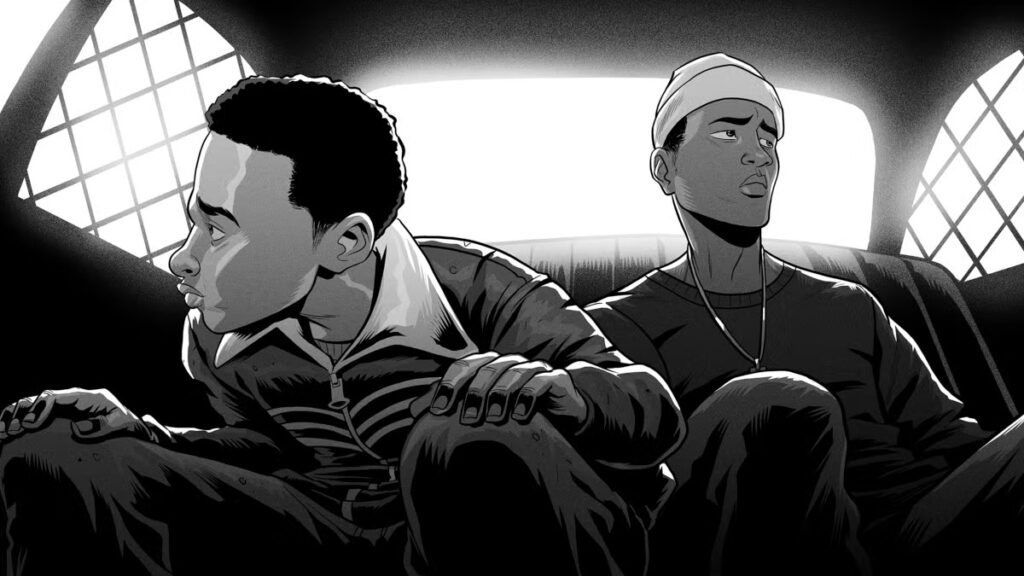
In the fall of 1983, a 14-year-old Baltimore high school student named DeWitt Duckett was shot and killed at point-blank range over a coveted Georgetown University jacket. The ensuing investigation and trial, which became known as the Georgetown Jacket murder, sent three 16-year-old boys to jail: Alfred Chestnut, Ransom Watkins and Andrew Stewart. Henceforth, they became known as the Harlem Park Three, and spent a collective 108 years in prison — a wrongful conviction.
In “When A Witness Recants,” documentarian Dawn Porter gives voice to three innocent men who were scapegoated by America’s justice system. Now released and having won a landmark $48 million settlement from the Baltimore Police Department, they reflect on the grave injustice they endured, despite the euphoria of exoneration. Scene by scene, Porter charts how these teens became fall guys for a crime they didn’t commit, nor could have committed. It’s devastating, maddening stuff; a scathing assessment of the rampant corruption and bigotry in America’s police and judicial institutions that’s gestated, like a festering rot, since the ’80s (and earlier).
But “When a Witness Recants” is not just reflection through information regurgitation.
While each freed man’s account drives the documentary’s fragile emotional core, footage of key law enforcement figures recounting how they reached their conclusions inspires appropriate outrage. Lead Detective Donald Kincaid’s testimony decades later, when questioned in conjunction with HP3’s exoneration, speaks volumes. Throughout Porter’s threaded narrative, we’re able to understand how a white cop failed three Black boys who were robbed of a fair investigation. Kincaid is grilled about his bullish manipulation tactics, asked why he didn’t follow up on other suspects, and each time he callously shrugs. “I can’t recall.” For whatever reason, Kincaid wanted to book the HP3 despite conflicting witness statements and alternative evidence hidden from court hearings — a true-to-life villain.
The police are supposed to keep us safe. ‘To Serve and Protect,’ reads the popularized LAPD slogan. But in connection with the recent Black Lives Matter and ACAB movements, Porter and collaborative producer Ta-Nehisi Coates (who has personal ties to Baltimore’s famed case) want us to remember that contemporary police abuses aren’t newfound behavior.
“When A Witness Recants” brings human stakes to commentaries on a broken system, showing audiences three lives unjustly stolen by officials meant to uphold the law. Chestnut, Watkins and Steward watched nearly four decades pass from behind bars. They missed funerals, couldn’t start families, and came of age while trying to survive penitentiary environments. Porter gives them a platform to unload their emotional weight, as we hear a tug-of-war between catharsis and agony coloring their words.
But there’s a pièce de résistance to “When A Witness Recants.” A crucial witness, Ron Bishop, is featured as prominently as the HP3. Only 14-years-old at the time, he was threatened and coerced by Kincaid to corroborate false accusations and testify against the trio — even though he knew they weren’t guilty. Bishop is given the space to lend credence to the film’s damning condemnation of Kincaid’s farce of an investigation, but also seek closure for his weakness. Sure, his eventual aid in releasing the HP3 was pivotal — but he also helped jail them. As he stammers on, Porter allows us to form our own feelings about Bishop and whether he’s stealing national spotlights from the real victims.
The documentary’s power shines through in its final act, when Porter dares to push beyond the informality of talking heads. Criminal documentaries typically wrap once the verdict is delivered, whereas “When A Witness Recants” advances the conversation. Questions arise throughout Bishop’s admissions of guilt and hurt, prompting Porter to offer her subjects a chance at reconciliation. What transpires is raw, captivating and ultimately a daunting climax that offers invaluable perspective.
For the New Yorker, Bishop collaborated with writer Jennifer Gonnerman for a piece that reflects the documentary’s title, and its subhead reads: “They’ve all lived with the consequences.” That sentiment, in relation to an article focusing on Bishop, becomes a primary element of the story’s developing drama.
“When A Witness Recounts” piggybacks off today’s sickening slew of reported police malfeasance, especially against Black individuals. Porter allows the Harlem Park Three to share their truths in hopes that eyes are opened, and the population reacts appropriately.
Blind faith in bureaucracy and judicial systems has never been properly rewarded — and this is just one case of mistreatment. “When A Witness Recounts” assesses a tragic misdoing from the inside, pointing an obvious finger at blame, but also permits messier emotions to play out organically on screen. Porter, a true documentarian, sees every aspect of an otherwise clear-cut case and lets us decide the level of infuriation we want to feel.
The post ‘When a Witness Recants’ Review: Profound Doc Spotlights the Harlem Park 3 appeared first on TheWrap.