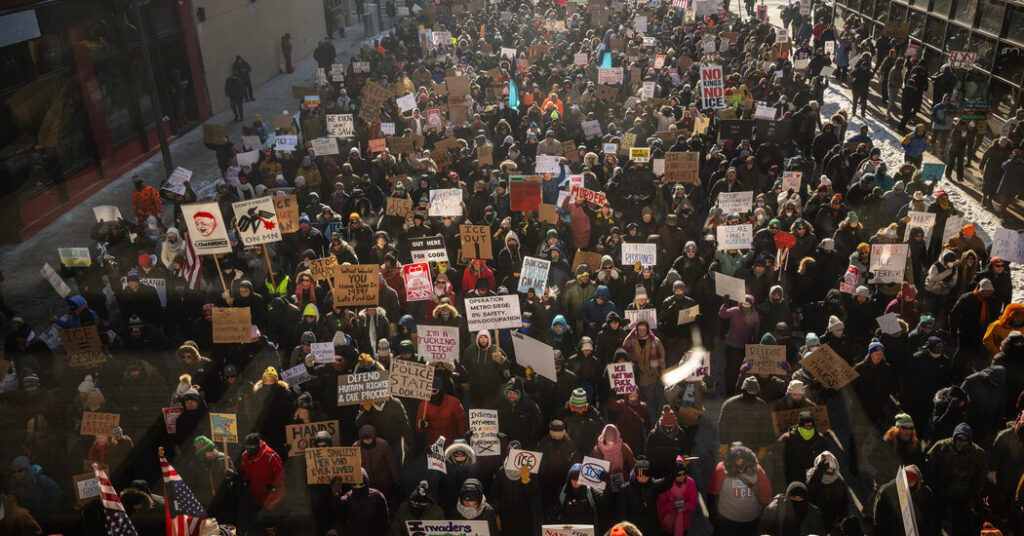
Protests following the killings of Renee Good and Alex Pretti are scheduled in Minneapolis and coast to coast throughout the weekend, as the nation continues to grapple with an immigration crackdown that has roiled cities.
There is a “national shutdown” planned for Friday that hopes to persuade people to stay home from school, work and shopping, and dozens of “ICE Out Everywhere” protests in towns large and small set for Saturday. Organizers hope that a sweeping show of resistance will convince the Trump administration to stop sending immigration agents to cities nationwide.
The demonstrations follow a general strike on Jan. 23 in Minneapolis that saw hundreds of business shut down and thousands take to the streets. That was the day before Mr. Pretti was killed by a federal agent, setting off a new wave of fury at ICE and Homeland Security.
Here’s what to know about this weekend:
What will the protests look like in Minneapolis?
On Friday, organizers are planning a protest at 8 a.m. outside the B.H. Whipple Federal Building, where immigrants caught in the dragnet have been detained. The building has seen countless protests over the past few weeks. There will also be a march and rally at the Government Plaza building at 2 p.m.
On Saturday, advocacy groups, including Twin Cities Coalition for Justice and the Minnesota Immigration Rights Action Committee, are holding a march and rally at 1 p.m. at Bryant Square Park in Minneapolis.
What will the protests look like across country?
On Friday, University of Minnesota student groups have called for a national shutdown. Working with hundreds of organizations in 46 states, organizers said they are encouraging Americans to abstain from daily activities to grind the economy to a halt.
“No work. No school. No shopping. Stop funding ICE,” their website reads.
The student groups taking the lead on organizing include the university’s Somali Student Association and Black Student Union. They are also encouraging high school students across the country to organize walkouts. The Somali community in Minneapolis has been a specific target of the Homeland Security operation.
“They wanted to intimidate us and to spread fear in our hearts, but that isn’t going to work. That’s exactly why we are going back,” Dahir Munye, the president of the Somali Student Association, said while announcing the shutdown at Minneapolis City Hall on Wednesday. “The only way to truly fight back is to extend and expand the shutdown movement from last Friday.”
Information about the shutdown quickly spread across social media, with celebrities, including singer Ariana Grande and actor Pedro Pascal, sharing posters on Instagram.
On Saturday, the national organization 50501 has organized an “ICE Out of Everywhere National Day of Action.” The group is encouraging organizers in all 50 states to host demonstrations outside detention centers, ICE field offices, airlines that work with the agency and congressional offices, according to a news release.
Protests will continue until federal agents are “permanently removed from our streets,” the statement said.
The organization — whose name stands for 50 states, 50 protests, one movement — has convened weekly demonstrations in towns and cities for much of the past year.
Why are people protesting?
Cities have seen waves of protests since the Trump administration began its immigration operation last year. But tensions in Minneapolis increased markedly after federal agents killed Ms. Good, who was part of a protest of a deportation action, and again just two weeks later when agents killed Mr. Pretti, who had been videotaping them.
Organizers have cited those killings, as well as the deaths of Silverio Villegas-Gonzalez, a Mexican immigrant shot by an ICE agent in September, and Keith Porter Jr., a Los Angeles man killed by an off-duty ICE officer on New Year’s Eve, as impetus for this weekend’s protests.
Talya Minsberg contributed reporting.
Sonia A. Rao reports on disability issues as a member of the 2025-26 Times Fellowship class, a program for early-career journalists.
The post What to Know About Anti-ICE Protests This Weekend appeared first on New York Times.