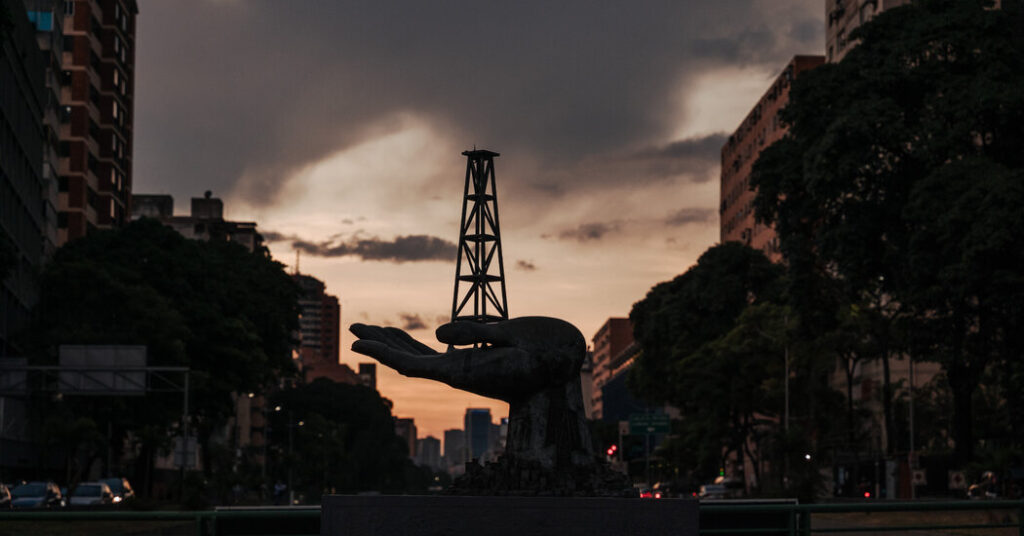
Venezuela’s National Assembly on Thursday approved a sweeping overhaul of legislation governing the oil industry, granting foreign oil companies greater control over operations and potentially slashing the royalties they pay to the government.
The move showcases how, experts say, the Trump administration has returned to an era of gunboat diplomacy, in which the United States has wielded its military superiority to coerce Latin American nations into yielding to Washington’s priorities.
The U.S. military captured Nicolás Maduro, Venezuela’s authoritarian leader, this month and replaced him with his vice president, Delcy Rodríguez. Faced with U.S. threats that she could meet the same fate, Ms. Rodríguez has rushed to meet demands to open the oil industry to greater U.S. involvement.
The new legislation gives foreign companies clear operational control over production ventures, effectively relegating the national oil company, Petróleos de Venezuela, to secondary status.
It also opens the way for the authorities to sharply reduce the royalties and taxes paid to Venezuela’s government and allows companies to resolve disputes in international venues instead of doing so in Venezuela’s legal system. Still, the changes did not go as far as some investors had wanted, leaving Petróleos de Venezuela under state control instead of breaking it up or privatizing it.
The overhaul effectively reverses much of Venezuela’s nationalization of oil projects in 2007, which led U.S. oil giants like Exxon Mobil and ConocoPhillips to exit a country with some of the world’s largest oil reserves. That takeover was a central pillar of Chavismo, the political movement that has held sway over Venezuela for nearly 30 years.
“I think this is a major step forward,” said Alejandro Grisanti, a prominent Venezuelan economist who runs the Caracas consulting firm Ecoanalítica. He said the new legislation could help raise oil production by 200,000 to 300,000 barrels a day, up from a current level of roughly one million.
Mr. Grisanti added that the law was “very pragmatic” in terms of improving conditions for large companies already operating in the country, such as Chevron, Repsol and ENI, as well as for smaller operators with a greater appetite for risk.
But Mr. Grisanti also sought to tamp down expectations that the law could unleash a wave of investment by huge companies like Exxon Mobil, whose chief executive has expressed skepticism about returning to Venezuela.
“Many of the giants won’t invest in Venezuela no matter the legal framework because of its past record of expropriations and nationalizations,” Mr. Grisanti said.
Trump Administration: Live Updates
Updated
- Trump says he shut his eyes at the last cabinet meeting because it was ‘boring.’
- Democrats block spending package as D.H.S. talks continue.
- Another top Kennedy Center official resigns.
Still, the oil legislation is expected to inject some badly needed vitality into Venezuela’s economy, which is exceptionally dependent on oil and has been devastated over the past decade by a collapse in oil revenues, expropriation sprees and U.S. sanctions.
Venezuela’s energy infrastructure, some of which is in a decrepit state, also stands to be improved.
Economic growth could reach 15 percent this year if oil investments materialize as a result of the overhaul, Mr. Grisanti said. While that may seem like a boom anywhere, it would occur from depressed levels of economic activity.
Reflecting greater efforts to ease concerns about instability in Venezuela, the law would allow foreign energy companies to resolve disputes in arbitration venues outside the country instead of relying on a legal system characterized by a lack of judicial independence.
“Loosening the grip of state control, creating a lot more operational autonomy, is a positive step for private-sector investors,” said Norma Mozeé, a former diplomat at the U.S. Embassy in Caracas who is now an energy consultant based in Denver.
Still, Ms. Mozée, who led the drafting of a U.S. recovery plan for Venezuela’s oil industry during Mr. Trump’s first term, also expressed caution about the new legislation.
Legal challenges in Venezuela, she said, could emerge over production-sharing agreements in the new legislation that are supposed to allow private operators to recover more than 50 percent of the oil they produce.
“Investors are looking for political stability as well as legislative and legal stability, and this current regime, which is the remnants of the Maduro regime, does not have a track record of protecting outside interests,” she said. “That rebuilding of trust is going to take time.”
The changes in the legislation are intended to lure investments from established companies and wildcatters, prospectors who drill exploratory oil wells. In an effort to muster support for the overhaul, Ms. Rodríguez’s government convened large numbers of oil workers and political supporters to march on Thursday in Caracas in support of the changes.
Alex Cranberg, a self-described wildcatter who was at the meeting that Mr. Trump convened with American oil executives this month, said he was intrigued by a wide variety of short-term and long-term opportunities in Venezuela.
But Mr. Cranberg said he was concerned about Venezuela’s track record of abrupt changes in oil laws, as well as the fact that Venezuela is being prodded to make changes under the threat of U.S. military force.
“Laws that are reliant only on U.S. military power will not be enough,” he said. “The Venezuelan government and investors must convince each other that we are dependable valuable partners in building prosperity.”
Simon Romero is a Times correspondent covering Mexico, Central America and the Caribbean. He is based in Mexico City.
The post Venezuelan Lawmakers Approve Sweeping Overhaul of Oil Sector appeared first on New York Times.