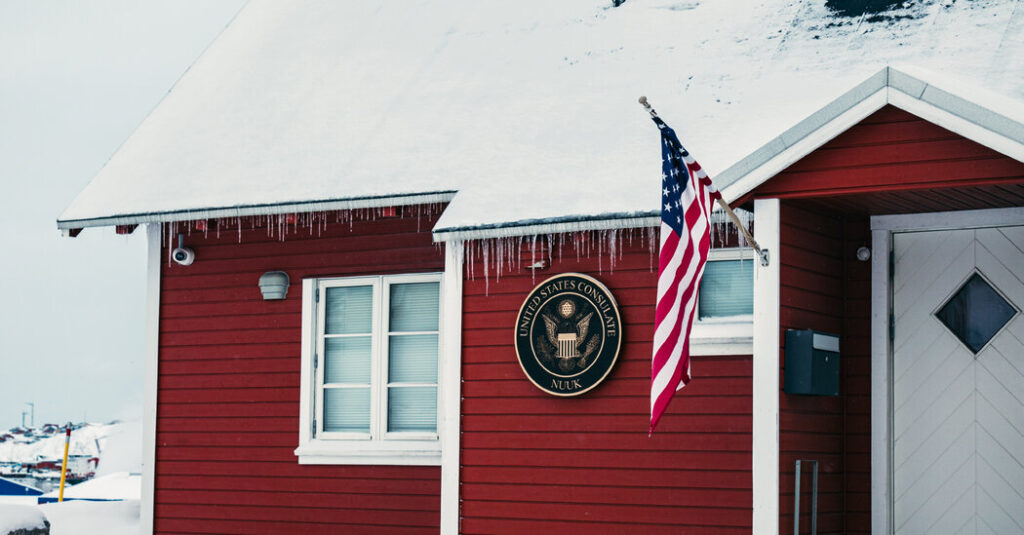
On Jan. 23, 1943, the transport ship Dorchester departed New York Harbor, bound for the U.S. Army command base at Narsarsuaq on Greenland’s southern coast. Aboard were some 900 service members, merchant seamen and civilian workers sailing to protect Greenland — and by extension the entire Western Hemisphere — from Nazi occupation and tyranny.
In the early morning hours of Feb. 3, a German U-boat struck the ship with a torpedo. Within 25 minutes, the Dorchester slipped into the icy North Atlantic. Only 230 men survived. It was the worst single loss of American personnel on any U.S. convoy during World War II.
That tragedy is forever defined by the heroism of the men remembered as the Four Chaplains: George L. Fox, Alexander D. Goode, John P. Washington and Clark V. Poling. As the ship went down, these ministers of different faiths gave their own life jackets to fellow soldiers, linked arms on the slanting deck and prayed together as the freezing waters rose.
That history matters today. It stands as a solemn reminder that Greenland is not some abstract geopolitical concept debated in think tanks and conference halls. It is a real place — and one Americans have defended with their blood.
President Trump has long expressed a cleareyed understanding of the island’s strategic importance. In a January 2025 Truth Social post, he pledged to protect Greenland from “a very vicious outside world.” Those words were reinforced last week by the president’s announcement of a framework that President Trump believes will lead to the United States’ gaining total, unfettered access to the island.
I cannot divulge the details, as they are being worked out, but the framework builds on the 1941 and 1951 defense agreements between the United States and Denmark and would enhance American, NATO and Greenlandic security and reaffirm longstanding trans-Atlantic defense obligations. It would expand America’s operational freedom, support new bases and infrastructure, facilitate deployment of advanced missile-defense systems like the Golden Dome and crowd out hostile Chinese and Russian influence. These measures are not provocative — they are preventive. They would ensure that the United States, not its adversaries, sets the rules in one of the world’s most strategically consequential regions in perpetuity.
As President Trump stated plainly in his 2026 address to the World Economic Forum in Davos, Switzerland, every NATO ally has an obligation to defend its own territory — and the reality is that no nation, or group of nations, is capable of securing Greenland without the United States. When President Trump took office last year, he recognized an uncomfortable fact that many others have avoided: America must guarantee its own unfettered and uninterrupted access to key strategic territories in the Western Hemisphere, including both Greenland and the Panama Canal. That assessment was driven by history, geography and hard military capability.
The result has been a reinvigoration of the 1823 Monroe Doctrine and a reassertion of American leadership where it matters most. Nowhere was this more evident than in Venezuela, where decisive action removed the longtime leader of a repressive regime.
Greenland fits squarely within that doctrine. America’s adversaries already understand what many past U.S. administrations ignored: The Arctic is no longer peripheral to global affairs. Greenland sits roughly equidistant between Washington and Moscow. It hosts critical early-warning and missile-defense infrastructure and lies along Arctic shipping routes that China and Russia are aggressively seeking to exploit.
The era when the Arctic could be treated as remote, static or secondary has passed. President Trump’s Greenland agreement confronts this reality directly. The president has been unequivocal: American dominance in the Arctic is nonnegotiable. His commitment to building what he described as “the greatest Golden Dome ever built” is about more than technology. It signals to allies and adversaries alike that the United States will not outsource its security responsibilities or retreat from critical terrain.
As President Trump emphasized in Davos, Greenland is a core national security interest for the United States, and strengthening America’s position there strengthens NATO itself. A strong America, in other words, remains the foundation of a strong alliance.
History reinforces this point. During World War II, the United States constructed 13 Army bases and four Navy bases across Greenland. At the height of the Cold War, the Thule Air Base (now called the Pituffik Space Base) hosted some 10,000 American military personnel. Sustained investment in Greenland’s defense was once the norm.
The neglect of recent decades stands out as an alarming departure from a strategy that worked in containing the Soviet Union. The end of the Cold War did not end strategic competition, nor did it erase the threats posed by foreign adversaries.
While Russia and China rapidly expanded their icebreaker fleets and Arctic infrastructure, the United States allowed its readiness to erode. Today, America operates just three icebreakers as those two powers, mainly Russia, field more than 40 combined. These vessels are not built for symbolism; they are tools of influence and control.
President Trump’s April 2025 executive order “Restoring America’s Maritime Dominance” finally began reversing this trend by calling for an increase in domestic shipbuilding and restoration of American maritime power. During President Trump’s first term in office, the then-Department of Defense issued a 2019 report to Congress that included the geopolitical importance of Greenland and advocated the expansion and modernization of our existing national security capabilities in the Arctic.
My mission as special envoy for Greenland is straightforward: to advance American national security while opening avenues of economic opportunity, including for states like Louisiana, where I am governor. That work means advising the president on strengthening America’s presence, deepening local partnerships and aligning U.S. Arctic strategy with today’s realities. Greenland has never been peripheral to America’s security. History proves it. Strategy demands it.
Jeff Landry is the U.S. special envoy to Greenland and the governor of Louisiana.
The Times is committed to publishing a diversity of letters to the editor. We’d like to hear what you think about this or any of our articles. Here are some tips. And here’s our email: [email protected].
Follow the New York Times Opinion section on Facebook, Instagram, TikTok, Bluesky, WhatsApp and Threads.
The post Trump’s Greenland Envoy: We Need ‘Total, Unfettered Access’ appeared first on New York Times.