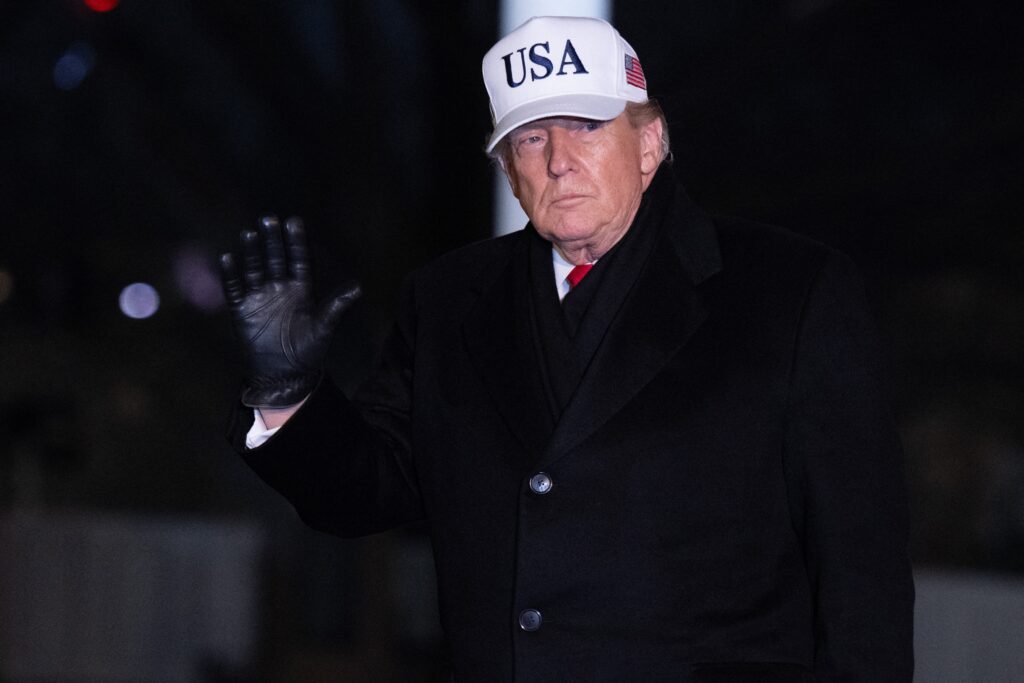
On the second day of January, as anti-government protests spread across Iran and there were early reports of demonstrators killed by Iranian security forces, President Donald Trump pledged to come to their rescue. “We are locked and loaded and ready to go,” he wrote on social media.
Less than two weeks later, as both the protests and the deaths had increased exponentially, Trump called on the demonstrators to “KEEP PROTESTING — TAKE OVER YOUR INSTITUTIONS,” and pledged that “HELP IS ON THE WAY.”
The promise to aid civilians suffering massive human rights abuses seemed a classic exercise of the Responsibility to Protect, the commitment undertaken unanimously by world governments, including the United States, at the United Nations more than a quarter century ago and occasionally cited by previous U.S. presidents since then as a justification for far-flung military action.
Such reasoning seemed out of political character for Trump, who promised an America First foreign policy that would end overseas entanglements and the historic U.S. role as international policeman and defender of democracy. Trump’s second-term military strikes in Yemen, Nigeria and elsewhere, and threats to use force in places such as Greenland and Colombia have sparked rumblings among his backers of creeping neoconservatism and ill-fated U.S. interventions in Afghanistan and Iraq.
Trump backed away from striking Iran after hearing the concerns of foreign allies and military advisers who feared a less than adequate U.S. military presence in the region to repel Tehran’s potential response. But he dispatched the Abraham Lincoln carrier strike group, sophisticated surveillance aircraft and other military assets to the Middle East, even as the countrywide protests that left thousands of Iranians dead had largely stopped by the time the carrier group arrived in the region this week.
The “massive Armada” he said in a Wednesday Truth Social post, is “ready, willing, and able to rapidly fulfill its mission, with speed and violence, if necessary.”
What that mission is now remains unclear.
Trump’s statement made no mention of anti-government protests. It was an even larger fleet than he had sent to the waters around Venezuela, he said, where the U.S. military has blown up boats allegedly smuggling drugs, seized oil tankers and earlier this month removed that country’s strongman, Nicolás Maduro, while leaving the rest of its governing structure intact.
In the same post, Trump demanded that Iran make a deal to give up its nuclear program, or face a “far worse” attack than it endured with last summer’s U.S. strikes against its nuclear facilities.
“Now that the [Iran] protests have died out, he wouldn’t be saying ‘I’m intervening to stop the killing,’” said Charles Kupchan, professor of international affairs at Georgetown University and a senior director on the National Security Council staff during the Obama administration. “He may be contemplating going after regime targets.”
“Trump feels like he’s on a roll,” Kupchan said, citing a drift from “neo-isolationism to neo-imperialism” over the past year. “He feels emboldened by the assertive use of U.S. military power and he’s looking for the next win.”
The White House did not respond to questions about the current mission of U.S. deployments around Iran.
In Wednesday testimony before the Senate Foreign Relations Committee, Secretary of State Marco Rubio offered another rationale for the military buildup, saying it was to “preemptively prevent” an Iranian attack on tens of thousands of U.S. service members that for years have been stationed at bases in Bahrain, Qatar, Saudi Arabia and elsewhere in the Middle East.
“I hope it doesn’t come to that,” Rubio said. “But that’s what I think what you’re seeing now is the ability to posture assets in the region to defend against what could be an Iranian threat against our personnel.”
Rubio also warned that the protests could start again and agreed with U.S. intelligence assessments that the Islamic regime, beset with economic collapse and dissatisfaction, was “probably weaker than it has ever been.”
Democrats at the hearing lambasted the administration for what Sen. Jeanne Shaheen (New Hampshire) called its “gap between rhetoric and reality in how this administration deals with other authoritarian regimes.”
“At a time when Iran is violently cracking down on protests, the U.S. is coming to agreements to deport Iranians in this country back to Iran,” with at least three flights having recently departed. “People who will face persecution and interrogation by Iranian security forces,” Shaheen said. “President Trump told the Iranian people that help was on the way, yet the United States has largely stood on the sidelines as the situation deteriorated.”
While protests across Iran’s major cities appear to have been squelched for now, the multitude of economic problems and other difficulties that precipitated them remain and the situation could again explode, according to people familiar with the U.S. intelligence reports who spoke on the condition of anonymity to discuss internal assessments.
One possible flash point may come on Sunday, the anniversary of the 1979 return to Iran from exile of Ayatollah Ruhollah Khomeini, the Islamic Republic’s founder, which precipitated the fall of the U.S.-backed monarchy led by the Shah.
Iranian officials have acknowledged that the protests were sparked by economic problems, but argued that foreign-controlled “terrorists” turned peaceful demonstrations into violence and widespread property destruction. Tehran also publicly denied Trump’s claim earlier this month that it had agreed to stop planned executions of what the U.S. president said were 800 Iranians sentenced to hanging as the demonstrations wound down.
The regime has given no indication it is planning to preemptively attack U.S. forces, although it has promised to respond aggressively if the United States or Israel strike first. “Our brave Armed Forces are prepared — with their fingers on the trigger — to immediately and powerfully respond to ANY aggression against,” Foreign Minister Abbas Araghchi said Thursday in a social media post.
In the meantime, Iran has rushed to enlist diplomatic support from neighbors who fear a U.S. attack and resulting retaliation would bring chaos to the region. Both Saudi Arabia and the United Arab Emirates said this week they would not allow their territory or airspace to be used for a strike on Iran.
A statement Wednesday from Qatar’s foreign ministry said that Prime Minister Mohammed bin Abdulrahman Al-Thani had spoken with Ari Larijani, the head of Iran’s national security council and a close aide to Supreme Leader Ali Khamenei about “cooperation relations between the two countries and ways to support and enhance them.”
Egypt’s Foreign Minister Minister Batr Abdelatty held separate phone conversations this week with Araghchi and U.S. Middle East envoy Steve Witkoff, a statement from the ministry in Cairo said. It said the talks focused on “the urgent need to intensify efforts aimed at reducing tensions and preventing the region from sliding further into instability.”
Araghchi plans to travel Friday to Turkey for a meeting with his Turkish counterpart.
In a Monday interview with Axios, Trump said that Tehran had reached out on “numerous occasions” and wanted “to make a deal.” U.S. officials have said Washington’s terms are that it stop uranium enrichment program and turn over any already-enriched material, curtail missile production and stop support for regional proxy groups in Lebanon, Iraq, Yemen and elsewhere.
Araghchi said Wednesday that he had not been contacted recently by Witkoff about resuming the nuclear dialogue that ended with last summer’s U.S. and Israeli airstrikes and that there has been no request for negotiations from either side, according to reports in Iranian media.
Meanwhile, the U.S. naval buildup in the Middle East has continued, with the Abraham Lincoln and three escort warships arriving in the North Arabian Sea, a defense official said Thursday, speaking on condition of anonymity because of the sensitivity of the issue.
The strike group includes the destroyers USS Frank E. Petersen Jr., USS Spruance, and USS Michael Murphy, each carrying dozens of Tomahawk missiles and air defenses.
Another U.S. destroyer, the USS Delbert D. Black — deployed from Naval Station Mayport in Florida — also has arrived in the region and was in the Red Sea on Thursday, the official said. Others were positioned near the Strait of Hormuz and the eastern Mediterranean, a second official said. Additional U.S. military assets, including land-based air defenses, are expected to flow into the region, officials have said.
Asked about the U.S. military buildup, Araghchi said that while threats and diplomacy have often gone hand in hand in international affairs, the United States must abandon exaggerations and what he described as irrational demands if it genuinely seeks negotiations.
In a post on X following Trump’s Truth Social comment, the Iranian mission to the U.N. said that “last time the U.S. blundered into wars in Afghanistan and Iraq, it squandered over $7 trillion and lost more than 7,000 American lives.” If pushed, it said, “IRAN WILL DEFEND ITSELF AND RESPOND LIKE NEVER BEFORE.”
Dan Lamothe, Warren Strobel, Noah Robertson and John Hudson contributed to this report.
The post Trump weighs imminent Iran strikes, but what’s the mission? appeared first on Washington Post.