Two global trading houses that brokered an opaque deal with the Trump administration this month to sell Venezuelan oil were previously prosecuted for bribery schemes involving oil sales elsewhere, court records show, underscoring concerns by anti-corruption experts and lawmakers that the arrangement is vulnerable to abuse.
The administration granted confidential licenses to Vitol and Trafigura in early January to sell Venezuelan oil with little independent oversight. The licenses come a year after the Trump administration gutted the foreign corrupt practicesunit of the Justice Department, which brought charges against the two companies and their traders in 2020 and 2024.
The licenses were granted as part of an energy deal the United States pushed Venezuela to accept after ousting its autocratic president, Nicolás Maduro, in a military raid Jan. 3. They allow Vitol and Trafigura to buy tens of millions of barrels of oil in Venezuelan reserves that had been blocked by sanctions from being sold. They also allow the trading houses to trade crude that Venezuela’s state oil company or other firms pump while sanctions remain in place. President Donald Trump has said the sales will help stabilize Venezuela’s economy and benefit the U.S.
According to public records, a senior trader at Vitol donated $6 million to political committees supporting Trump’s 2024 election. Vitol has stressed the donations were made by the individual and not the company.
The bribery schemes were colorful and elaborate, according to court records. They involved code words such as “shoes” and “coffee,” shell entities, and fake contracts and invoices with Mexican and Ecuadorian state oil companies in the case of a Vitol trader who was convicted of bribery in 2024, four years after the company paid $135 million in criminal penalties to resolve accusations it bribed officials in Mexico, Ecuador and Brazil. That was not its only run-in with prosecutors.
The other company, Trafigura, had plotted with Brazilian oil company officials to route funds through shell companies and offshore accounts to conceal a bribery scheme that helped net it $61 million in profits, according to a 2024 federal plea agreement in which the company admitted guilt and agreed to fines and forfeitures totaling $126 million. It’s one of several past allegations against the company, including a corruption conviction last year in Switzerland on charges of having bribed an Angolan official for oil contracts. The company is appealing.
“Trump is taking advantage of firms that know how to circumvent regulation,” said Robert Bachmann, an analyst at Public Eye, a Swiss nongovernmental organization that investigates commodities traders. “They were previously hunted down by the U.S. Department of Justice,” but that “does not seem to matter” to the current administration.
Vitol said in an emailed statement that it has “enhanced” its anti-corruption “compliance procedures and controls” in accordance with its 2020 federal deferred prosecution agreement, resulting in the charges being dropped. “Vitol operates its business in compliance with all relevant laws and regulations,” the company wrote. “Any suggestion otherwise is incorrect.”
Trafigura did not respond to detailed questions. In a statement earlier this month, the company said it is helping facilitate the sale of Venezuelan oil “at the request of the U.S. government.”
Administration officials say Vitol and Trafigura — among the three largest oil trading firms in the world — are some of the only ones with the resources and expertise to execute the complicated trades quickly. Officials note that the firms paid for $500 million of Venezuelan oil up-front and that the proceeds have already made their way to Venezuelan banks, where they will be used to stabilize the economy and address citizens’ basic needs.
“If not for President Trump’s bold action and courageous leadership, Venezuela would still be controlled by narcoterrorist Maduro and Venezuelan oil would still be funding our foreign adversaries,” White House spokeswoman Taylor Rogers said in an email. “The historic U.S.-Venezuela energy deal will restore prosperity and security in Venezuela, safeguarding the economic and national security interests of the United States.”
Trafigura’s and Vitol’s existing networks of tankers and storage facilities across the Caribbean made them an obvious choice to quickly move Venezuela crude, administration and industry officials said.
“They are probably among the few companies that can in short notice allocate such a large number of barrels — 30 million to 40 million — so it’s a very convenient way for the administration to solve what would have been a much more complex problem,” said Francisco Monaldi, director of the Latin American Energy Program at Rice University.
Administration officials stressed that the deal requires the firms to sell at least half the Venezuelan oil to U.S. buyers. Most of the rest is expected to be sold in India and other Asian markets, according to analysts who are tracking the shipments.
Separate from the bribery case, Trafigura agreed to pay$55 million in civil penalties to U.S. commodities trading regulators in June 2024 to resolve allegations that it acquired “material nonpublic information” about gasoline contracts, manipulated a benchmark fuel price and impeded potential whistleblowers. The following month, Vitol and another firm agreed to pay $50 million to settle allegations by the California attorney general that they “secretly worked together to tamper with and manipulate spot market prices for California gasoline.”
It is unknown how much the two companies could profit from the Venezuela deal, but it’s potentially far more lucrative than previously reported, according to a copy of Vitol’s license obtained by The Washington Post. The license permits trading other natural resources in Venezuela, including iron ore and agricultural products. It is valid through June 2027.
Vitol confirmed some broad contours of the Venezuelan deal in an email, including that it encompasses “natural resources” beyond oil. But it said both the license and Vitol’s contract with the Venezuelan state oil company — which is providing the fuel — are confidential.
Vitol and Trafigura are depositing their payments for the oil in a bank account in Qatar, according to the Vitol license. The structure of the deal could shield the money from creditors that have claims pending against Venezuela and its state-owned oil company, in alignment with an executive order Trump signed Jan. 9.
Administration officials say the funds will be used to benefit the Venezuelan people, with Trump controlling their disbursement. They say the interim government in Venezuela has met the conditions needed for the release of funds from the first oil sales, after cooperating with the White House on the energy deal.
Last week, Venezuela confirmed receipt of the first $300 million. The dollars were funneled through four authorized private banks in Venezuela and then directly offered to importers, largely for food and medical goods, according to people with knowledge of the transactions who spoke on the condition of anonymity because details have not been publicly disclosed. In an effort to limit corruption, the buyers had to have a unique alphanumeric identifier known as a SWIFT code with a traceable account, they said.
Qatari emissaries had been working to facilitate talks between the Venezuelan government and the Trump administration, and they had earned the confidence of both sides, according to people familiar with the conversations who spoke on the condition of anonymity because they were not authorized to share details publicly.
Trump has indicated the U.S. could take a cut of the oil proceeds at some point, but that does not appear to be the arrangement with initial sales. The White House has been more focused on imposing rules that require U.S. firms to receive contracts to revive Venezuela’s rotting energy infrastructure and that give preference to U.S. oil firms interested in pumping there.
The United States’ taking control of sales of another nation’s oil and routing payments to an offshore account is not unprecedented, said Peter Harrell, a fellow at the Carnegie Endowment for International Peace and former White House adviser in trade and economics. The U.S. facilitated sales of Iraqi oil using foreign bank accounts in the 2000s, and earlier through the United Nations’ oil-for-food program in the 1990s. “There is also precedent for corruption scandals popping up around these schemes,” he said.
Both in the U.S. and Venezuela, secrecy over the deal has raised hackles.
“The Venezuelans are the owners of the oil, and we know nothing. There is no transparency,” said José Guerra, an economist and member of the Venezuelan opposition, in an interview. “In a normal condition, a sovereign country sells oil and the exact number of barrels and the price are known, and goes to the central bank. Again, right now, we know nothing.”
Secretary of State Marco Rubio has said Trump’s control of how the money gets released to Venezuela gives the White House “leverage” to bring this oil back on the market without risking proceeds will be used for narco-terrorism and drug trafficking.
At home, congressional Democrats are demanding greater accountability.
“The Trump administration is funneling another country’s oil revenues into handpicked accounts with virtually no oversight,” Sen. Elizabeth Warren (Massachusetts), the top Democrat on the Senate Banking Committee, said in a statement. “Congress cannot allow Trump to treat Venezuela’s oil profits like his personal slush fund.”
Warren and four other senators have launched an investigation seeking information from 15 large U.S. banks, including JPMorgan, to determine whether they were approached by the administration for help executing the deal. The license reviewed by The Post specifically authorizes JPMorgan to be involved in the purchase of Venezuelan oil, metals and agricultural products. The bank declined to comment.
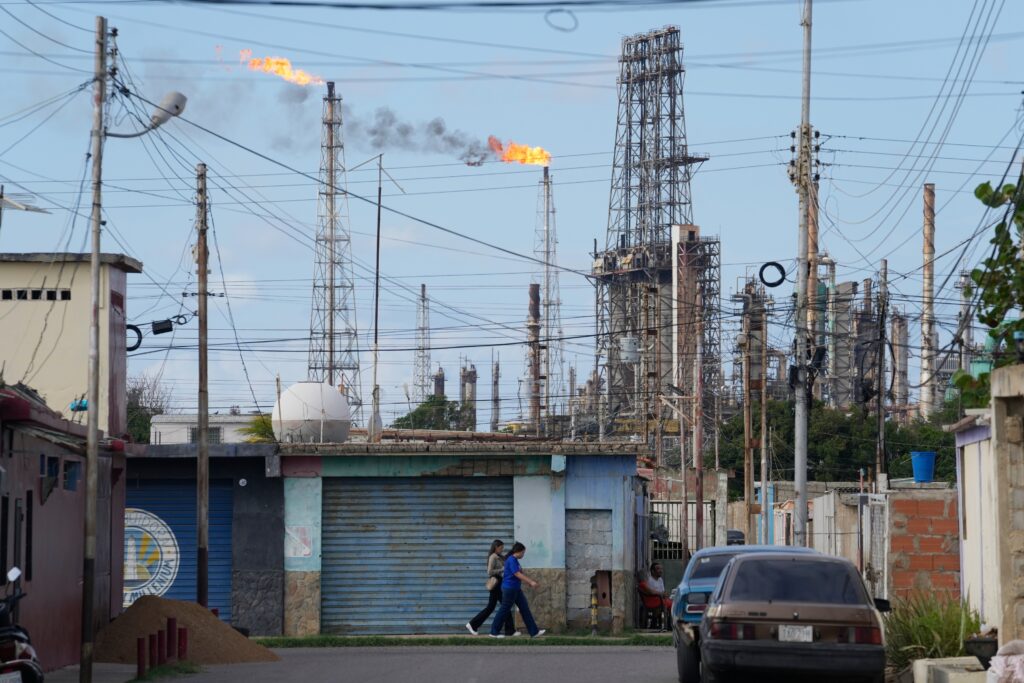
The sales come after a U.S. blockade, which began in September, that crippled Venezuelan crude distribution. With storage facilities brimming, fears were growing that some wells would need to be shut off — a process that is costly and difficult to reverse.
Administration officials say other buyers will be invited to compete with Trafigura and Vitol to buy Venezuelan oil in the future, but there have been no concrete steps to grant other licenses, vexing other firms.
“Sanctions remain in place and no licenses have been issued,” said a person in the industry who spoke on the condition of anonymity to speak frankly about confidential conversations with the administration. “We can’t even go down there and look around or negotiate.”
The post Trump officials awarded Venezuela oil-sale contracts to firms tied to bribery appeared first on Washington Post.